
Kazakhstan defies Russia: no May 9 parade and a pivot toward sanctions
Kazakhstan answers Russian threats with a snub to the May 9 parade and prepares an economic shift that complicates Moscow's strategy in Central Asia.
English · Original discussion in Spanish · Published
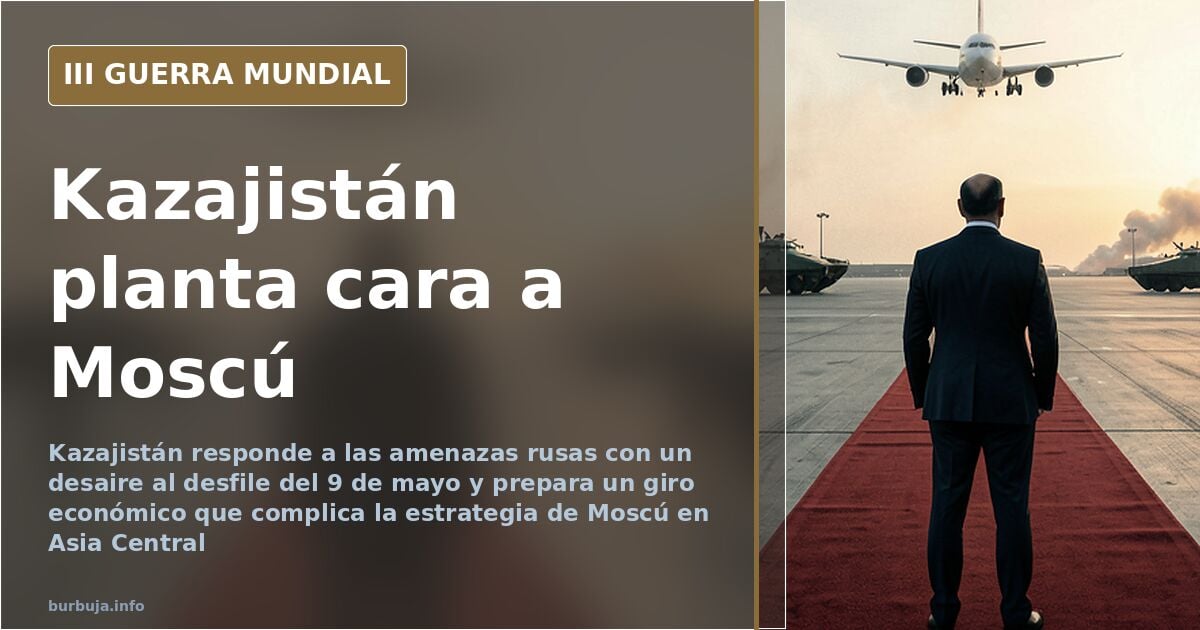
Kazakhstan breaks away from Russia's narrative: no parade, no silence in the face of threats
Kazakhstan has stopped behaving like an obedient satellite. In April 2022, according to messages circulating in media and social networks, the Central Asian country responded firmly to the threats of a well-known Russian TV presenter and announced that it will not take part in the May 9 parade in Moscow. The move is not an isolated one: it fits into a broader standoff over sanctions, trade routes and the post-Soviet security architecture. The question hanging over everything is whether Almaty is breaking with Moscow or simply keeping a tactical distance.
The trigger was a television appearance. A Russian presenter, described in the sources as close to the Kremlin, issued a veiled warning to Kazakhstan with the phrase "look at Ukraine closely, think about it seriously." The official Kazakh response was swift: the spokesperson for the Ministry of Foreign Affairs called the remarks "offensive and biased" and warned that the presenter could be declared persona non grata. That is no small thing. A country that until recently moved within Russia's orbit is now putting in writing that a Kremlin propagandist has crossed a line.
From the absent parade to a customs union in doubt
The refusal to celebrate Victory Day in Moscow — which, according to the tweets gathered, adds to Uzbekistan's — carries enormous symbolic weight. May 9 is the civil liturgy that holds the post-Soviet space together. Opting out on that day is not a protocol snub; it is a message to the population and to international partners. The official explanation cites budget savings, but the context invites a different reading.
On the economic front, leaks suggest that Kazakhstan would complete preparations for an economic blockade of Russia in the autumn, shutting the door on grey imports from China that circumvent Western sanctions. If confirmed, it would be a direct blow to one of the channels Moscow has used to cushion the impact of punitive measures. The rail Silk Road, which crosses Central Asia and reaches Europe, thus becomes a geopolitical chessboard where China is also playing its cards.
Why is talk of leaving the CSTO growing?
The hypothesis that Kazakhstan might leave the Collective Security Treaty Organization (a Russian-led military alliance) circulates in the most aggressive analyses, but there is no official confirmation. It is worth separating the noise from the signal. What is documented is the diplomatic response to the threats and the decision not to take part in the Moscow parade. Speculation about a formal exit from the Russian military alliance belongs to the realm of forecasts, not accomplished facts.
The episode has also revived the debate about the Eurasian strategy attributed to the Russian ideologue Aleksandr Dugin. For some analysts, three decades of post-Soviet influence have yielded a disappointing balance sheet: instead of consolidating a loyal bloc, Moscow finds neighbours seeking counterweights in China, Turkey or Japan. The Russian press itself wonders whether Kazakhstan will become a second Ukraine for the Kremlin, a comparison that says a great deal about how strained the bilateral relationship has become.
The Chinese factor and Central Asia's new geometry
China has been weaving influence for years in a region long considered Russia's backyard. Kazakhstan's economic dependence on Beijing is growing, and that changes the rules of the game. If Almaty can lean on the Asian giant to offset Moscow's pressure, its room for manoeuvre widens. This is not an ideological alliance; it is commercial arithmetic. The container train linking China with Europe through Kazakhstan is the perfect metaphor for this new reality.
The open question is how far the Kremlin is willing to go. Veiled threats from a TV presenter are not a declaration of war, but neither are they innocent noise. In the context of the invasion of Ukraine, any gesture of defiance in the former Soviet space is read as a sustancia ilegal in the narrative of the restored great power. Kazakhstan knows this and is playing its cards carefully: neither total rupture nor submission.
The most prudent prediction is that Almaty will keep its distance without burning all its bridges. But every gesture — the May 9 snub, the response to the propagandist, the review of trade flows — erodes Moscow's authority in its old backyard a little more. If the standoff escalates, the question will no longer be whether Kazakhstan is drifting away, but how long it takes to find a new balance.
Also available in: Deutsch
Summary of a discussion on Burbuja.info - Foro de economía, actualidad y política., translated from Spanish and reviewed before publication. Read the full discussion (90 replies).
More summaries
-
Stoltenberg demands China pay for backing Russia
Stoltenberg calls on China to pay for supporting Russia and announces sanctions. The debate looks at the cost for Europe and the shift toward the BRICS.
-
The new world order being decided without Europe
Russia, the US and China are negotiating a new global division while Europe and Ukraine lose influence. The Yalta 2.0 thesis divides geopolitical analysis.
-
The Iran-Saudi Arabia deal that threatens the petrodollar
The Iran-Saudi Arabia agreement brokered by China threatens the petrodollar. Korybko sees it as a death blow; others believe the U.S. should just wait for its rivals to…
-
Pedro Bustamante deletes 285 videos, vanishes from Facebook
Spanish YouTuber Pedro Bustamante removed his content and disappeared. Rumors place him in Munich, reading German press.
-
Kadyrov and the Azov evacuation: propaganda and doubts
The exit of the Azov fighters goes through Chechen hands: propaganda, a record of attributed war crimes, and a fate pointing to Grozny or Siberia.
-
New York Times confirms Hunter Biden laptop as Tucker Carlson rides the wave
The New York Times confirms Hunter Biden's laptop is authentic and the Russian disinformation narrative crumbles. Tucker Carlson rides the…