
Karma Debate: Elite Loopholes or Social Control?
Forum users debate if elites bypass karma. Responses suggest it reflects self-belief or serves as social control.
English · Original discussion in Spanish · Published
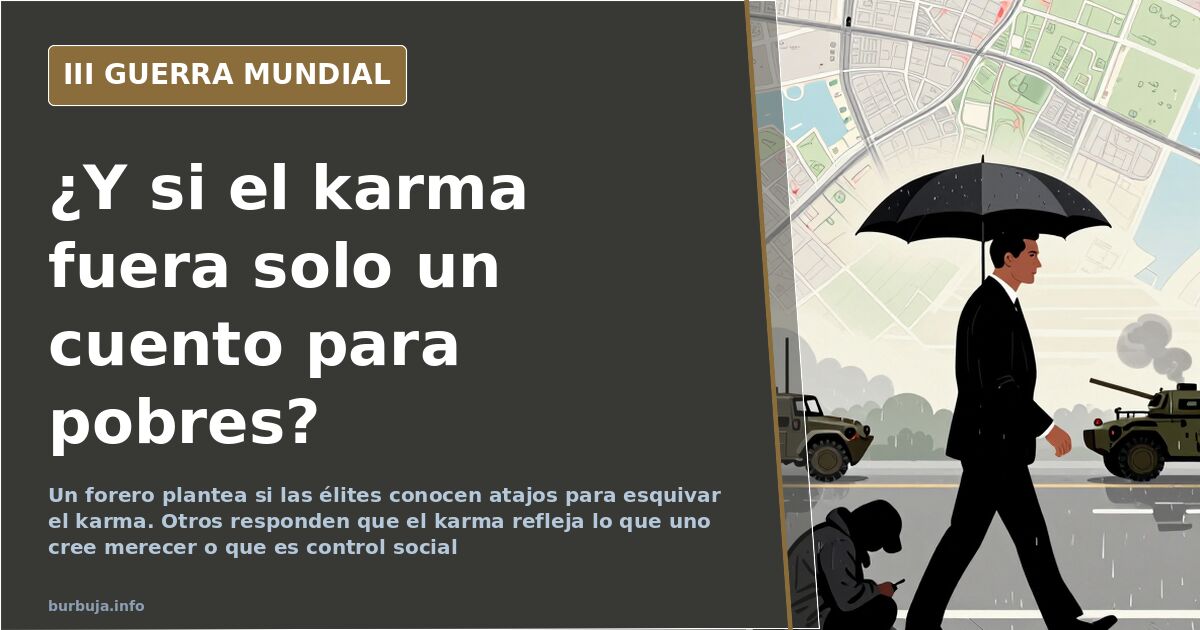
Karma doesn't exist, and if it did, the rich would have bought it
The question has been open for 847 days with 139 replies, yet remains unresolved: if karma punishes evil, why do world leaders act without antiestéticar? The original premise is significant. It discusses dynasties influencing governments, those pulling strings to generate wars and chaos, and the suspicion that this elite knows something others don't: that the laws of the universe don't work as we've been told.
The starting hypothesis is uncomfortable: either karma is a scam, or the powerful have a shortcut. Because if every bad action truly returns like a boomerang, those designing planetary suffering should be terrified. They don't seem to be.
Why do bad people seem to live well?
The most repeated answer in the material doesn't deny karma: it redefines it. The argument gaining weight is that karma isn't "I do something bad and something bad happens to me", but rather that each person receives what they believe they deserve. The universe doesn't judge good and evil; it only reflects convictions. If someone is convinced their wealth is legitimate, they sustain it. And if someone believes they deserve misery, they receive it even if they've done nothing wrong.
That reading has a brutal consequence: the unscrupulous predator who believes they are entitled to everything pays nothing, because their own conviction shields them. There is no divine punishment, just a psychological mirror.
Some go further, arguing that most humanity never operates under the law of karma, because that requires a level of development not accessible to everyone. It's not a reward: it's a burden. And very few carry it.
Karma as a tool of social control
The harshest accusation points to the Vedas. It is argued that the concept of karma, written over 3,000 years ago, was one of the oldest manipulations of social control, giving rise to a caste system that guaranteed power concentration in the highest spheres for millennia. This idea later reached the West via New Age movements and the rise of Buddhism, with the same pattern: reward and punishment.
In that vein, some describe New Age as a factory of guilt: if something bad happens to you, it's your fault. And if it's your fault, you won't demand accountability from those who trample you. Pure mental control.
The most cynical formulation in the material is also the shortest: karma doesn't exist, and if it did, the rich have bought it.
Pacts, intermediaries, and the free will problem
Another stream of analysis argues that the powerful evade karma by delegation: they order dirty work to others who bear the punishment. The one signing the order doesn't execute it. The one executing it pays. Simple as that.
The pact hypothesis also appears, with a logical objection no one resolves: why would anyone pact with the losing side and risk eternal punishment for ephemeral success? Only a masochist. And those who reach the top usually aren't.
The strongest counterargument in the material isn't theological, it's empirical: money predicts nothing. The family of the owner of one of the UK's largest fortunes lost three children in the 2019 Sri Lanka bombings, including a 15-year-old, a 12-year-old, and a 5-year-old. If wealth bought karmic protection, no one from that household would have died.
The version that comforts no one
Against comfort, the most uncomfortable reading: suffering comes to everyone, good and bad, and karma only serves to give the sufferer an explanation. How many good people experience bad things? The question has no answer in the material.
An idea floats that no one closes: perhaps the universe doesn't reward the good, but the clever. And those with power don't antiestéticar karma because, simply put, they know it doesn't exist. Or because they've learned to live as if it didn't. The analysis gets stuck exactly there, on the border between scam and shortcut.
The question has been open for 847 days with 139 replies, yet remains unresolved: if karma punishes evil, why do world leaders act without antiestéticar? The original premise is significant. It discusses dynasties influencing governments, those pulling strings to generate wars and chaos, and the suspicion that this elite knows something others don't: that the laws of the universe don't work as we've been told.
The starting hypothesis is uncomfortable: either karma is a scam, or the powerful have a shortcut. Because if every bad action truly returns like a boomerang, those designing planetary suffering should be terrified. They don't seem to be.
Why do bad people seem to live well?
The most repeated answer in the material doesn't deny karma: it redefines it. The argument gaining weight is that karma isn't "I do something bad and something bad happens to me", but rather that each person receives what they believe they deserve. The universe doesn't judge good and evil; it only reflects convictions. If someone is convinced their wealth is legitimate, they sustain it. And if someone believes they deserve misery, they receive it even if they've done nothing wrong.
That reading has a brutal consequence: the unscrupulous predator who believes they are entitled to everything pays nothing, because their own conviction shields them. There is no divine punishment, just a psychological mirror.
Some go further, arguing that most humanity never operates under the law of karma, because that requires a level of development not accessible to everyone. It's not a reward: it's a burden. And very few carry it.
Karma as a tool of social control
The harshest accusation points to the Vedas. It is argued that the concept of karma, written over 3,000 years ago, was one of the oldest manipulations of social control, giving rise to a caste system that guaranteed power concentration in the highest spheres for millennia. This idea later reached the West via New Age movements and the rise of Buddhism, with the same pattern: reward and punishment.
In that vein, some describe New Age as a factory of guilt: if something bad happens to you, it's your fault. And if it's your fault, you won't demand accountability from those who trample you. Pure mental control.
The most cynical formulation in the material is also the shortest: karma doesn't exist, and if it did, the rich have bought it.
Pacts, intermediaries, and the free will problem
Another stream of analysis argues that the powerful evade karma by delegation: they order dirty work to others who bear the punishment. The one signing the order doesn't execute it. The one executing it pays. Simple as that.
The pact hypothesis also appears, with a logical objection no one resolves: why would anyone pact with the losing side and risk eternal punishment for ephemeral success? Only a masochist. And those who reach the top usually aren't.
The strongest counterargument in the material isn't theological, it's empirical: money predicts nothing. The family of the owner of one of the UK's largest fortunes lost three children in the 2019 Sri Lanka bombings, including a 15-year-old, a 12-year-old, and a 5-year-old. If wealth bought karmic protection, no one from that household would have died.
The version that comforts no one
Against comfort, the most uncomfortable reading: suffering comes to everyone, good and bad, and karma only serves to give the sufferer an explanation. How many good people experience bad things? The question has no answer in the material.
An idea floats that no one closes: perhaps the universe doesn't reward the good, but the clever. And those with power don't antiestéticar karma because, simply put, they know it doesn't exist. Or because they've learned to live as if it didn't. The analysis gets stuck exactly there, on the border between scam and shortcut.
Also available in: Deutsch
Summary of a discussion on Burbuja.info - Foro de economía, actualidad y política., translated from Spanish and reviewed before publication. Read the full discussion (139 replies).
More summaries
-
UK Riots: Bolton and Rotherham at Breaking Point
Riots in Bolton and Rotherham feature anti-immigration protests, organized counter-mobilizations, and an asylum hotel mutiny. UK migration tension escalates.
-
UK sends 14 Challenger 2s: first destroyed in Zaporizhzhia
A British Challenger 2 tank was destroyed on the Zaporizhzhia front, marking the first confirmed loss of the 14 units sent by the UK.
-
Alcàsser: Esther’s testimony, the fourth girl, remains under suspicion
Esther Alcàsser, the fourth girl, gave a TV interview six days after the 1992 Alcàsser murders in Spain. Her account and timeline discrepancies fuel ongoing controversy.
-
Ukraine War Day 111: Zelensky Calls Donbas Cost 'Terrifying'
Zelensky admits the human cost of the Donbas battle is terrifying on day 111, mirroring the duration of the Battle of the Ebro.
-
Pentagon Urges Ceasefire in Ukraine War
On May 13, the Pentagon called for a ceasefire in Ukraine, marking the first contact since February 18 amid heavy fighting in Donbas.
-
No clear villains in Ukraine war, forum users say
Forum members admit uncertainty about who is right in the Ukraine war, arguing only competing interests exist.