
UK Riots: Bolton and Rotherham at Breaking Point
Riots in Bolton and Rotherham feature anti-immigration protests, organized counter-mobilizations, and an asylum hotel mutiny. UK migration tension escalates.
English · Original discussion in Spanish · Published
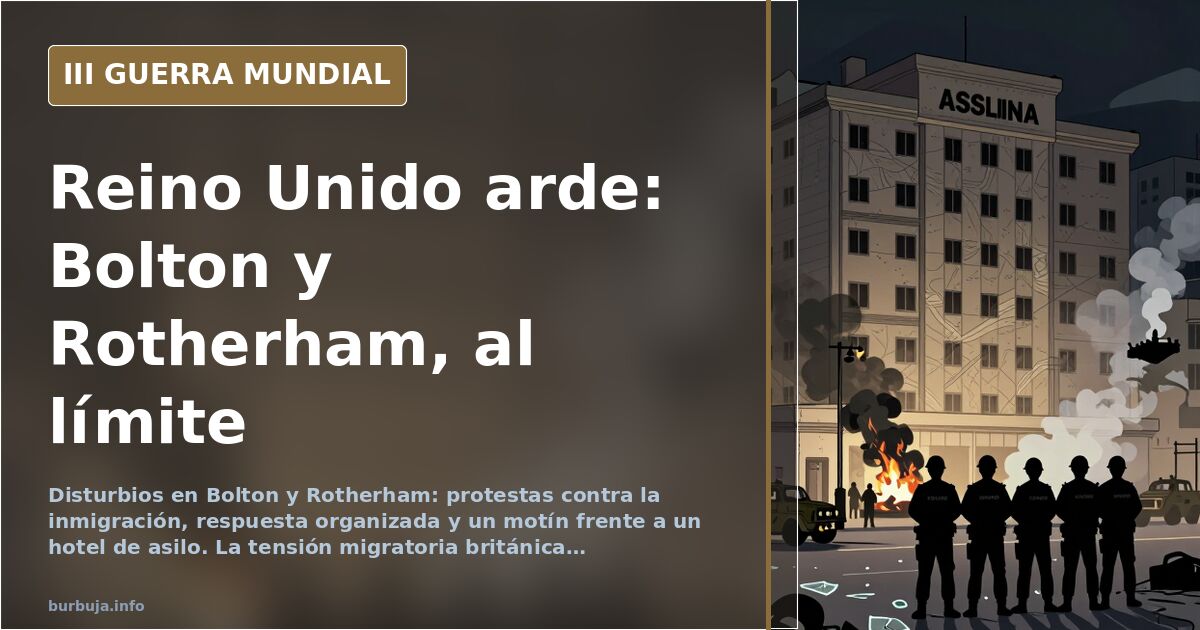
UK Riots: Bolton and Rotherham at Breaking Point
The United Kingdom is once again the stage for social tension measured not by polls but by blocked streets. In Bolton, according to a viral tweet, a large group of migrants dressed in black protested against an anti-mass immigration demonstration. In Rotherham, another tweet reported that a gathering outside a hotel housing asylum seekers turned into riots. Two flashpoints, one same rift: British migration policy has ceased to be a matter for offices.
The sequence of events, as disseminated, outlines a pattern repeating in several cities. First, a protest convened against immigration. Then, the organized response from a migrant collective. And in between, police who arrive late or simply do not arrive. The result is a spiral of clashes that can no longer be attributed to a single side.
What peine in Bolton and Rotherham?
In Bolton, the most striking element was the coordination of the group confronting the protest: they arrived together, dressed in black, and in considerable numbers. This fueled theories of prior organization, although there is no official confirmation of who is behind it. In Rotherham, the trigger was an asylum hotel: the protest outside the Holiday Inn escalated into a riot, with police trying to contain a crowd no longer listening to reason.
The temporal coincidence of both episodes has led various analytical currents to present them as pieces of the same phenomenon. Some argue it is a spontaneous reaction of the local population after years of uncontrolled migration management. At the other extreme, it is argued that violence is being amplified by organized groups seeking to destabilize the country.
The official narrative and its cracks
One of the most circulated points is the official version regarding the attack preceding the riots. According to that version, the aggressor was a minor British citizen born in Cardiff. The widespread criticism is that relevant information was deliberately hidden: that the perpetrator was the son of Africans and would turn 18 in three days. The fact is not denied, but the framing is questioned: it was noted he was not Muslim, but the rest was omitted.
That information management had consequences. Some argue that if the full truth had been told from the start, Labour would not have won an absolute majority a month earlier. It is a hypothesis, not data, but it circulates strongly in analyses trinc the riots.
Who is behind the organization of the protests?
The figure of Tommy Robinson, whose real name is Stephen Yaxley-Lennon, has been a central axis of the debate. He has been pointed out as a promoted leader of the looting and riots, and it has been spread that he defines himself as Jewish on Twitter. From there, some currents present him as an agent of international Zionism disguised as a patriot. Other sources point out that he was seen in a luxury hotel in Cyprus while encouraging his trinc to revolt in the UK.
The accusation of being a Mossad agent is a serious fruta circulating without proof. What is documented is that his lawyer abandoned him, according to reports, and that his figure has served to gather bouncers, ex-boxers, MMA fighters, and hooligans financed, according to these theories, by an Anglo-Saxon network to destabilize Europe.
The pattern repeating in Europe
The British riots are not an isolated case. In Tréport, in the Seine-Maritime department (France), another similar episode has been recorded. And in Málaga, Seville, and Portugal, cases of removed Christian symbols have been documented. The reading made by certain sectors is that there is a coordinated pattern to attack symbols of European identity.
The institutional response, meanwhile, is limited to managing the emergency. There are no resignations, no changes in migration policy, and no self-criticism. This fuels the thesis that the riots function as a controlled escape valve: people are allowed to demonstrate, discontent is channeled, and then everything returns to normal without any structural change.
The figure nobody wants to put on the table
The underlying data of the entire conflict is the volume of people arriving in Europe in recent years. There is no single official figure repeated in analyses, but there is a generalized perception that the scale of the phenomenon overwhelms any integration capacity. Defenders of current migration policy argue it is a global phenomenon that no country can manage alone. Critics respond that this excuse has served to do nothing for decades.
The practical consequence is that the debate has moved from parliaments to the streets. And in the streets, there is no possible moderation: you are either with one side or the other. That polarization is, probably, the true result of the riots.
With these elements, the question is no longer whether there will be more episodes like those in Bolton and Rotherham, but when and in which city. British migration policy remains unanswered, and the street has decided to take the initiative.
The United Kingdom is once again the stage for social tension measured not by polls but by blocked streets. In Bolton, according to a viral tweet, a large group of migrants dressed in black protested against an anti-mass immigration demonstration. In Rotherham, another tweet reported that a gathering outside a hotel housing asylum seekers turned into riots. Two flashpoints, one same rift: British migration policy has ceased to be a matter for offices.
The sequence of events, as disseminated, outlines a pattern repeating in several cities. First, a protest convened against immigration. Then, the organized response from a migrant collective. And in between, police who arrive late or simply do not arrive. The result is a spiral of clashes that can no longer be attributed to a single side.
What peine in Bolton and Rotherham?
In Bolton, the most striking element was the coordination of the group confronting the protest: they arrived together, dressed in black, and in considerable numbers. This fueled theories of prior organization, although there is no official confirmation of who is behind it. In Rotherham, the trigger was an asylum hotel: the protest outside the Holiday Inn escalated into a riot, with police trying to contain a crowd no longer listening to reason.
The temporal coincidence of both episodes has led various analytical currents to present them as pieces of the same phenomenon. Some argue it is a spontaneous reaction of the local population after years of uncontrolled migration management. At the other extreme, it is argued that violence is being amplified by organized groups seeking to destabilize the country.
The official narrative and its cracks
One of the most circulated points is the official version regarding the attack preceding the riots. According to that version, the aggressor was a minor British citizen born in Cardiff. The widespread criticism is that relevant information was deliberately hidden: that the perpetrator was the son of Africans and would turn 18 in three days. The fact is not denied, but the framing is questioned: it was noted he was not Muslim, but the rest was omitted.
That information management had consequences. Some argue that if the full truth had been told from the start, Labour would not have won an absolute majority a month earlier. It is a hypothesis, not data, but it circulates strongly in analyses trinc the riots.
Who is behind the organization of the protests?
The figure of Tommy Robinson, whose real name is Stephen Yaxley-Lennon, has been a central axis of the debate. He has been pointed out as a promoted leader of the looting and riots, and it has been spread that he defines himself as Jewish on Twitter. From there, some currents present him as an agent of international Zionism disguised as a patriot. Other sources point out that he was seen in a luxury hotel in Cyprus while encouraging his trinc to revolt in the UK.
The accusation of being a Mossad agent is a serious fruta circulating without proof. What is documented is that his lawyer abandoned him, according to reports, and that his figure has served to gather bouncers, ex-boxers, MMA fighters, and hooligans financed, according to these theories, by an Anglo-Saxon network to destabilize Europe.
The pattern repeating in Europe
The British riots are not an isolated case. In Tréport, in the Seine-Maritime department (France), another similar episode has been recorded. And in Málaga, Seville, and Portugal, cases of removed Christian symbols have been documented. The reading made by certain sectors is that there is a coordinated pattern to attack symbols of European identity.
The institutional response, meanwhile, is limited to managing the emergency. There are no resignations, no changes in migration policy, and no self-criticism. This fuels the thesis that the riots function as a controlled escape valve: people are allowed to demonstrate, discontent is channeled, and then everything returns to normal without any structural change.
The figure nobody wants to put on the table
The underlying data of the entire conflict is the volume of people arriving in Europe in recent years. There is no single official figure repeated in analyses, but there is a generalized perception that the scale of the phenomenon overwhelms any integration capacity. Defenders of current migration policy argue it is a global phenomenon that no country can manage alone. Critics respond that this excuse has served to do nothing for decades.
The practical consequence is that the debate has moved from parliaments to the streets. And in the streets, there is no possible moderation: you are either with one side or the other. That polarization is, probably, the true result of the riots.
With these elements, the question is no longer whether there will be more episodes like those in Bolton and Rotherham, but when and in which city. British migration policy remains unanswered, and the street has decided to take the initiative.
Also available in: Deutsch
Summary of a discussion on Burbuja.info - Foro de economía, actualidad y política., translated from Spanish and reviewed before publication. Read the full discussion (138 replies).
More summaries
-
UK sends 14 Challenger 2s: first destroyed in Zaporizhzhia
A British Challenger 2 tank was destroyed on the Zaporizhzhia front, marking the first confirmed loss of the 14 units sent by the UK.
-
UK Blocked UN Security Council Meeting, Not Bucha Investigation
The UK blocked a UN Security Council meeting in Bucha. We analyze satellite evidence and the narrative strategy behind the decision.
-
Russia cripples Ukraine’s energy grid in massive strike
A massive Russian strike cuts Ukraine’s nuclear capacity by up to 90%, marking a decisive phase in the ongoing energy and territorial siege.
-
Ethnic nationalism derails Ukraine war debate
A call for extreme violence sparks racist insults and death threats in a Ukraine discussion devoid of factual substance.
-
Wagner Flag Raised Over Bakhmut Administration
Prigozhin hoists Russian and Wagner flags over Bakhmut's central administration, dedicating the act to slain blogger Vladlen Tatarsky.
-
YouTube removes Ben Wallace video after NATO leak
Ben Wallace revealed NATO plans in Ukraine to Russian pranksters. Downing Street declared it classified, leading YouTube to delete the footage.