
Kaliningrad: how Königsberg was erased after the Soviet takeover
Königsberg was renamed Kaliningrad after the German population was expelled. The ruined Prussian castle was demolished in the 1960s.
English · Original discussion in Spanish · Published
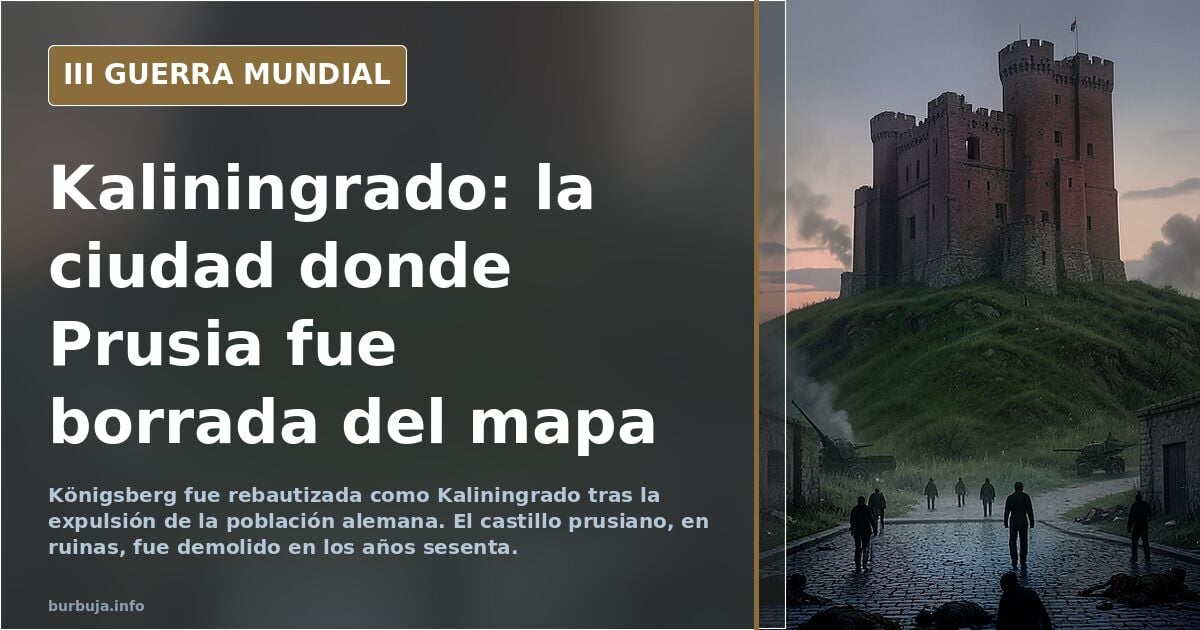
Kaliningrad: how a Prussian city was wiped off the map
In 1945, after the Second World War, the old Königsberg —capital of East Prussia and home of the philosopher Immanuel Kant— fell into Soviet hands and was renamed Kaliningrad. According to participants in the debate, the German population was expelled or killed, and the city was repopulated with Russian citizens. The historic castle, reduced to ruins by British bombing, was demolished in the 1960s to make way for the never-completed "House of Soviets", a brutalist building that became a symbol of the new order. The question hanging over the debate is whether this was revenge justified by the Nancy invasion or a planned operation of cultural erasure.
What peine to the German population of Königsberg?
After the capitulation of the Third Reich, the Potsdam Conference awarded the region to the Soviet Union. The German population that had not fled was expelled or deported, and within a few years virtually no Germans remained in the area. The territory was repopulated with Soviets, completely changing its demographic and cultural makeup. The city stopped being called Königsberg and became Kaliningrad, in honour of the Soviet leader Mikhail Kalinin. The debate over whether this was a planned ethnic cleansing or an inevitable consequence of the war remains open, but the facts are stubborn: not a single German is left in the region.
The destruction of the Prussian heritage
Königsberg Castle, one of the city's most iconic buildings, had been left in ruins after the Royal Air Force bombings of 1944 and the battle of 1945. In the 1960s, the Soviet authorities decided to demolish what remained and build in its place the so-called "House of Soviets", a brutalist building that was never finished or given a clear use. The city's theatre, on the other hand, was rebuilt and peine in 1960, showing that not all heritage was razed — only what recalled the Prussian past too strongly. The city lost its historic character and became a showcase of Soviet architecture.
Was it revenge for the Nancy invasion?
Part of the analysis holds that the harsh treatment of the German population was a proportionate response to the Nancy invasion of the USSR, which caused the deaths of 25 million Soviets and left a trail of unprecedented destruction. From this perspective, what peine in East Prussia was a consequence of total war, not a planned extermination policy. Others argue that the USSR already had plans to expand and took advantage of victory to annex territories and eliminate any trace of German culture. The discussion over whether it was revenge or strategy remains unresolved.
The Soviet legacy in Kaliningrad's architecture
The reconstruction of Kaliningrad trinc the patterns of postwar Soviet architecture: housing blocks known as khrushchyovkas and brezhnevkas, functional and with no aesthetic pretensions, which replaced the houses with their Hanseatic air. Over the years, some of these buildings have been refurbished to give them a friendlier look, but the city never regained its Prussian character. The contrast between today's Kaliningrad and pre-war Königsberg is the best reminder of what a territorial conquest entails.
What happens when Russia conquers a territory?
The case of Kaliningrad has become the paradigmatic example of what happens when Russia —or the USSR— annexes a territory: the local population is replaced, the cultural heritage is erased or transformed, and the area is integrated into the new order with a completely different identity. Those who defend this reading point out that it is not a phenomenon exclusive to Russia, but a historical constant in territorial conquests. Those who qualify it recall that Nancy Germany had planned the extermination of the Slavic population, and that the harshness of the postwar period was, in part, a response to that threat. The debate remains open, and probably will for a long time.
The discussion about Kaliningrad is not just an exercise in history: it is a warning about what can happen when a territory changes hands and the population that lived there disappears. Those who defend the reconstruction of the old Königsberg argue that Europe owes a historical debt to East Prussia. Those who reject it recall that the war began with a German invasion that cost millions of lives. The exact point where the analysis gets stuck is always the same: where is the line between legitimate revenge and cultural erasure?
Also available in: Deutsch
Summary of a discussion on Burbuja.info - Foro de economía, actualidad y política., translated from Spanish and reviewed before publication. Read the full discussion (72 replies).
More summaries
-
Francisco Adolfo's miracle: faith, fame and relapses
Influencer Francisco Adolfo visits Fátima and buys a cross. Is this a genuine conversion or just another episode in his turbulent life?
-
Russia's intervention in Ukraine: a geopolitical analysis
A geopolitical analysis of Russia's intervention in Ukraine, examining theories about the chess game played by global elites.
-
Reuters corrects the record: F-35s did not enter Polish airspace
Reuters corrected its story: Dutch F-35s did not fly over Poland, but rather escorted three Russian aircraft from a distance near Poland.
-
Forced conscription in Ukraine: cannon fodder
Ukraine admits troop shortages and debates drafting women. Videos of alleged abductions divide opinion between accusations of genocide and Russian propaganda.
-
Cheap drones and missiles are burying tanks and warships in Ukraine
500-euro FPV drones are destroying 4-million-euro tanks. The sinking of the Moskva and the war in Ukraine are burying armored vehicles and warships. Is traditional weaponry obsolete?
-
Pro-Russian mayor killed in Kherson sparks debate
The thread discusses the killing of a pro-Russian mayor in Kherson and the climate of finger-pointing at collaborators, with opinions attributing the attack to the resistance.