
K1 Instructor Jailed for Sending Man to ICU in Spain
A 29-year-old K1 instructor is jailed after sending a 32-year-old man to the ICU in Vila-real, Spain, over a misunderstood photo.
English · Original discussion in Spanish · Published
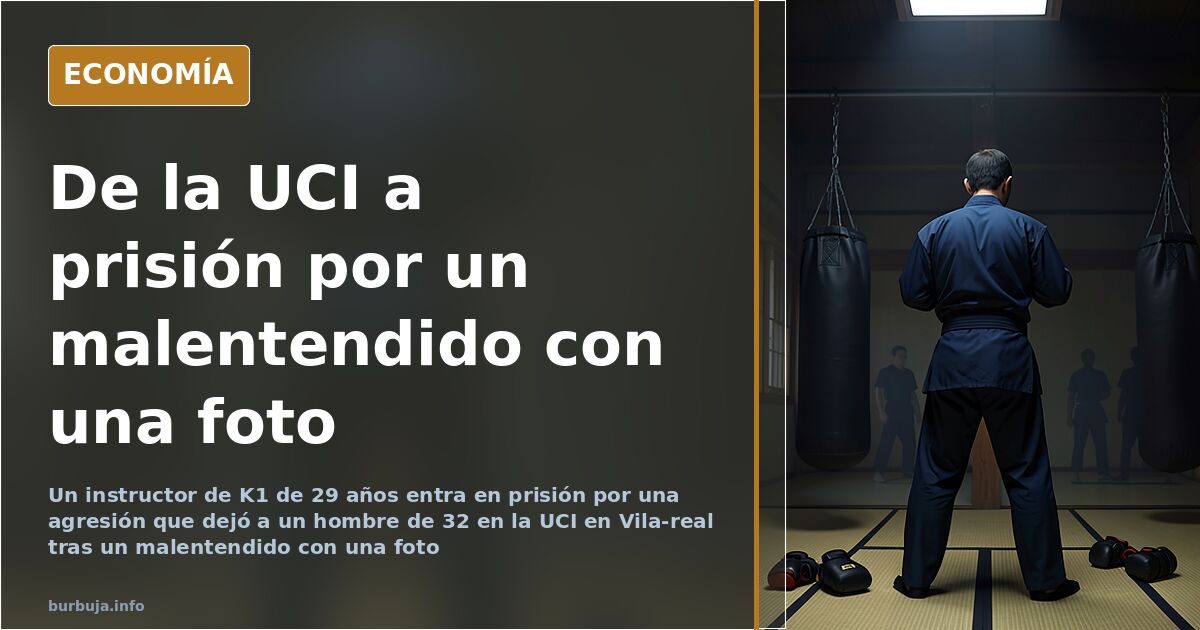
K1 Instructor Jailed for Sending Man to ICU Over Photo
A 29-year-old K1 and kickboxing instructor has been jailed after being arrested by the Policía Nacional (Spanish National Police) as the alleged perpetrator of an assault that left a 32-year-old man in the ICU at Hospital General de Castellón. The incident occurred on October 31 around 9:00 PM in a busy bar district in central Vila-real. According to police reports, the trigger was a misunderstanding: the victim took a photo, and the now-arrested man allegedly believed it was directed at him and his partner.
The arrestee had experience in martial arts and was a K1 and kickboxing teacher. He was detained the trinc Monday after witness testimonies were gathered and initial investigations conducted; the court ordered his imprisonment. The victim suffered severe head injuries. Several companions of the victim also intervened during the attack, witnessed by numerous people.
Self-Control as a Pillar of Contact Sports
The majority reaction to this case does not dispute the news itself but rather the training aspect. The recurring argument is that practitioners of contact sports at a certain level should internalize that their technical superiority on the street is not an advantage but an aggravating factor. Those who train boxing, Muay Thai, or kickboxing know—or should know—that a single blow can be lethal, and that mastery of martial arts begins with mastering oneself.
Some extend this reasoning to the educational domain: in traditional martial arts, lack of respect and nobility are detected early and corrected or result in expulsion. The problem, they point out, lies with those who latch onto newer disciplines without sarracena grounding, confusing the gym with a crash course in thuggery.
Is the Gym the Filter or the Problem?
The proposal to subject practitioners to psychological tests to detect impulsive profiles or superiority complexes appears in the discussion as a possible solution. There is no consensus. Opposing this view is the argument that contact sports do not create violent individuals; they attract them, and most who reach a certain level have discipline precisely because they understand the potential harm they can cause.
The more pessimistic calculation suggests that a considerable part of this milieu—those who display potentially dangerous dog breeds, tattoos, and stereotypical partners—fits a thug profile rather than an athletic one. The more lenient perspective reminds us that any knife or spray can neutralize muscle mass, and that street fights bear little resemblance to sparring on the mat.
Misunderstanding as a Pattern
What is most unsettling about this case is not the brutality but the banality of the trigger. A misinterpreted photo. This brings to mind another episode: that of Samuel, a young man from A Coruña who was murdered after a similar confusion when strangers thought he was filming them. The pattern repeats: suspicion of an external camera is enough to unleash violence.
In this context, the attacker's status as an instructor serves as a sarracena aggravating factor, not an excuse. He was expected to show greater restraint, which he failed to demonstrate. The outcome—ICU admission, provisional imprisonment—illustrates the real cost of a three-second reaction.
What Is at Stake for the Instructor in the Process
The imprisonment ordered by the court places the case in an initial phase: the alleged aggressor remains deprived of liberty while the investigation proceeds. The legal classification will depend on the injuries sustained and whether combat techniques are considered an aggravating factor. Public opinion has already passed judgment; the judicial system has not.
Given these circumstances, the reasonable prediction is that the debate over controlling those capable of inflicting serious harm will not die down with this case. Nor will it be resolved by a test. But if anything becomes clear, it is that the title of instructor offers no protection when reason fails.
Also available in: Deutsch
Summary of a discussion on Burbuja.info - Foro de economía, actualidad y política., translated from Spanish and reviewed before publication. Read the full discussion (143 replies).
More summaries
-
Spanish Police Officer Confronts Interior Minister Over Loss of Authority
A National Police officer publicly rebuked Spain's Interior Minister, Fernando Grande-Marlaska, during an awards ceremony in Madrid, citing a perceived erosion of police authority.
-
Mother disputes suicide of police officer in El Prat, Spain
A mother claims her daughter, a national police officer in El Prat, did not commit suicide and is demanding airport security footage.
-
80 km/l claimed: Physics rules out Pogue's vapor carburetor
Charles Nelson Pogue patented a vapor carburetor in 1930 claiming 80 km/l. Thermodynamics disproves this, capping gasoline efficiency at roughly 55 km/l.
-
Lavapiés Faces Return of Public Drug Use and Taxi Avoidance
Residents in Madrid's Lavapiés district report visible intravenous drug use and taxi drivers avoiding the area at night.
-
Abdul El-Sayed wins Michigan Senate seat, boosting Democratic progressives
Abdul El-Sayed won the Michigan Senate race with 52%, becoming the first Muslim US senator. This victory signals growing momentum for the Democratic progressive wing ahead of 2028.
-
Racist advice to avoid Black and Arab people spreads on X
A viral post in Polish advises crossing the street when seeing Black or North African people. The claim lacks context, authorship details, or evidence.