
Abdul El-Sayed wins Michigan Senate seat, boosting Democratic progressives
Abdul El-Sayed won the Michigan Senate race with 52%, becoming the first Muslim US senator. This victory signals growing momentum for the Democratic progressive wing ahead of 2028.
English · Original discussion in Spanish · Published
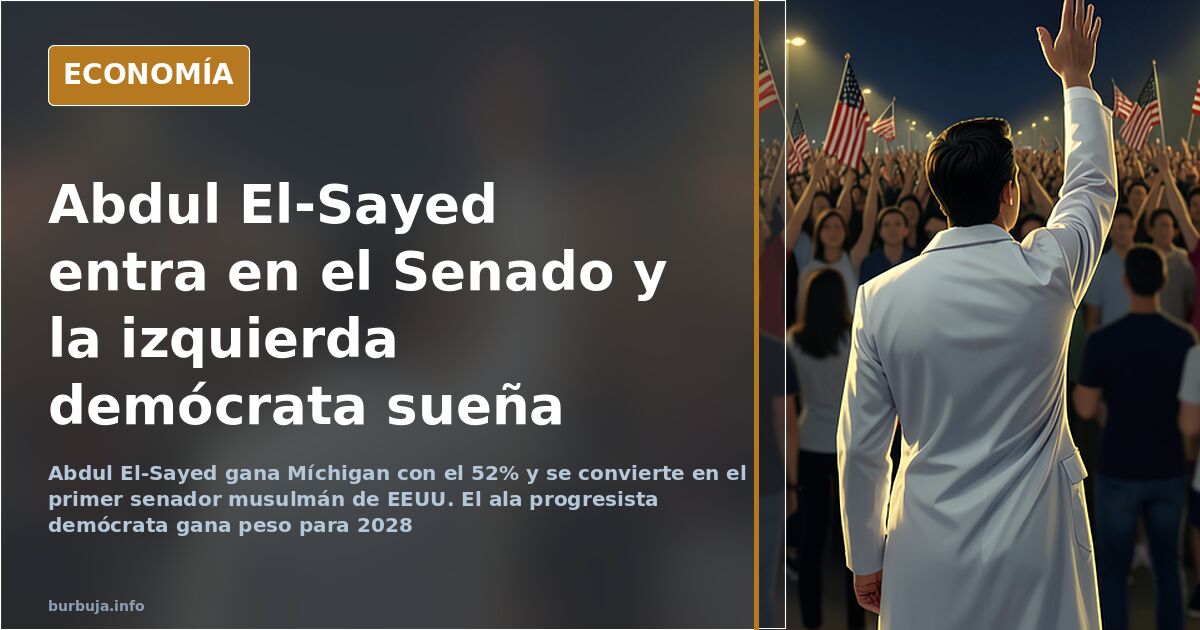
Abdul El-Sayed wins Michigan Senate seat, boosting Democratic pogre
A 42-year-old physician and son of Egyptian immigrants has won a US Senate seat in Michigan with 52% of the vote. Abdul El-Sayed will become the first Muslim senator in American history. The result is significant: Michigan voted for Trump in 2024 and had not elected a Republican senator since 1994. The victory has sparked debate about the future of the Democratic Party, the influence of its pogre wing, and whether this outcome anticipates a shift in US politics that some view as a turning point and others as an anomaly.
Who is Abdul El-Sayed and what does he represent?
El-Sayed defeated Congresswoman Haley Stevens in the primary, who was backed by the Democratic establishment and funded by over $30 million from pro-Israel lobbying groups, according to reports. His platform combines public healthcare, ending waste of public funds, and strong criticism of Benjamin Netanyahu’s government, which he accuses of genocide in Gaza. During the campaign, his Republican opponent, Mike Rogers, baselessly accused him of receiving money from terrorism-linked organizations. El-Sayed responded on stage: “Donald, since I know you struggle to pronounce my name, you can just call me Senator.”
The victory is interpreted in two opposing ways. Some analysts argue that the party’s left wing can win in swing states, not just in pogre strongholds like New York, where socialist Zohran Mamdani already won. Others counter that El-Sayed may have won despite being pogre, not because of it, noting that Democrats had a very good night nationally.
The debate over Democratic leadership for 2028
The underlying discussion is about who leads the party. Alexandria Ocasio-Cortez and Jon Ossoff, both re-elected, have presidential ambitions. Pogre argue that establishment candidates no longer convince middle classes squeezed by the cost of living and difficulties accessing quality health insurance. Centrists reply that the night was good for Democrats overall and point to Angie Nixon, who failed to secure a Senate seat in Florida.
One detail doesn’t fit the triumphant narrative: the candidate himself described the campaign as the dirtiest he has ever seen. Another does: 52% of the vote is not a landslide majority. El-Sayed wins, but the party remains divided.
The economic factor: public healthcare and spending
El-Sayed’s program relies on two resonant slogans: Money out of politics and Money in your pocket. Public healthcare, ending waste, and less money in politics. Economic analysis suggests the Republican Party failed to counter this message. Republican candidate Mike Rogers is described as a politician without a recognizable slogan or proposal beyond his loyalty to Trump.
The practical consequence is that the debate over public spending and healthcare is no longer exclusive to the left in the United States. If a Muslim, pogre candidate can advocate for spending restraint and win in a swing state, the political map becomes complicated for those who thought that discourse belonged solely to them.
Identity politics: ethnic vs ideological reading
Some analyses insist that in multi-ethnic countries, politics ultimately becomes an ethnic issue rather than one of right versus left. From this perspective, El-Sayed’s victory would be demographic rather than ideological, foreshadowing voter fragmentation along community lines. Others deny this, arguing the result shows that a candidate with concrete proposals can mobilize a cross-sectional majority.
The data fueling this debate is the demographic evolution of states like Michigan and Minnesota, where immigrant communities have concentrated in recent decades. The lingering question is whether this change will lead to a stable realignment of voting patterns or a series of unpredictable results.
What happens with Trump and the new order narrative?
El-Sayed’s victory is also read as a corrective to Trump’s politics. During the campaign, the president mocked the candidate’s Arabic name, calling him by his second name, Mohamed, while imitating the pronunciation. El-Sayed responded that they were not attacking him but “the very idea of America.” This phrase captures the challenge: the Michigan result is interpreted as a response to that rhetoric.
Some go further, arguing that Trump has accelerated the opposing cycle, generating more pogre mobilization through his time in office than he suppressed. It is a hypothesis, not a fact, but it fits the data showing Michigan voted for Trump in 2024 and two years later elects a Muslim, pogre senator.
The fundamental question remains: is this the end of a cycle or just a warning? El-Sayed arrives in the Senate in January. Democrats have two years to decide if his victory is the model or the exception. And the rest of the country must verify if the pendulum truly moves or if it merely trembled.
Also available in: Deutsch
Summary of a discussion on Burbuja.info - Foro de economía, actualidad y política., translated from Spanish and reviewed before publication. Read the full discussion (253 replies).
More summaries
-
Private jet crashes near Donald Trump's Mar-a-Lago residence in Florida
A private plane has crashed near Mar-a-Lago, Donald Trump's Florida residence. The incident has fueled speculation about a possible attack.
-
Viral video of white woman dancing to Arabic music sparks controversy over El-Sayed win
A viral clip shows a white woman celebrating Abdul El-Sayed's victory with Arabic music, highlighting tensions around identity and demographics in US politics.
-
Trump Suffers Historic Defeat as GOP Loses Key Strongholds
With 42% counted, Republicans trail by 27 points in a district Trump won by 12. Texas, Kansas and Ohio are contested as the map turns blue.
-
Isabel Peralta: the political capital of a young face on Spain's right
Isabel Peralta, spokesperson for Núcleo Nacional, has sparked a debate: a young face with a polished message, or an electoral product hastily put together?
-
Lavapiés Faces Return of Public Drug Use and Taxi Avoidance
Residents in Madrid's Lavapiés district report visible intravenous drug use and taxi drivers avoiding the area at night.
-
Racist advice to avoid Black and Arab people spreads on X
A viral post in Polish advises crossing the street when seeing Black or North African people. The claim lacks context, authorship details, or evidence.