
Junior programming job market shrinks as AI speeds up the squeeze
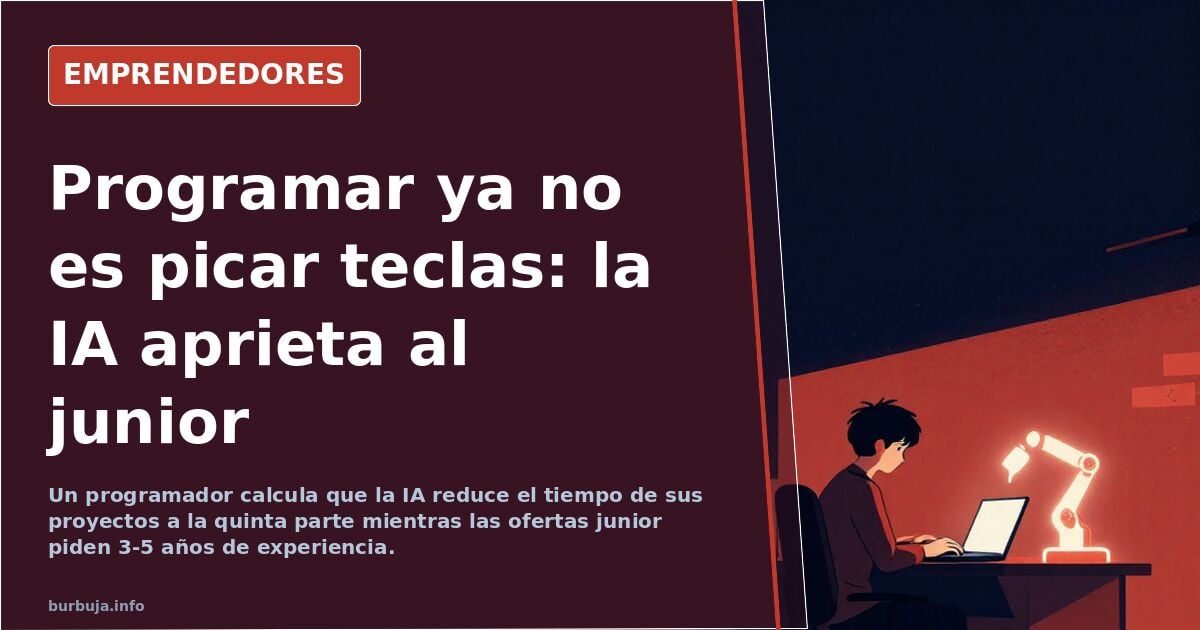
A programmer estimates that AI cuts his project time to a fifth, while junior job postings demand 3-5 years of experience.
English · Original discussion in Spanish · Published
Junior programming job market shrinks as AI speeds up the squeeze
The paradox is summed up by a graduate of Spain's vocational training programme in Multiplatform Application Development: artificial intelligence lets him multiply his productivity, but it also forces him to review and fix far more code than he used to write. In the same boat, another developer with years of experience calculates that AI cuts the time of his projects to a fifth. Two sides of the same coin that are reshaping access to tech jobs.
The trigger of the frustration is not the tool, but the entry door. Job postings for entry-level profiles have become a funnel: three to five years of experience as a standard requirement, plus technical tests, psychological assessments, references and a portfolio. Meanwhile, in other regulated sectors, such as healthcare, hiring continues without demanding even a year of track record. The comparison, raised in the debate, stings.
The collapse of junior demand
The first consequence is quantitative. If one AI-assisted programmer performs like five, basic arithmetic suggests that only a fifth of the workforce is needed for the same volume of work, or that projects must multiply to absorb the same professionals. The blunt question is whether that additional demand exists. The market's answer, according to those on the inside, is not in the short term.
The blow hits hardest those finishing their vocational training and those who have been laid off. Profiles with stable jobs at companies used to keeping staff on board fare better, and even work less. Everyone else competes in a market where the supply of candidates grows while junior vacancies shrink. Formal education, for now, does not offset that imbalance.
Cheap code, garbage code
There is a side effect nobody had foreseen so starkly: AI makes software cheaper and puts it within reach of those who previously could not afford it. One concrete case: a company that managed its CRM in spreadsheets has received offers far below what it used to be quoted and is going ahead with the project. The digital product is being democratized, yes, but at the cost of a quality that developers themselves describe without mincing words.
The generated code works and even looks good, but once you open it up you find the worst mess you can imagine. It has to be steered, forced to work cleanly, every edge case reviewed. AI solves hard-to-diagnose problems with a reliability that astonishes some veterans, but it leaves behind monsters that grow in complexity until it can no longer manage them itself. That is when a human is needed again to maintain them, funded by someone who believed the current model was enough.
Is the era of 'grinding out code' over?
The discussion drifts toward what it means to be a programmer. The most repeated thesis: the craft is no longer about writing lines, but about architecture, database modelling, optimization and innovation. AI replicates human cognitive abilities, but it does not reason causally; it programs, though inconsistently as a project gains complexity. Value shifts to system design and to supervising the automated output.
The scenario some paint is uncomfortable: the developer as a supervisor of the machine's blunders, a less creative and more reactive job. At the opposite end, the entrepreneur sees it as an opportunity: launching products is cheaper, and those who only aspired to churn out code are in trouble. The gap between the two narratives is not ideological, it is about position in the value chain.
The blow that is coming and the one that already hit
In the small business segment the impact was already felt: work dropped in the first half of the year and recovered afterwards, with the feeling that the structural adjustment is yet to come. The warning is twofold: a lot of digital product will be utter garbage until AI learns to program and organize itself, and the massive influx of new programmers puts further pressure on wages and hiring.
The sector should recover as software spreads into every corner of the economy, but the timeline is unknown. Meanwhile, the message from those on the inside is that education no longer guarantees a job, and that adapting means taking on roles AI does not yet cover. How long will it take the market to absorb a generation trained for a job that no longer exists as it used to be taught?
Also available in: Deutsch
Summary of a discussion on Burbuja.info - Foro de economía, actualidad y política., translated from Spanish and reviewed before publication. Read the full discussion (15 replies).
More summaries
-
90% of New Coders Will Fail to Find Jobs
Forum users claim 90% of new programmers won't find work, blaming layoffs, outsourcing to India, and market saturation.
-
From €35,000 to €150,000: What Counts as a Good Salary in Spain?
Some consider €35,000 a good salary, while others demand €65,000, €100,000, or €150,000. The threshold depends on wealth and cost of living.
-
Kike GTR reviews: ecommerce courses under scrutiny
A student asks about ecommerce courses in the style of Kike GTR, and among the replies is a carpenter who earns 80% of his income online without knowing…
-
Paella delivery in Valencia, Spain: a forum thinks it's a money-loser
An entrepreneur plans to get rich with a paella delivery website in Valencia, Spain. Logistics, pricing and SEO are the focus of the forum's mockery.
-
Digital business for sale at €40,000: the €6,000-a-month promise that doesn't add up
A digital business is listed for €40,000 with promised monthly profits of €6,000. Our analysis dismantles the claimed profitability and points to a possible scam. The data, here.
-
Holographic trading cards: the printing press you'd need and why it's not viable
Making homemade holographic trading cards requires UV offset printing and industrial machinery. Official box prices are skyrocketing, but replication isn't viable.