
Kike GTR reviews: ecommerce courses under scrutiny
A student asks about ecommerce courses in the style of Kike GTR, and among the replies is a carpenter who earns 80% of his income online without knowing…
English · Original discussion in Spanish · Published
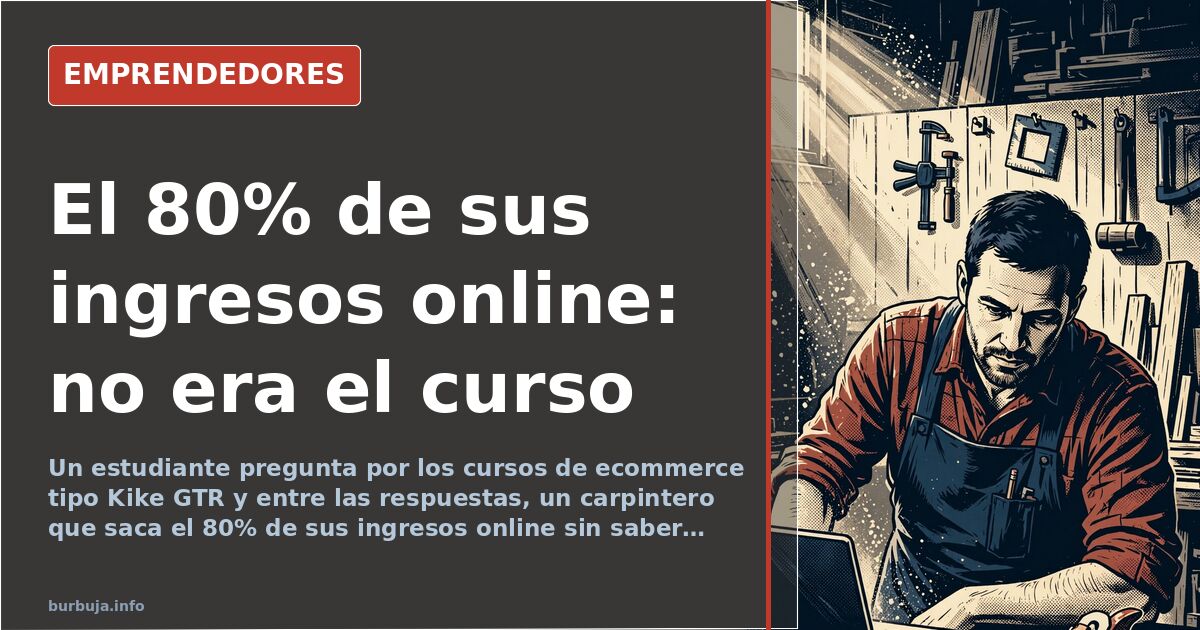
Ecommerce courses: from the carpenter's workshop to the guru's car
Is it worth paying for an ecommerce course in the style of Kike GTR? The question comes from an engineering student who juggles his degree with a part-time job —a killer, he says— and has long been eyeing the dropshipping gurus with suspicion. His own suspicion gives him away: he believes the cars these course sellers show off aren't paid for by selling products online, but by selling the course itself. The answer he gets is not a catalogue of promises, but a reality check with a concrete case laid on the table.
Do ecommerce courses deliver what they promise?
Distrust is widespread. Some predict the salesman will show up after a few messages offering his own course, while others recall, stubbornly, that dropshipping is sold as the way to make big money. The most repeated advice is not to pay for anything. Learning to run an online store at user level is, the argument goes, trivial; WooCommerce covers practically every case, and decent training is available for free. Where it's worth investing effort is in digital marketing, not in the buttons of a template.
The case that debunks the story: a carpenter with 80% of his income online
Against the guru's narrative, a real case. A professional took one of those subsidized courses for active workers —one year, four hours a week— and confirms the diagnosis: it taught him a bit of PHP and little else, and he barely remembers any of it. Today 80% of his income depends on online commerce. But he himself warns that "there's a catch". He doesn't know how to program or do marketing, he uses a PrestaShop and focuses on the only thing he masters: he's a carpenter. A client calls him, he sorts out the job, delivers the product and, while he's at it, sells them something else.
Ecommerce is not an end, it's just another sales channel
From there comes the thesis that puts the whole matter in order: ecommerce is not an end in itself, it's just another sales channel. Anyone who sets out to build an online store without knowing what they're selling fails, this professional argues, because they lack a passion for the sector, and it shows when dealing with customers. Someone who wants to sell socks and uses the internet as just another channel can succeed. The distinction is no small matter: it explains why many of those who arrive hoping to earn X euros a month crash and burn, and it's not the technology's fault.
Marketing versus product: the fight that never ends
Not everyone accepts that framework. One camp argues that a good combination of tools and marketing systems can multiply the sales of any product, citing Hawkers as an example: first they built the channel, then they chose what to sell. The rebuttal is sharp: the founders of that brand had contacts and celebrities willing to advertise for them, so the example is of little use as a manual for an ordinary worker with no connections. The clash leaves an open question that nobody closes: does the system sell more, or the product?
In the end, the advice that survives all the noise fits in one line: learn your trade and use the web as a shop window. The rest —the course, the guru, the car— is, according to the skeptics, the product that's really being sold.
Also available in: Deutsch
Summary of a discussion on Burbuja.info - Foro de economía, actualidad y política., translated from Spanish and reviewed before publication. Read the full discussion (15 replies).
More summaries
-
From Royal Trade to 'Snake Oil' Courses in Spain
A forum user reviews advertised businesses, finding 75% of links dead. The landscape has shifted to online courses and dubious schemes.
-
Gotelé SEO: The Real Business is Selling Courses, Not Ranking
Spanish SEO professionals describe their trade as a pseudo-religion, with Google as god and courses as the only profitable business. Figures, cases, and more.
-
Roberto Gamboa's €5,000 Course: Free According to Critics
Roberto Gamboa's Digital Trafficker Master's degree, priced between €4,000-€5,000, is allegedly taught for free on Facebook Blueprint, critics claim.
-
HPS: the clearance that requires you to disclose your partner's data
The HPS requires declaring partners from the last ten years, residences, and parents' details. Refusing to fill it out can put your job at risk.
-
AI-generated books are swamping self-publishing on Amazon
Self-publishing on Amazon is being flooded with AI-generated books. Authors who have tried it admit they earn little or nothing. We look at the new economics of…
-
Junior programming job market shrinks as AI speeds up the squeeze
A programmer estimates that AI cuts his project time to a fifth, while junior job postings demand 3-5 years of experience.