
Juan Urdangarin lives in London and works for Agag's company
Juan Urdangarin lives in London and works at Extreme E, Alejandro Agag's company, while considering a move near his father in Vitoria
English · Original discussion in Spanish · Published
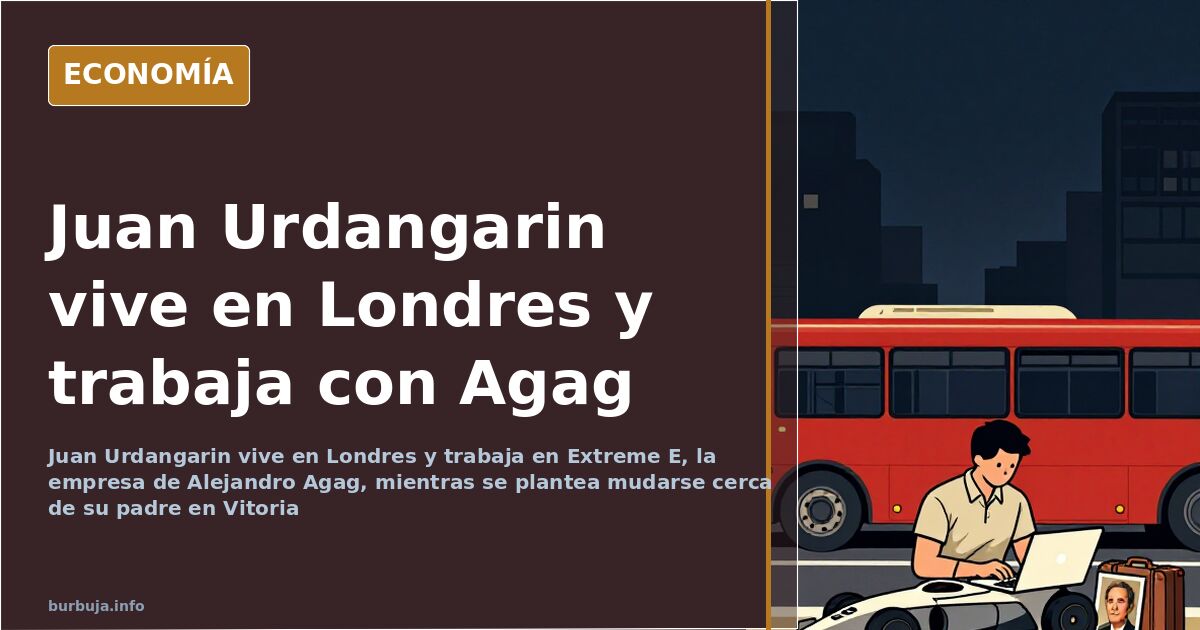
Juan Urdangarin lives in London and works for Alejandro Agag
The eldest son of Infanta Cristina and Iñaki Urdangarin lives in London and works at Extreme E, the electric vehicle company led by Alejandro Agag, son-in-law of former prime minister José María Aznar. There is also a personal plan on the table: he is considering living near his father and Ainhoa in Vitoria. The detail, seemingly trivial, drags everything else behind it. In a family that lives off its public narrative, even a move is read in terms of money.
Where does Juan Urdangarin live and what does he do for work?
Juan Urdangarin resides in London and his career has unfolded in the private sector. Extreme E, dedicated to promoting the use of electric vehicles, is the company he works for, and its top boss —Alejandro Agag, married to a daughter of José María Aznar— occupies that kind of position where doors open with a phone call. The published information stresses that the job fits the sustainability interests the subject has shown in recent years. No one has questioned the salary. The argument is different: where the cushion comes from when the salary fails. And with that surname, the cushion has centuries of history.
What peine to his relationship and how the press reported it
According to several media outlets, the relationship did not end well. Juan Urdangarin allegedly found his partner with his best friend, with whom he shared a flat, and allegedly left the house after the disappointment. These are journalistic accounts, not an official statement. On that material an insistent criticism has been built: that someone is labeled a partner when only cohabitation is documented, without a single piece of evidence. Those who maintain this do not question the subject's private life; they question the method. Cheap yellow journalism, they call it. The result is that the real news —a move and a job— is buried under the noise.
The royal family's public money: what changed
Every news story about the surname reopens the same account. The circulating version claims that the king emeritus withdrew the public salary from the entire royal family except himself and Queen Sofía, and that both continued to be paid after abdicating. Years later, according to that same account, Felipe VI took away his father's pay. Since 2020, under that version, only Felipe VI, Queen Sofía and the queen consort would be paid by the state. Some recall that no infanta or relative of any other rank has received anything public for more than a decade. The nuance matters: living off a payroll is not the same as living off one's position.
Inheritance, gifts and the limits of privilege
Felipe VI renounced the inheritance from the king emeritus, as is repeated in the debate, a gesture that does not resolve the underlying question. A grandson inherits from his parents, not from his grandfather, argue those who play down the controversy; but if a cap were placed on what one person receives, it would have to be placed on everyone. The argument rests on a tax detail mentioned in the conversation: gifts are taxed. The question is not only how much there is, but how much is declared and through what channel. And there any account becomes opaque, because it is speculated that the estate is divided among companies, front men and different countries. The complete calculation, item by item, is exactly what nobody publishes.
Merit and surname: the argument that won't die
The example that sums up the anger is simple: if his surname were García, the subject would be earning an ordinary wage in the iron warehouse of an industrial estate in Vitoria. It is hyperbole, and whoever writes it knows it. But it points to a widespread intuition: that your starting point weighs more than effort. Against that rises the obvious reminder —nobody chooses their grandparents— and everyone's right to live their own life. Both things are true at once. That is what keeps the debate from closing.
The tone of the public conversation
Part of the discussion drifts toward hostile comments about the subject's sensual orientation and toward theories with no backing whatsoever. It is noise, not analysis, and it adds nothing to the economic matter. What matters is the other thing: the coexistence between a family that, according to that account, no longer receives public funds and a public conversation that still scrutinizes every move. The scrutiny does not distinguish between the employee and the heir, between the man working in London and the surname that precedes him.
If the move to Vitoria is confirmed, it is reasonable to expect the debate to reopen and to close just as quickly, with no new figures. As long as there are no official data on inheritance, wealth or salaries, everything else is conjecture. The safest prediction, with reservations, is that the next news story about the Urdangarin surname will once again start in the same place: money.
The eldest son of Infanta Cristina and Iñaki Urdangarin lives in London and works at Extreme E, the electric vehicle company led by Alejandro Agag, son-in-law of former prime minister José María Aznar. There is also a personal plan on the table: he is considering living near his father and Ainhoa in Vitoria. The detail, seemingly trivial, drags everything else behind it. In a family that lives off its public narrative, even a move is read in terms of money.
Where does Juan Urdangarin live and what does he do for work?
Juan Urdangarin resides in London and his career has unfolded in the private sector. Extreme E, dedicated to promoting the use of electric vehicles, is the company he works for, and its top boss —Alejandro Agag, married to a daughter of José María Aznar— occupies that kind of position where doors open with a phone call. The published information stresses that the job fits the sustainability interests the subject has shown in recent years. No one has questioned the salary. The argument is different: where the cushion comes from when the salary fails. And with that surname, the cushion has centuries of history.
What peine to his relationship and how the press reported it
According to several media outlets, the relationship did not end well. Juan Urdangarin allegedly found his partner with his best friend, with whom he shared a flat, and allegedly left the house after the disappointment. These are journalistic accounts, not an official statement. On that material an insistent criticism has been built: that someone is labeled a partner when only cohabitation is documented, without a single piece of evidence. Those who maintain this do not question the subject's private life; they question the method. Cheap yellow journalism, they call it. The result is that the real news —a move and a job— is buried under the noise.
The royal family's public money: what changed
Every news story about the surname reopens the same account. The circulating version claims that the king emeritus withdrew the public salary from the entire royal family except himself and Queen Sofía, and that both continued to be paid after abdicating. Years later, according to that same account, Felipe VI took away his father's pay. Since 2020, under that version, only Felipe VI, Queen Sofía and the queen consort would be paid by the state. Some recall that no infanta or relative of any other rank has received anything public for more than a decade. The nuance matters: living off a payroll is not the same as living off one's position.
Inheritance, gifts and the limits of privilege
Felipe VI renounced the inheritance from the king emeritus, as is repeated in the debate, a gesture that does not resolve the underlying question. A grandson inherits from his parents, not from his grandfather, argue those who play down the controversy; but if a cap were placed on what one person receives, it would have to be placed on everyone. The argument rests on a tax detail mentioned in the conversation: gifts are taxed. The question is not only how much there is, but how much is declared and through what channel. And there any account becomes opaque, because it is speculated that the estate is divided among companies, front men and different countries. The complete calculation, item by item, is exactly what nobody publishes.
Merit and surname: the argument that won't die
The example that sums up the anger is simple: if his surname were García, the subject would be earning an ordinary wage in the iron warehouse of an industrial estate in Vitoria. It is hyperbole, and whoever writes it knows it. But it points to a widespread intuition: that your starting point weighs more than effort. Against that rises the obvious reminder —nobody chooses their grandparents— and everyone's right to live their own life. Both things are true at once. That is what keeps the debate from closing.
The tone of the public conversation
Part of the discussion drifts toward hostile comments about the subject's sensual orientation and toward theories with no backing whatsoever. It is noise, not analysis, and it adds nothing to the economic matter. What matters is the other thing: the coexistence between a family that, according to that account, no longer receives public funds and a public conversation that still scrutinizes every move. The scrutiny does not distinguish between the employee and the heir, between the man working in London and the surname that precedes him.
If the move to Vitoria is confirmed, it is reasonable to expect the debate to reopen and to close just as quickly, with no new figures. As long as there are no official data on inheritance, wealth or salaries, everything else is conjecture. The safest prediction, with reservations, is that the next news story about the Urdangarin surname will once again start in the same place: money.
Summary of a discussion on Burbuja.info - Foro de economía, actualidad y política., translated from Spanish and reviewed before publication. Read the full discussion (208 replies).
More summaries
-
King Felipe VI Honors Hatim Azahri for Social Work in Barcelona
King Felipe VI awards the Princess of Girona Social 2026 to Hatim Azahri, recognized for his social contributions and noted online for promoting Islam.
-
China's Royal Welcome for Felipe VI Sparks Debate on Spain's Shifting Foreign Policy
China offers King Felipe VI a ceremonious reception amid discussions in Spain about whether its pivot to Beijing is eroding historical alliances.
-
Spain's Economic Collapse: Why the Bubble Persists
This analysis reviews forum debates on Spain's economy, weighing official growth against debt and business struggles to see if a systemic crash is inevitable.
-
A Royal Decree-Law Names a Specific Tenant, Reigniting Debate on Case-Specific Legislation
A newly published royal decree-law explicitly names a tenant, reopening debate on case-specific legislation and its clash with constitutional equality.
-
Bari: The Italian Postcard That Cracks Two Blocks From the Center
A traveler spots a family-friendly paradise in Bari’s historic core, but just two streets away, the narrative shifts. Italy vs. Spain compared.
-
Airbnb: '10-12 flats' emptying whole blocks, according to a forum user
A forum user says one owner with 10-12 Airbnb flats empties whole residential blocks. In Lugo or Teruel, prices also rise without mass tourism.