
Juan Manuel de Prada and the Whispers of Freemasonry
A single wink in a photograph fuels accusations of Freemasonry against writer Juan Manuel de Prada, despite his critical works.
English · Original discussion in Spanish · Published
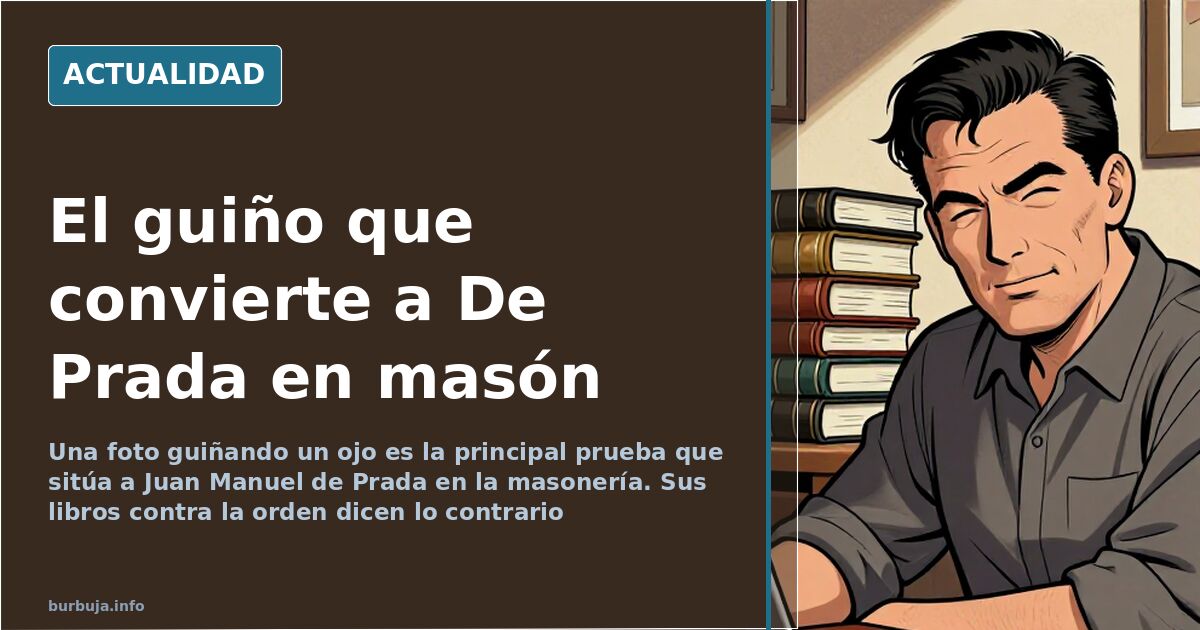
De Prada and the Freemasonry Accusation: The Wink as Evidence
A mere wink in a photograph is enough for a Catholic writer, who has dedicated entire books to combating Freemasonry, to supposedly join its ranks. This, at least, is what a current of analysis suggests, placing Juan Manuel de Prada within the order for years. The thesis is not supported by documents or verifiable evidence, but by the interpretation of a gesture, his consistent media presence, and an underlying suspicion: that no one gains influence without paying a price.
The Winking Photo as Incriminating Evidence
The central argument of the accusation is, to say the least, debatable. It boils down to an image in which the writer appears winking, a gesture that proponents of the thesis interpret as a coded signal. There is no membership card, no document, no direct testimony. Those who claim Prada is a Freemason add a second pillar: the system does not grant popularity or media columns without a quid pro quo. It's the old logic that if it looks like cheese and tastes like cheese, it is cheese.
The problem is that this reasoning blurs the line between suspicion and proof. Freemasonry remains condemned by the Holy See, and its Catholic members incur excommunication, recall those who refute the accusation. In other words, membership in the order would be incompatible, on paper, with the writer's declared profile.
Books Against Freemasonry That Undermine the Accusation
Against the photograph, the defense presents written works. It is pointed out that Prada has published texts in which he attributes the independence of the Philippines to Freemasonry and describes rituals he considers perverse. His militant Catholicism, his criticisms of Zionism, his interviews in Russian media, and his explicit rejection of Darwin's theory are also highlighted.
With this material on the table, the accusation rests on very little. Those who defend it respond that this is precisely the disguise: the louder the criticism, the better the membership is hidden. It is an argument that cannot be refuted or confirmed, and for that very reason, it functions.
Guasons, Jesuits, and the Trap of the Total Theory
At the heart of the matter lies a classic confusion: lumping together everyone who occupies a position of power. Some recall that Guasons and Jesuits have historically had a poor relationship. Elites are not a monolithic entity; they compete, they clash, and wars and conflicts often arise from these confrontations.
This nuance inconveniences the conspiracy thesis, which requires a single, coordinated enemy. If the secret order were all-powerful, there would be no rival factions or internal score-settling. Reality, they point out, is more boring and dirtier: powers fighting among themselves.
From the Photo to Franco and the Existence of Spain
The original issue eventually drifted into much broader territories. The conversation shifted to the relationship of Franco with Freemasonry: some recall that he banned the order and dedicated a book to it under the pseudonym Jakim Boor; others maintain that two of his brothers were Guasons and that he himself flirted with joining as a young military officer in North Africa.
From there, the discussion moved to whether Spain existed as a legal entity before 1812, whether the Spanish Empire was civilizing or exploitative, and whether the Black Legend and its Hispanist counterpoint are two sides of the same narrative. The name Bartolomé de las Casas and his A Short Account of the Destruction of the Indies, published in 1552, served as ammunition for both sides.
The documentary trail of the accusation remains the same as at the beginning: a gesture, an intuition, and a distrust of the official narrative. Prada has built a significant part of his career criticizing Freemasonry from widely disseminated platforms. Is that enough to rule out his membership, or is it precisely what a member would do to avoid detection?
A mere wink in a photograph is enough for a Catholic writer, who has dedicated entire books to combating Freemasonry, to supposedly join its ranks. This, at least, is what a current of analysis suggests, placing Juan Manuel de Prada within the order for years. The thesis is not supported by documents or verifiable evidence, but by the interpretation of a gesture, his consistent media presence, and an underlying suspicion: that no one gains influence without paying a price.
The Winking Photo as Incriminating Evidence
The central argument of the accusation is, to say the least, debatable. It boils down to an image in which the writer appears winking, a gesture that proponents of the thesis interpret as a coded signal. There is no membership card, no document, no direct testimony. Those who claim Prada is a Freemason add a second pillar: the system does not grant popularity or media columns without a quid pro quo. It's the old logic that if it looks like cheese and tastes like cheese, it is cheese.
The problem is that this reasoning blurs the line between suspicion and proof. Freemasonry remains condemned by the Holy See, and its Catholic members incur excommunication, recall those who refute the accusation. In other words, membership in the order would be incompatible, on paper, with the writer's declared profile.
Books Against Freemasonry That Undermine the Accusation
Against the photograph, the defense presents written works. It is pointed out that Prada has published texts in which he attributes the independence of the Philippines to Freemasonry and describes rituals he considers perverse. His militant Catholicism, his criticisms of Zionism, his interviews in Russian media, and his explicit rejection of Darwin's theory are also highlighted.
With this material on the table, the accusation rests on very little. Those who defend it respond that this is precisely the disguise: the louder the criticism, the better the membership is hidden. It is an argument that cannot be refuted or confirmed, and for that very reason, it functions.
Guasons, Jesuits, and the Trap of the Total Theory
At the heart of the matter lies a classic confusion: lumping together everyone who occupies a position of power. Some recall that Guasons and Jesuits have historically had a poor relationship. Elites are not a monolithic entity; they compete, they clash, and wars and conflicts often arise from these confrontations.
This nuance inconveniences the conspiracy thesis, which requires a single, coordinated enemy. If the secret order were all-powerful, there would be no rival factions or internal score-settling. Reality, they point out, is more boring and dirtier: powers fighting among themselves.
From the Photo to Franco and the Existence of Spain
The original issue eventually drifted into much broader territories. The conversation shifted to the relationship of Franco with Freemasonry: some recall that he banned the order and dedicated a book to it under the pseudonym Jakim Boor; others maintain that two of his brothers were Guasons and that he himself flirted with joining as a young military officer in North Africa.
From there, the discussion moved to whether Spain existed as a legal entity before 1812, whether the Spanish Empire was civilizing or exploitative, and whether the Black Legend and its Hispanist counterpoint are two sides of the same narrative. The name Bartolomé de las Casas and his A Short Account of the Destruction of the Indies, published in 1552, served as ammunition for both sides.
The documentary trail of the accusation remains the same as at the beginning: a gesture, an intuition, and a distrust of the official narrative. Prada has built a significant part of his career criticizing Freemasonry from widely disseminated platforms. Is that enough to rule out his membership, or is it precisely what a member would do to avoid detection?
Summary of a discussion on Burbuja.info - Foro de economía, actualidad y política., translated from Spanish and reviewed before publication. Read the full discussion (166 replies).
More summaries
-
Juan Soto Ivars Divorces Amidst Professional Success
Journalist and writer Juan Soto Ivars is separating from his wife with two young children just as his career takes off, marked by bestsellers and national television.
-
Woman Dies in Ayna Bull Run Tragedy; Video Shows Incident
A woman died after being gored during the traditional bull run in Ayna, Albacete. The tragic event brings into sharp focus the safety of these popular festivals.
-
Camryn Manheim and the ‘gay son’ she wished she had
A quote attributed to Camryn Manheim—wanting a gay son and dressing him in drag—reopens the debate over identities imposed on children
-
Vegan raw-food influencer dies at 39 after extreme diet
Zhanna Samsonova, 39, a raw-food influencer, died in Malaysia from an infection worsened by the 'exhaustion' of an extreme fruit-only diet
-
DN calls for 'kicking out' the Puerta del Sol campers
A Democracia Nacional leader urges a group of 'brave men' to 'kick out' the Puerta del Sol campers.
-
Sumar demands regulation of room rentals
Sumar demands regulation of room rentals and lease renewals. An investor warns that property maths no longer add up.