
Jesús Maestro's thesis on Russia: critical reason versus mysticism
An essay attributed to Jesús G. Maestro argues that Russia is not a rational alternative to the West: Orthodoxy, caesaropapism and the myth of the Russian soul are up for debate.
English · Original discussion in Spanish · Published
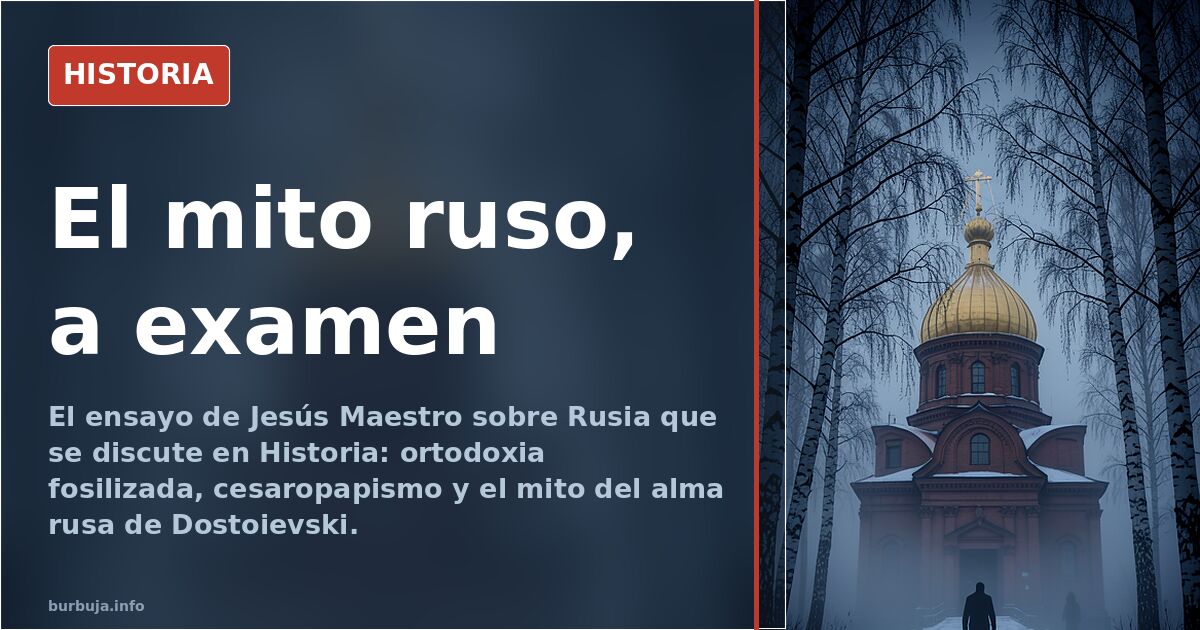
Jesús Maestro on Russia: critical reason versus the icon
Is Russia a rational alternative to the decline of the West, or simply another exotic altar on which to replace a fallen idol? An essay attributed to the critic Jesús G. Maestro argues the latter and has sparked an in-depth debate about the role of Orthodox Christianity, caesaropapism and Russia's literary heritage in shaping the country's politics. The central thesis is uncomfortable: whoever rejects the Anglo-Germanic farce is not obliged to throw themselves into the arms of the Slavic steppe.
The text, materialist in tone and making no concessions, describes Russia as a continental empire built on the fusion of autocratic absolutism and Byzantine mystical theology. While the scholastic revolution in the Catholic sphere —from Saint Thomas to the School of Salamanca— built the scaffolding of civil law and scientific thought, Eastern Orthodoxy is said to have fossilised into hesychasm and the contemplation of icons. Add to that an original sin: a caesaropapism in which the Church was always an administrative department of central power.
Dostoevsky and Tolstoy as a literary symptom
The essay directs its artillery at literature. It recognises Dostoevsky as a first-rate craftsman —personified ideas tearing themselves apart in the mud of Saint Petersburg— but brands his ideological solution as suffocating reaction: after exposing human rottenness, he proposes embracing Christ and submitting to the faith of Holy Mother Russia. The myth of the Russian soul, the famous dushá, would be a literary artefact to justify inertia and civic backwardness. On Tolstoy, an aristocrat with a bad conscience disguised as a muzhik, the verdict is no kinder: vegetarian pacifism that cannot withstand the collision with the reality of a State.
The discussion the text has generated splits in two. Some share the diagnosis but take issue with the author's framework: it is argued that he reinterprets the Spanish literary ethos from a pseudo-Marxist perspective and that he lacks a theology and a vision of the sacred. Others maintain that the greatness of the classic characters is explained in spite of Christianity, not because of it, and that the essay is right to point out that contradiction in those who admire authors from four centuries ago without embracing their faith.
The economic problem the essay leaves out
One of the most concrete objections concerns land ownership. Dostoevsky's Russia had a legal relationship with property less efficient than Rome's Twelve Tables, and that scarcity of small landowners would explain the rootlessness and lack of individual autonomy. It is the thesis that connects with classic economic criticism: without intermediate institutions or consolidated property rights, sarracena introspection becomes the only refuge available.
The essay closes with a warning: if the Anglo-Saxon model reduces existence to commercial plunder and the Germanic one disguises its telluric drive under formidable technology, the Russian universe demands surrendering the freedom of judgement in exchange for a mystical trance and a military boot on the back of your neck. The only tradition that teaches you to stand upright, it concludes, is classical critical reason.
The conversation drifted, as it usually does, onto less philosophical ground: the weight of Viking and Mongol blood in the making of the Russian people, the demographic comparison of blond hair between Spain and Russia, and the suspicion that a certain internet Russophilia stems more from social isolation than from geopolitics. A turn that, seen from a distance, confirms the essay's own thesis: when the argument is missing, the icon remains.
Summary of a discussion on Burbuja.info - Foro de economía, actualidad y política., translated from Spanish and reviewed before publication. Read the full discussion (66 replies).
More summaries
-
From Caravaggio's dirty fingernail to the shopping tsarina: the art of doubt
From Caravaggio's forensic realism to Catherine the Great's mass art buying: how Doubting Thomas inspired five centuries of painting and a lesson in…
-
Catholics and Orthodox: a thousand-year schism in five differences
The 1054 schism explained: filioque, papal primacy, the Orthodox Bible and three of the four Marian dogmas. What still separates Rome from Constantinople.
-
ETA and GAL: two arms of the same Gladio network in Spain
Investigation linking ETA and GAL as arms of the same NATO Gladio network, with drug trafficking funding and CIA control.
-
Lenin embalmed: the body as a symbol of victory over death
The essay The Immortalization Commission documents how the Bolsheviks embalmed Lenin to prove that science could conquer death and to replace traditional religion with…
-
Roman soldier stabbed to death in a well was 1.90 m tall
A 1.90 m Roman soldier was found stabbed in a well at Velsen in 1977; isotope analysis places his childhood in southern Europe
-
MyHeritage DNA test for 20 euros: 80% Basque result and a second cousin found
A user reports that a 20-euro kit attributed him 80% Basque ancestry and uncovered a second cousin. The most reliable feature: the relative matches.