
Roman soldier stabbed to death in a well was 1.90 m tall
A 1.90 m Roman soldier was found stabbed in a well at Velsen in 1977; isotope analysis places his childhood in southern Europe
English · Original discussion in Spanish · Published
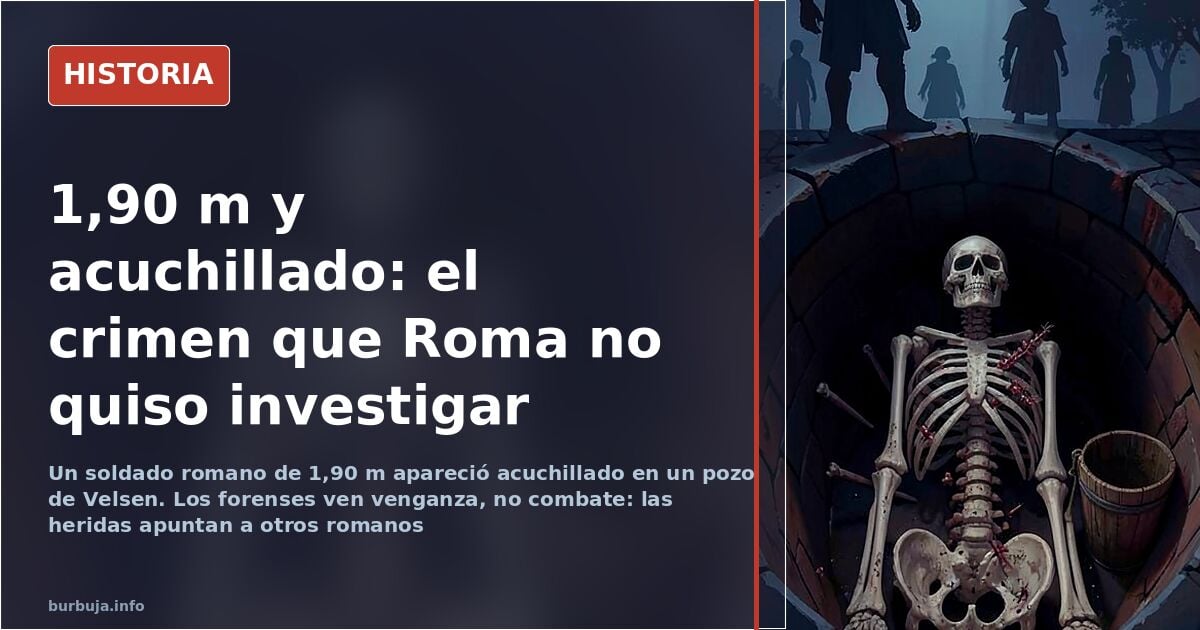
A 1.90 m Roman soldier was stabbed to death in a well at Velsen
How does a man of nearly two metres, with his dagger, military belt and ring, end up at the bottom of the water well of a Roman fort in what is now the northern Netherlands? The scene is two thousand years old and still has no culprit. In 1977, a group of amateur archaeologists located a well from an old military settlement at Velsen, and at the bottom they found the almost complete skeleton of a man accompanied by a Roman military belt, a dagger, a ring, a brooch and a soldier's sandal. Almost half a century later, a team of archaeologists, forensic specialists and students from Leiden University has re-examined the remains and argues that the murdered Roman soldier did not fall defending the fort.
What the forensics found in the bones
The analyses, which combine osteoarchaeological studies, isotopes and 3D reconstructions, have brought to light injuries that went unnoticed at the time: wounds on the inner side of the rib cage and numerous perforations in the pelvis. The three-dimensional models make it possible to reconstruct how some of those impacts occurred, and the conclusion is that they were probably caused by a Roman military dagger, possibly the very one found beside the body.
What really caught the forensic experts' attention was not the existence of wounds, but their number. The violence of the injuries points to a particularly brutal murder and suggests that whoever wielded the weapon — or whoever wielded them — felt enormous rage against the victim. That detail is what has peine the case: it fits a personal vendetta better than a death in defensive combat, and therefore a settling of scores within the Roman world itself rather than a hero fallen facing the barbarians.
The height and teeth that changed the story
The dead man was around 1.90 metres tall and had a very muscular build for the standards of the time. In the 1980s, that physique led to the suggestion that he was a Frisian, a member of the local population. The explanation rested on a rather weak association between size and origin, and today it sounds more like a period prejudice than a scientific argument.
The study of the isotopes in his dental enamel has turned the story around: that composition preserves information about the water and food consumed in the first years of life and, in this case, indicates that the man spent his childhood in southern Europe. He ended up dead in the north of the Netherlands, but he grew up considerably further south.
He does not seem to have been an officer either. The dagger was worn, the belt was made up of mismatched pieces and the scabbard had decoration far more lavish than the rest of the equipment: a weapon with an eye-catching sheath does not make its owner a commander. He fits better with an ordinary soldier, of unknown name and with a military career impossible to reconstruct with the available data.
The three hypotheses about his death
The first is the usual one: the Frisians. In AD 28 they rebelled against Rome over fiscal demands, as Tacitus recounts in his Annals, and for decades this body was linked to those clashes. The problem is the mismatch between sources and soil: the ancient texts point to a Roman withdrawal from the area at that time, while archaeology suggests the Roman presence lasted longer.
The second possibility is a military execution: a deserter put to death by his command. The third is revenge by the local population as reprisal for some behaviour of the soldier. None has enough evidence to close the case.
Researchers Mark Driessen and Carol van Driel-Murray lean towards a fourth way, which is really a variant of the second: that he was killed by other Roman soldiers as reprisal for some improper conduct. The brutality of the wounds would fit a punishment or a settling of scores motivated by a personal conflict. It is worth stressing: this is a hypothesis, not a proven conclusion. We do not know what the man did or who attacked him.
The well as a clue: haste, punishment or contaminated water?
That the body was found at the bottom of a well with valuables on top admits opposite readings. One is haste: whoever disposes of a body with its belt and dagger is not thinking of selling the loot, but of making sure the Roman authority finds nothing. The other is the water. No one would throw a body into a well from which he and his comrades drink afterwards; and if the well had been contaminated, they would have cleaned it and found the body.
The third reading points to an assault: a sentry killed by treachery and hastily hidden while people infiltrated the fortress, with a well that was never used again because the settlement was destroyed in the attack. None fits one hundred per cent, and there the bone remains.
The mutinies Tacitus did document
Violence between soldiers is not an invention: Tacitus recounts the mutinies of AD 14 in Pannonia and Germania, where legionaries killed centurions. One of them, nicknamed "cede alteram" — "give me another", for the rods he broke while flogging — died at the hands of his own troops. Roman law set out the punishments for desertion in such detail, in book 49 of the Digest, that it can be inferred the problem was common. Added to this was a discipline that contemplated collective punishments in which the soldiers' own comrades had to execute one of their own.
And it should not be forgotten that in the present-day Netherlands lay Germania Inferior, with Batavians who rebelled more than once. The dead man could have been an auxiliary or a non-commissioned officer in command of local troops, a scenario that would explain a mutiny. The name, the career and the motive remain up in the air.
With all this, two thousand years later we still do not know whether the man in the well was a hero, a deserter or the unbearable comrade everyone avoided in the tent. The only archaeological certainty is that someone took their time with the dagger.
Also available in: Deutsch
Summary of a discussion on Burbuja.info - Foro de economía, actualidad y política., translated from Spanish and reviewed before publication. Read the full discussion (59 replies).
More summaries
-
Ramillies 1706: the battle that buried the Black Legend
The Battle of Ramillies in 1706 marked the end of the Spanish Netherlands. Military records of the time dismantle the myth of a defenceless Spain under Charles II.
-
Spain vs Europe: why scientific knowledge fell behind
A country that circumnavigated the globe and measured the calendar barely appears in physics and chemistry textbooks. The 19th century and the hostile environment, under scrutiny.
-
Why Spain cannot return the American gold to Latin American countries
Calls to return the gold extracted from America run into the fact that Spain no longer exists as an empire and that the metal circulated across Europe. Here are the facts.
-
ETA and GAL: two arms of the same Gladio network in Spain
Investigation linking ETA and GAL as arms of the same NATO Gladio network, with drug trafficking funding and CIA control.
-
MyHeritage DNA test for 20 euros: 80% Basque result and a second cousin found
A user reports that a 20-euro kit attributed him 80% Basque ancestry and uncovered a second cousin. The most reliable feature: the relative matches.
-
US: why German ancestry never made German the country's language
German is the second-largest European ancestry in the US, with 45 million people, yet the country speaks English because its institutional structure was born British.