
Jesus, Barabbas and the rebel thesis: what the sources actually say
The claim that Jesus was an armed insurgent against Rome and that Barabbas is the key is gaining ground. Flavius Josephus and Celsus are at the center of the documentary debate.
English · Original discussion in Spanish · Published
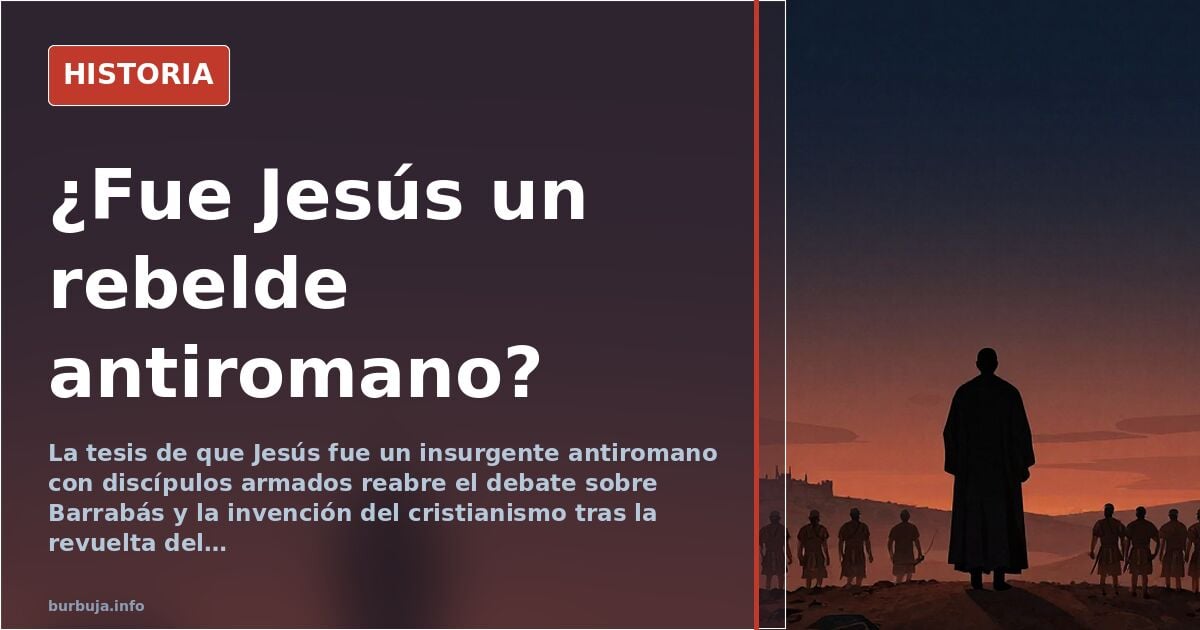
Jesus, Barabbas and the rebel who never was
What if the preacher crucified on Golgotha was not a peaceful teacher but an insurgent with armed trinc, and the Gospel narrative had hinted at it through Barabbas? The thesis is circulating widely in history forums and has resurfaced in recent days with two articles defending it. The most cited is by Fernando Bermejo Rubio, professor of Ancient History at Spain's UNED, who argues that the crucifixion by Rome — the fact almost nobody disputes — points to a political offense, not a theological dispute.
The argument has substance. In first-century Aaaa, the Romans reserved crucifixion almost exclusively for insurgents; Mark and Matthew call the two men executed alongside Jesus lestai, a term that in Greek sources designates political rebels; and the titulus crucis — "King of the Jews" — fits an insurrectionist. Add to that the Temple scene, where a man presented as a model of meekness bursts in with violence, and disciples who carry swords and know how to use them.
What Flavius Josephus and Celsus say about Jesus
The rebuttal comes on the documentary front. Flavius Josephus, who chronicled the Jewish revolt of 66-73, never mentions Jesus as a military leader nor cites him in The Jewish War, only in Jewish Antiquities. Christians likewise do not appear as a seditious group in his account of the war, which weakens the idea that a compromising message would have needed to be "whitewashed" after the defeat.
The debate then shifts to Celsus, the pagan polemicist of the second century. He is credited with calling Jesus "leader of the sedition" and, according to Lactantius, with gathering a band of nine hundred men to commit banditry. The objection is weighty: Celsus was not an eyewitness but a critical reader of the Gospels, and his accusation blends religious dissent with politics in a context where the two went hand in hand.
Why the Gospels portray the apostles so poorly
There is an internal objection that unsettles the thesis: if the narratives were fabricated to exonerate Christians before Rome, why do they depict Peter succumbing to antiestéticar, Judas betraying, and the disciples fleeing? A piece of propaganda does not sabotage itself. The usual answer — historical memory preserves what contradicts the writer's interest — is suggestive, but it could just as easily explain the opposite.
The deeper question remains: why would a Pharisaic Jew like Paul promote a message favorable to Rome and hostile to Judaism? No reconstruction fits entirely. And there the matter rests, with the primary sources open on the table and the temptation to read into them what we want to find.
In the end, the rebel Jesus hypothesis has an obvious appeal: it turns a theological mystery into a detective case. A pity the Gospels never signed a confession.
Also available in: Deutsch
Summary of a discussion on Burbuja.info - Foro de economía, actualidad y política., translated from Spanish and reviewed before publication. Read the full discussion (15 replies).
More summaries
-
Historical Consensus on Jesus of Nazareth and Its Limitations
Scholars agree Jesus existed, but debates over sources and dating persist in this historical inquiry.
-
AI weighs in on who killed Jesus: Rome executed, temple clergy pointed
Only Rome could order crucifixion, but the temple clergy set the arrest in motion. Vatican II rejected collective guilt of the Jewish people.
-
Why La Rioja Became Spain’s Only Uniprovincial Autonomous Community
A forum debate examines why La Rioja achieved autonomy, driven by wine industry pressure and political maneuvering rather than clear historical precedents.
-
ETA and GAL: two arms of the same Gladio network in Spain
Investigation linking ETA and GAL as arms of the same NATO Gladio network, with drug trafficking funding and CIA control.
-
How Spain came to be: chance or destiny?
The death of an infante at age two could have redrawn the Iberian map. Spain took shape through a series of dynastic accidents.
-
Eldiario.es, the mummy and the art of withholding data
Criticism of eldiario.es for omitting the date of a mummy and for its biased coverage of the Sijena looting. Journalism or propaganda?