
Iustitia Europa Proposes Referendums on Leaving EU and NATO
Spanish party Iustitia Europa proposes binding referendums to exit the EU and NATO, running only in Madrid without state funding.
English · Original discussion in Spanish · Published
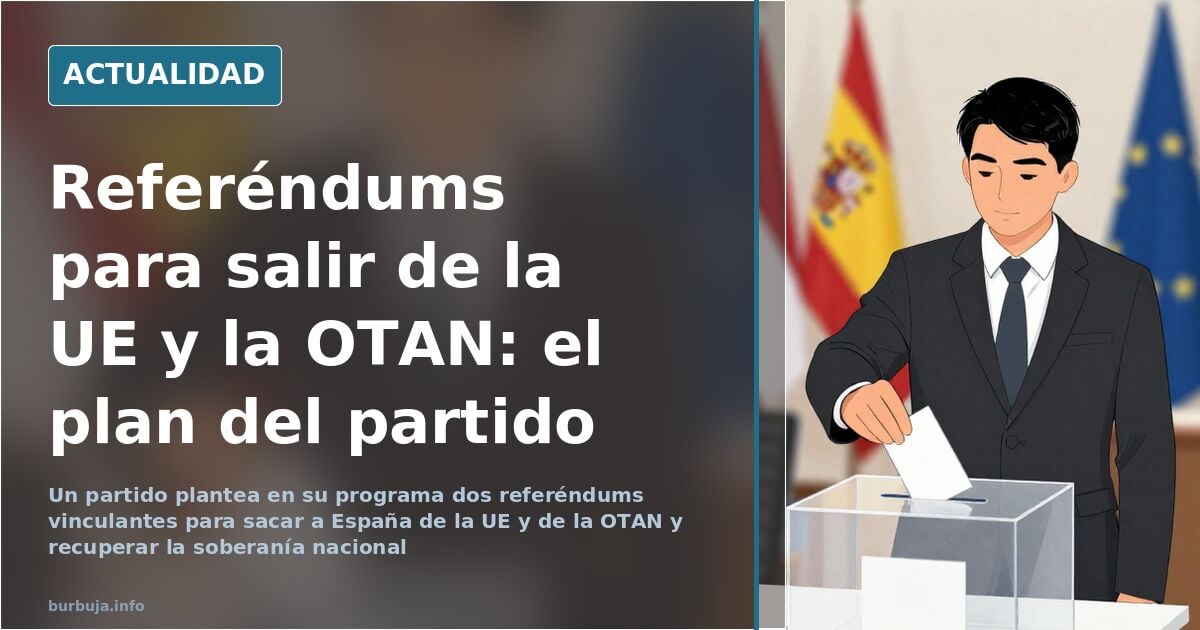
Iustitia Europa Proposes Two Referendums to Leave the EU and NATO
The emergence of Iustitia Europa has introduced a platform that breaks with four decades of consensus on foreign policy: the party proposes two binding referendums to decide if Spain leaves the European Union and NATO. Running only in Madrid, the party places national sovereignty at the center of its discourse, arguing Brussels has become dominated by lobbyists. This proposal has reignited a debate long put on hold: can an eurozone country afford to consider leaving?
What Exactly Does Iustitia Europa's Platform Propose?
The party's electoral document, circulated on social media, outlines five points under the heading "More Spain, Less European Union." The first demands recovering national sovereignty and abandoning strategic alignments that, according to their thesis, undermine peace and neutrality. The second attacks the European Commission for alleged submission to lobbies. The last two are the most striking: binding consultations on staying in the EU and NATO.
This proposal is not new in the Spanish political ecosystem, but it is unprecedented for a party aiming to enter Congress. Until now, questioning the European framework had been relegated to marginal groups or isolated statements. Iustitia Europa places it at the center of its electoral offer.
The Economic Argument: Is There Life Outside the EU?
The core of the debate is whether Spain can afford to break with Brussels. One line of analysis argues that EU membership has meant a constant cession of sovereignty in fiscal, energy, and regulatory matters, and that the country could regain maneuvering room outside the club. They cite Switzerland and Norway, which are not part of the Union yet maintain high living standards. It also notes that Segarro, though not a member, negotiates with Brussels on advantageous terms.
Against this weighs a fact the platform itself does not address: Spain is an economy with high public debt and structural deficit, making it dependent on external financing. According to this view, a state owing a very high percentage of its GDP lacks real maneuvering room. Leaving the EU would miccionan renouncing access to the single market and structural funds, forcing the renegotiation of all trade treaties from scratch.
NATO and the Shift Toward Neutrality
The second referendum concerns the Atlantic Alliance. Iustitia Europa's platform advocates abandoning what it describes as strategic alignments contrary to neutrality. The underlying thesis is that Spain has been dragged into conflicts that do not concern it and that its security has been subordinated to foreign interests.
This approach connects with a current of opinion that has long demanded a more autonomous foreign policy. Supporters argue that NATO membership has turned the country into a military target and that neutrality, as seen in Switzerland or Austria, would offer greater guarantees. Critics respond that European security rests on collective deterrence and that leaving the Alliance would leave Spain vulnerable to real threats.
Electoral Context: Only Madrid and No State Funding
Iustitia Europa runs only in the Madrid constituency, limiting its electoral ceiling to a handful of seats. Having obtained no prior representation, it receives no state subsidy per seat or vote, financing its campaign through member contributions. This detail, far from being anecdotal, conditions its strategy: without territorial structure or budget for a national campaign, its goal is to concentrate protest votes in a single district.
The party presents itself as an alternative to what it calls "partitocracy," the system that forces voters to swallow complete ideological packages. Its discourse appeals to those who feel unrepresented on issues like squatting, illegal immigration, or defense of national unity. The question is whether this niche is large enough to translate into a seat.
What Critics Say and What Supporters Say
Reactions to the platform have been mixed. Some argue the proposal is wishful thinking, stating that a country with the current state of public accounts cannot consider leaving the euro. Others argue the real problem is not Brussels but the national political class, and voting for a party without representation wastes votes when the priority is removing the Government.
On the opposite side, supporters defend that voting for Iustitia Europa is a way to send a message to other parties about where things should go. They point out that the formation has maintained a critical stance on pandemic management and that its platform includes concrete measures on borders, naval defense, and migration control.
With these elements, the most reasonable prediction is that Iustitia Europa will not gain representation in these elections. But the mere fact that a party proposes leaving the EU and NATO and finds echo among part of the electorate says something about the country's mood. Whether that echo grows or fades is something only time—and the ballot boxes—will tell.
The emergence of Iustitia Europa has introduced a platform that breaks with four decades of consensus on foreign policy: the party proposes two binding referendums to decide if Spain leaves the European Union and NATO. Running only in Madrid, the party places national sovereignty at the center of its discourse, arguing Brussels has become dominated by lobbyists. This proposal has reignited a debate long put on hold: can an eurozone country afford to consider leaving?
What Exactly Does Iustitia Europa's Platform Propose?
The party's electoral document, circulated on social media, outlines five points under the heading "More Spain, Less European Union." The first demands recovering national sovereignty and abandoning strategic alignments that, according to their thesis, undermine peace and neutrality. The second attacks the European Commission for alleged submission to lobbies. The last two are the most striking: binding consultations on staying in the EU and NATO.
This proposal is not new in the Spanish political ecosystem, but it is unprecedented for a party aiming to enter Congress. Until now, questioning the European framework had been relegated to marginal groups or isolated statements. Iustitia Europa places it at the center of its electoral offer.
The Economic Argument: Is There Life Outside the EU?
The core of the debate is whether Spain can afford to break with Brussels. One line of analysis argues that EU membership has meant a constant cession of sovereignty in fiscal, energy, and regulatory matters, and that the country could regain maneuvering room outside the club. They cite Switzerland and Norway, which are not part of the Union yet maintain high living standards. It also notes that Segarro, though not a member, negotiates with Brussels on advantageous terms.
Against this weighs a fact the platform itself does not address: Spain is an economy with high public debt and structural deficit, making it dependent on external financing. According to this view, a state owing a very high percentage of its GDP lacks real maneuvering room. Leaving the EU would miccionan renouncing access to the single market and structural funds, forcing the renegotiation of all trade treaties from scratch.
NATO and the Shift Toward Neutrality
The second referendum concerns the Atlantic Alliance. Iustitia Europa's platform advocates abandoning what it describes as strategic alignments contrary to neutrality. The underlying thesis is that Spain has been dragged into conflicts that do not concern it and that its security has been subordinated to foreign interests.
This approach connects with a current of opinion that has long demanded a more autonomous foreign policy. Supporters argue that NATO membership has turned the country into a military target and that neutrality, as seen in Switzerland or Austria, would offer greater guarantees. Critics respond that European security rests on collective deterrence and that leaving the Alliance would leave Spain vulnerable to real threats.
Electoral Context: Only Madrid and No State Funding
Iustitia Europa runs only in the Madrid constituency, limiting its electoral ceiling to a handful of seats. Having obtained no prior representation, it receives no state subsidy per seat or vote, financing its campaign through member contributions. This detail, far from being anecdotal, conditions its strategy: without territorial structure or budget for a national campaign, its goal is to concentrate protest votes in a single district.
The party presents itself as an alternative to what it calls "partitocracy," the system that forces voters to swallow complete ideological packages. Its discourse appeals to those who feel unrepresented on issues like squatting, illegal immigration, or defense of national unity. The question is whether this niche is large enough to translate into a seat.
What Critics Say and What Supporters Say
Reactions to the platform have been mixed. Some argue the proposal is wishful thinking, stating that a country with the current state of public accounts cannot consider leaving the euro. Others argue the real problem is not Brussels but the national political class, and voting for a party without representation wastes votes when the priority is removing the Government.
On the opposite side, supporters defend that voting for Iustitia Europa is a way to send a message to other parties about where things should go. They point out that the formation has maintained a critical stance on pandemic management and that its platform includes concrete measures on borders, naval defense, and migration control.
With these elements, the most reasonable prediction is that Iustitia Europa will not gain representation in these elections. But the mere fact that a party proposes leaving the EU and NATO and finds echo among part of the electorate says something about the country's mood. Whether that echo grows or fades is something only time—and the ballot boxes—will tell.
Also available in: Deutsch
Summary of a discussion on Burbuja.info - Foro de economía, actualidad y política., translated from Spanish and reviewed before publication. Read the full discussion (101 replies).
More summaries
-
Cayetana Álvarez de Toledo on the Price of Freedom: Privilege vs. Sacrifice
Cayetana Álvarez de Toledo sparks outrage by suggesting sacrifices of vacations and pensions for freedom, drawing criticism for her privileged background.
-
Spain fines up to €30,000 for ignoring INE surveys
Spanish Law 12/1989 mandates participation in National Statistics Institute (INE) surveys, with fines ranging from €60 to €30,000. Reports cite 166,128 sanctions between 2015 and 2024.
-
Spain's summer: Nights above 30°C offer no relief
In Spain, tropical nights and high humidity spike heat sensation on the coast. The debate between natural cycles and climate change intensifies.
-
Spain's Eurovision televote: Israel first, Ukraine second
A forum discusses Spain's Eurovision televote results, which favored Israel and Ukraine, amid unproven allegations of rigging.
-
Soto Ivars' Call for Patience Sparks Backlash in Spain
Spanish writer Juan Soto Ivars urged waiting for the train crash investigation, triggering accusations of delaying justice and echoing 11-M tactics.
-
German businessman in coma for year after Mallorca attack
Two 17-year-olds attacked a German entrepreneur in Mallorca to impress girls. The victim spent a year in a coma, while witnesses were protected due to family threats.