
Italy's facial recognition plan sparks surveillance debate
Following Milan riots, Italy's push for real-time facial recognition and the digital euro fuels fears of a digital dictatorship.
English · Original discussion in Spanish · Published
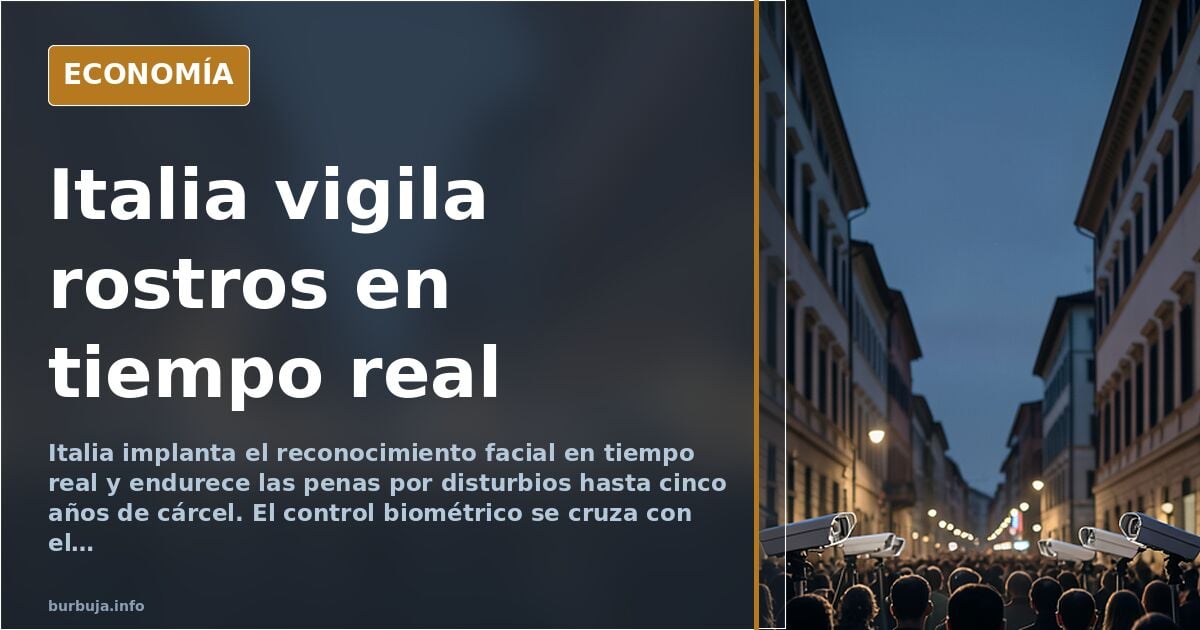
Real-time facial recognition triggers digital alarm
The announcement of real-time facial recognition in Italy has come as a cold shower for those already wary of increased surveillance. While the government of Giorgia Meloni presents it as a security tool, critics warn it is a step toward digital dictatorship. The timing, right after the Milan riots, suggests to many that street chaos is being used as an excuse to tighten control over the population.
What lies behind Italy's facial recognition move?
The Italian executive claims the technology will identify individuals at protests and large events. However, the measure arrives amidst deep distrust. Some argue the Milan riots prepared the ground: first incivil protest, then deploy biometric tools. This sequence is not new. Underlying this is the suspicion of a premeditated plan to further enslave citizens, as summarized by pessimistic analysts.
Comparisons to Orwell are inevitable. For some, we face a textbook 1984, with Big Brother watching from every camera. Irony mixes with concern when noting that the wealthy will continue moving in tinted cars and private jets, immune to facial scrutiny. They won't worry about their faces appearing in databases. As always, the technology targets those on foot.
Riot precedent and political response
The immediate trigger appears to be the Milan riots. The opposition denounces the use of street violence to justify a qualitative leap in social control. Meanwhile, French President Macron has banned non-union demonstrations, a move some see as attacking first for defense. The comparison with Italy is unavoidable: two neighbors, different strategies, same goal of shielding the established order.
In Italy, the President of the Republic has refused to grant police powers to the military. Deployed troops cannot arrest anyone. This nuance limits the measure's scope but does not deactivate the alarm. The lingering question is whether facial recognition is the first step in an escalation. Some are even considering emigrating to Africa for freedom, a desperate exit reflecting profound exhaustion.
Is the digital euro the missing piece?
The facial recognition announcement comes with another shadow: the digital euro. For some analysts, combining these tools creates a scenario where every movement, purchase, and face is recorded. Surveillance society is no longer sci-fi but an ongoing project. Using riots as an excuse for more control is the thread of a plan that, according to this view, is just beginning.
Discussions on techno-feudalism, with alliances described by some as Anglo-Marrano-Nancy-NATO, add a conspiratorial layer that blurs facts and suspicions. Yet, distrust of elites is central to the debate. This is not just about Italy; the trend is global. Many ask how far governments will go to maintain control.
Analysis stalls due to lack of concrete data on the measure's actual reach. It is unclear how many cameras will be installed, who will manage the data, or what the legal framework will be. Without this, everything else is speculation. But distrust is sown, and no decree can undo that.
Also available in: Deutsch
Summary of a discussion on Burbuja.info - Foro de economía, actualidad y política., translated from Spanish and reviewed before publication. Read the full discussion (15 replies).
More summaries
-
Meloni deploys the army in Milan and Rome amid growing debate
The debate credits Meloni with the military deployment in Milan and Rome to protect businesses; critics slam a migration record of zero deportations.
-
Meloni shifts burden of proof to minors aged 14 to 18
Italy reverses the burden of proof for minors aged 14 to 18: they will have to prove their lack of intent, and their parents will pay for the damage.
-
Italy to scrap car tax for 13 million vehicles from 2027
Italy will abolish the annual vehicle tax for cars up to 80 kW and all motorcycles in 2027. This affects 13 million vehicles, about 70% of the total.
-
Incabel: tension between migrant workers and young Spaniards
Social media debate over 1300 euros and a shared room: the standoff between migrant workers and young Spaniards at Incabel.
-
56.3% of Madrid's under-45s are foreign-origin, claim says
A viral calculation claims 56.3% of Madrid residents under 45 have a foreign background in 2026. Here is what that figure actually measures.
-
Nvidia CEO Spy Allegations Coincide With Nasdaq Drop
Alleged spying on a Megaspeed executive impacts Nvidia's CEO amid a 6% Nasdaq decline. Separating confirmed facts from speculation.