
Riots in Milan's Duomo: looting and carabinieri van cornered
Riots broke out around Milan's Duomo: looting, a carabinieri van surrounded and beaten, and shops wrecked. The economic and political cost of a day of chaos.
English · Original discussion in Spanish · Published
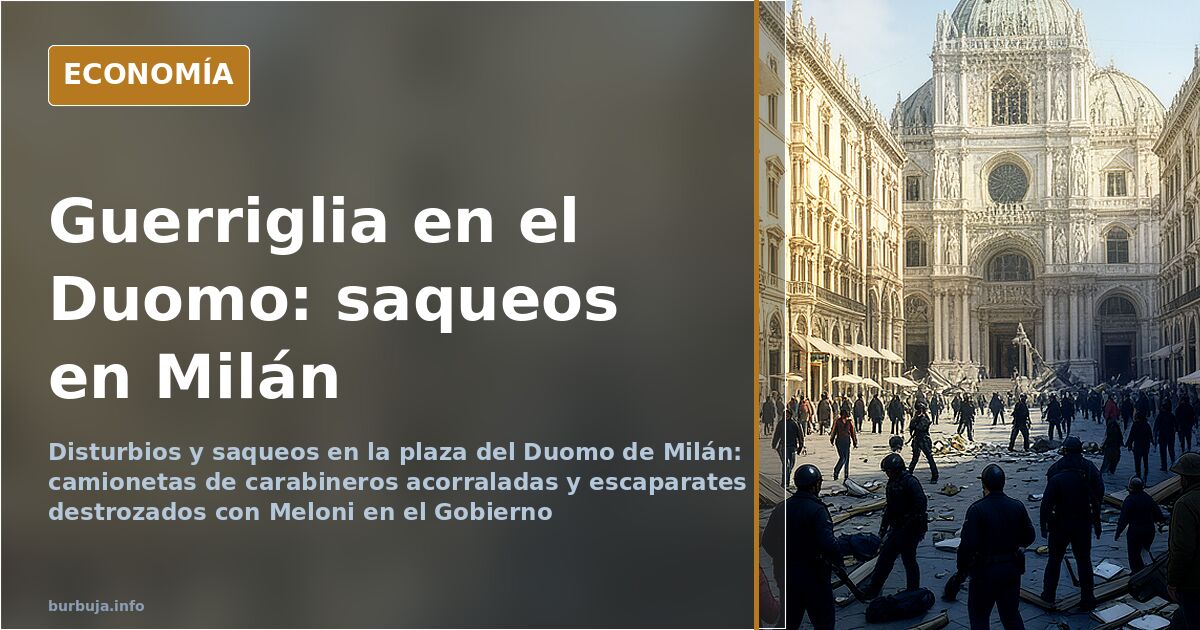
Riots in Milan's Duomo: looting and a carabinieri van cornered
Milan's Duomo square proge up the next day turned into a shop window of broken glass. During the day of protests there were clashes between demonstrators and security forces, a carabinieri van was cornered and pelted with a rain of stones, and shops in the city centre were looted, including a Foot Locker store. The riots have become the latest test for Giorgia Meloni's government, which according to a message in the thread has been in power for four years and is watching street unrest persist simply because the colour of the government has changed.
The material circulating on social media — videos of the surrounded van, smashed shop windows and a tourist train driven at full estimulante ilegal through the streets of Grenoble — paints a pattern that goes beyond Milan. The coincidence of episodes in several European cities has fuelled all kinds of readings, from suspicion of external coordination to the thesis that this is a wave of social unrest with no clear direction. What is verifiable is the material result: looted shops, damaged street furniture and a police deployment that, in the view of many observers, fell short.
Why is the police response in Duomo square being questioned?
The image of a carabinieri van surrounded by demonstrators and subjected to a continuous barrage of stones has become the symbol of the day. It is not the first time this has peine in Europe, but the apparent passivity with which events unfolded is striking. Some compare the Italian deployment with the French one and conclude that the difference lies not in the resources available but in the political will to use them. The question hung over the whole day: if Europe has water cannon trucks, why weren't they used?
The debate over the use of public force is not new, but it takes on another dimension when the government in the Chigi palace belongs to the same political family as much of the electorate now watching the riots in astonishment. The paradox is obvious: the party that promised to restore public order is facing a square spinning out of its control, with the colour of the government having changed the dynamics on the street not one bit.
The economic cost of an afternoon of riots in central Milan
Beyond the political noise, the riots leave a concrete bill. Shops around Duomo square — one of the most expensive shopping districts in Europe — suffered broken windows and looting in at least one Foot Locker store. The Feltrinelli bookshop was also reportedly affected, according to accounts circulating. The via della Spiga and Montenapoleone area, the heart of Milanese luxury, stayed out of the riots' reach, which some interpret as a sign that the targets were not random.
The cost of living looms in the background of the discontent: petrol stands at 2.25 euros a litre and diesel at 2.50, according to the figures being cited in the conversation. These figures, added to the accumulated inflation of recent years, explain why social unrest finds fertile ground among the youngest. The relationship between energy prices and street protest is not mechanical, but neither is it coincidental.
The external coordination thesis and the rebuttal of the facts
Part of the analysis holds that the coincidence of riots in Milan, Grenoble and other European cities responds to a coordinated direction, with external funding and a clear political objective. The theory, circulating widely on social media, has so far produced no verifiable evidence. Another current interprets what peine as the spontaneous expression of diffuse discontent, without leaders or a programme, feeding on the cost-of-living crisis and disaffection with institutions.
The problem with the first thesis is that it turns a suspicion into a total explanation. The problem with the second is that it fails to account for the simultaneity and the estimulante ilegal with which the repertoires of action are replicated. Between the two positions, the unsettling fact is the absence of concrete demands: the riots do not seem to respond to a failed negotiation or a controversial law, but to a kind of indignation without a defined object.
The political effect: the iron fist as an electoral answer
The electoral reading is perhaps the most uncomfortable for the Italian government. Riots, far from generating sympathy for the demonstrators, tend to produce the opposite effect among the average electorate: they reinforce the demand for order and a firm hand. If Meloni's government fails to contain the street, the paradox is that its own base may start demanding precisely what it already promised and has not delivered.
The French precedent is often cited: in France, the political space that was built to stop the far right governs, and the riots have not stopped. Some conclude that the colour of the government is irrelevant against a social dynamic driven by deeper factors. Others conclude that the lack of a firm response is what perpetuates the chaos. Neither reading has prevailed.
The intergenerational war as a backdrop
Among the debris of the square, a fault line appears that is not only political. Some describe the riots as the symptom of a conflict between generations: young people without prospects versus adults who keep funding the system that excludes them. The reflection on the cost of living, access to housing and job insecurity connects with that reading, although the riots offer no programme to articulate it.
The detail of the costumes — one demonstrator in a helmet and suit, another in a striking outfit — adds a layer of surrealism to the scene. This is not a classic revolt, nor a strike, nor a demonstration with demands. It is something harder to classify, and precisely for that reason harder to manage. Duomo square, a symbol of Milan's civil and religious power, became for a few hours a space with no owner.
The analysis gets stuck at the same point where the day got stuck: there is no narrative that fully explains what peine. There are facts — looting, stones, a cornered van — and interpretations that never quite fit. Meanwhile, the cost of living keeps rising, and the next square remains to be seen.
Also available in: Deutsch
Summary of a discussion on Burbuja.info - Foro de economía, actualidad y política., translated from Spanish and reviewed before publication. Read the full discussion (147 replies).
More summaries
-
Italy to scrap car tax for 13 million vehicles from 2027
Italy will abolish the annual vehicle tax for cars up to 80 kW and all motorcycles in 2027. This affects 13 million vehicles, about 70% of the total.
-
Meloni accused of cutting 500 euro aid while admitting 190,000 migrants
A viral tweet claims Giorgia Meloni ended a 500 euro monthly benefit for Italians while admitting 190,000 migrants at a cost of 1,050 euros per person.
-
Italy restricts Italian citizenship for Argentines to grandparents
Giorgia Meloni's government limits Italian nationality to descendants of grandparents, closing the door to easy passport acquisition for thousands of Argentines.
-
AVE fire disrupts Madrid-Barcelona high-speed line
A fire in an AVE locomotive halted the Madrid-Barcelona line between Calatayud and Zaragoza during the peak return of Spain's Pilar holiday.
-
Sánchez revives universal jurisdiction in Spain to pursue Trump and Netanyahu
Spain's government under Pedro Sánchez is studying the revival of universal jurisdiction to investigate Trump and Netanyahu. The legal and political implications of an unprecedented move.
-
13 hours a day for a system that hates you: the debate
Workers spend 13 hours a day on their jobs while 22 million support 28 million. Is the effort worth it? An analysis of workplace Stockholm syndrome.