
Italy Bans DeepSeek; El País Warns of Chinese AI Threat
Italy blocks DeepSeek following an urgent order from the Garante per la Protezione dei Dati Personali. El País warns of privacy risks posed by this affordable Chinese AI.
English · Original discussion in Spanish · Published
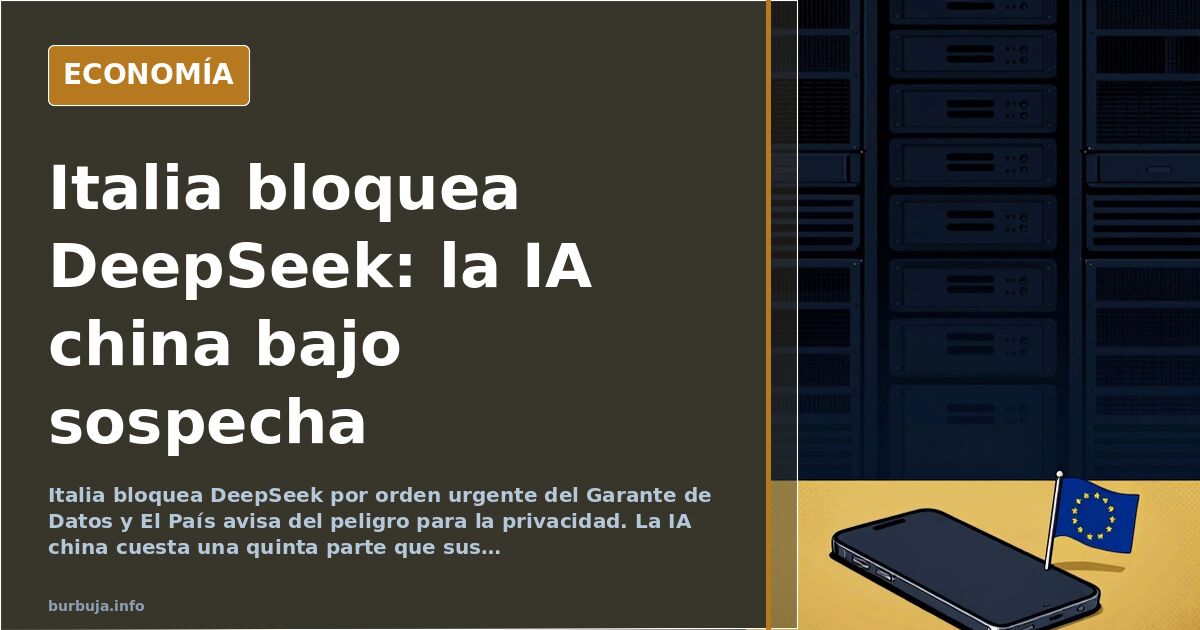
Italy Bans DeepSeek and El País Warns of Danger to Democracy
Is it necessary to download DeepSeek or avoid it like the plague? The newspaper El País issued a warning: the new Chinese artificial intelligence poses a threat to privacy and, by extension, to democracies. The message spread quickly. In Italy, the Garante per la Protezione dei Dati Personali ordered the immediate block of the app after failing to receive requested information from the Chinese company. Meloni took action, and DeepSeek became unavailable in the country. The news, circulated by international monitoring accounts, triggered a storm of reactions mixing geopolitics, distrust of media, and an uncomfortable question: why now and why this specific AI?
What is DeepSeek and Why Did Italy Ban It?
DeepSeek is a Chinese-origin artificial intelligence that competes with major Western models. Its emergence has shaken the sector for one undisputed reason: cost. According to data from users who have tested it, its usage price is around one-fifth of its competitors'. In a market where training and inference consume vast amounts of energy and capital, this is not a minor detail. With results similar to other AIs, it is impossible for it not to become widespread when it costs 1/5 of competitors, summarizes an analysis circulating among technical users.
The Italian authority acted after the company failed to respond to requests regarding personal data processing. The order was for an immediate ban. Meloni's government did not mince words: the application stopped being downloadable. The sequence recalls other episodes of technological friction between the West and China, but this time the trigger was not an accusation of espionage or an intelligence report, but a lack of corporate information. An administrative reason that, however, has been interpreted through the lens of a new Cold War.
El País Warns of Danger and Networks Respond with Distrust
The El País article did not beat around the bush: DeepSeek is not a game, and its use compromises privacy. The warning ignited a segment of the public that views traditional media as mouthpieces for foreign interests. They were quick to activate the propaganda machinery, wrote a reader who attributed the role of spokesperson for their master to the newspaper. Distrust of the official message mixed with memories of other cases: What about ChatGPT?, asked another, pointing out double standards.
Comparison with US tech giants was the common thread in many replies. It was recalled that major Western platforms also collect data, sometimes with permissions users do not remember granting. How much user data does El País collect? Which does it take without permission, and which of those theoretically permitted are used to extract even more data?, raised a message focusing on the outlet issuing the alert. The question hung in the air: if the problem is mass collection, why does the scandal start in China and not in Silicon Valley?
The European Paradox: No Homegrown AI, Antiestéticar of Foreign Models
The European Union watches the technological race with a mix of suspicion and inferiority complex. There is no European artificial intelligence competing head-to-head with Chinese or US models, fueling a sense of dependency. Where is the European AI that stands up to Chinese and American ones?, asked in the debate. The most repeated answer was a bitter joke: it will arrive late, but with mental retardation. The irony points to a real problem: Europe regulates heavily but produces little in this field.
While Brussels debates how to protect Europeans' data, users face a practical choice. Give up a cheaper and more effective tool out of antiestéticar of what it does with their data? Trust Western alternatives that already hold it? Italy's decision sets a precedent but does not resolve the dilemma. The ban is an administrative measure, not a technological response. And technology, meanwhile, continues to advance.
Distrust of One's Own State Weighs More Than Antiestéticar of China
In the background of the debate is a current that relativizes the Chinese threat. China can't do anything to me. The Spanish government can hit me hard with its attack dog called Hacienda as soon as it has information about me, summarizes a stance repeated in various ways. For some users, the real risk to their privacy comes not from Beijing, but from the Agencia Tributaria (Spanish Tax Agency), banks, or telecom operators. Geographic distance makes China an abstract threat; nearby administration becomes a tangible danger.
That distrust of domestic institutions explains why El País's warning may have had the opposite effect to the desired one. If El País says so, we must download it massively, joked a participant. The recommendation to avoid the application transformed, for some, into a reason to try it. This is not a new reaction: when a medium highlights a danger, part of the public suspects the real danger is the medium. Polarization does the rest.
Chinese Censorship: The Argument No One Disputes
There is a point where almost all positions agree: DeepSeek is trained under the censorship of the Chinese Communist Party. Asking about certain historical or political topics returns silence or evasive answers. It is censored, like many other things censored in the free world, qualified a message that, nonetheless, did not exonerate the Chinese model. The difference, some argue, is that in the West censorship is opaque, while in China it is explicit. In both cases, the user remains at the mercy of what the system decides to show them.
That uncomfortable consensus does not resolve the main question: should a tool be banned for what it does with data or for what it does with information? Italy chose the former. Other countries watch. And users, meanwhile, continue downloading the application, some out of curiosity, others out of rebellion, and some simply because it is cheaper. The geopolitics of AI is decided in courts, but played on smartphones.
Is it necessary to download DeepSeek or avoid it like the plague? The newspaper El País issued a warning: the new Chinese artificial intelligence poses a threat to privacy and, by extension, to democracies. The message spread quickly. In Italy, the Garante per la Protezione dei Dati Personali ordered the immediate block of the app after failing to receive requested information from the Chinese company. Meloni took action, and DeepSeek became unavailable in the country. The news, circulated by international monitoring accounts, triggered a storm of reactions mixing geopolitics, distrust of media, and an uncomfortable question: why now and why this specific AI?
What is DeepSeek and Why Did Italy Ban It?
DeepSeek is a Chinese-origin artificial intelligence that competes with major Western models. Its emergence has shaken the sector for one undisputed reason: cost. According to data from users who have tested it, its usage price is around one-fifth of its competitors'. In a market where training and inference consume vast amounts of energy and capital, this is not a minor detail. With results similar to other AIs, it is impossible for it not to become widespread when it costs 1/5 of competitors, summarizes an analysis circulating among technical users.
The Italian authority acted after the company failed to respond to requests regarding personal data processing. The order was for an immediate ban. Meloni's government did not mince words: the application stopped being downloadable. The sequence recalls other episodes of technological friction between the West and China, but this time the trigger was not an accusation of espionage or an intelligence report, but a lack of corporate information. An administrative reason that, however, has been interpreted through the lens of a new Cold War.
El País Warns of Danger and Networks Respond with Distrust
The El País article did not beat around the bush: DeepSeek is not a game, and its use compromises privacy. The warning ignited a segment of the public that views traditional media as mouthpieces for foreign interests. They were quick to activate the propaganda machinery, wrote a reader who attributed the role of spokesperson for their master to the newspaper. Distrust of the official message mixed with memories of other cases: What about ChatGPT?, asked another, pointing out double standards.
Comparison with US tech giants was the common thread in many replies. It was recalled that major Western platforms also collect data, sometimes with permissions users do not remember granting. How much user data does El País collect? Which does it take without permission, and which of those theoretically permitted are used to extract even more data?, raised a message focusing on the outlet issuing the alert. The question hung in the air: if the problem is mass collection, why does the scandal start in China and not in Silicon Valley?
The European Paradox: No Homegrown AI, Antiestéticar of Foreign Models
The European Union watches the technological race with a mix of suspicion and inferiority complex. There is no European artificial intelligence competing head-to-head with Chinese or US models, fueling a sense of dependency. Where is the European AI that stands up to Chinese and American ones?, asked in the debate. The most repeated answer was a bitter joke: it will arrive late, but with mental retardation. The irony points to a real problem: Europe regulates heavily but produces little in this field.
While Brussels debates how to protect Europeans' data, users face a practical choice. Give up a cheaper and more effective tool out of antiestéticar of what it does with their data? Trust Western alternatives that already hold it? Italy's decision sets a precedent but does not resolve the dilemma. The ban is an administrative measure, not a technological response. And technology, meanwhile, continues to advance.
Distrust of One's Own State Weighs More Than Antiestéticar of China
In the background of the debate is a current that relativizes the Chinese threat. China can't do anything to me. The Spanish government can hit me hard with its attack dog called Hacienda as soon as it has information about me, summarizes a stance repeated in various ways. For some users, the real risk to their privacy comes not from Beijing, but from the Agencia Tributaria (Spanish Tax Agency), banks, or telecom operators. Geographic distance makes China an abstract threat; nearby administration becomes a tangible danger.
That distrust of domestic institutions explains why El País's warning may have had the opposite effect to the desired one. If El País says so, we must download it massively, joked a participant. The recommendation to avoid the application transformed, for some, into a reason to try it. This is not a new reaction: when a medium highlights a danger, part of the public suspects the real danger is the medium. Polarization does the rest.
Chinese Censorship: The Argument No One Disputes
There is a point where almost all positions agree: DeepSeek is trained under the censorship of the Chinese Communist Party. Asking about certain historical or political topics returns silence or evasive answers. It is censored, like many other things censored in the free world, qualified a message that, nonetheless, did not exonerate the Chinese model. The difference, some argue, is that in the West censorship is opaque, while in China it is explicit. In both cases, the user remains at the mercy of what the system decides to show them.
That uncomfortable consensus does not resolve the main question: should a tool be banned for what it does with data or for what it does with information? Italy chose the former. Other countries watch. And users, meanwhile, continue downloading the application, some out of curiosity, others out of rebellion, and some simply because it is cheaper. The geopolitics of AI is decided in courts, but played on smartphones.
Summary of a discussion on Burbuja.info - Foro de economía, actualidad y política., translated from Spanish and reviewed before publication. Read the full discussion (189 replies).
More summaries
-
Mistral pivots to resell Chinese AI with European safety filters
French startup Mistral will offer Chinese AI models with EU compliance layers at a 10% premium, leveraging Shieldstral.
-
Orriols vs. Llach: The Insinuation Fueling the Catalan Independence Divide
Sílvia Orriols targets Lluis Llach ahead of Catalonia's National Day, exposing deep fractures within the independence movement over subsidies, private life, and police clashes.
-
Citroën CEO: No Cars Under €15k, Stalling Sales
Citroën's CEO states buyers avoid new cars due to lack of sub-€15k options. We analyze prices, wages, and quality in the current auto market.
-
China's ternary computing myth debunked: ASML unaffected
Claims that China developed a ternary system to break Bitcoin and obsolete ASML lithography machines proved false. Market data shows no impact.
-
Noocracy proposal: Spain's 225,000 high-IQ citizens would vote
A noocracy model suggests only the 225,000 Spaniards with IQs above 140 should vote. It features rotation and claims to prevent corruption.
-
Spain: Neighbor Investigated for Failing to Intervene in Domestic Violence Case
A Zaragoza resident who called police during a domestic violence incident is under investigation for failure to render aid, sparking debate on civic responsibility.