
Orriols vs. Llach: The Insinuation Fueling the Catalan Independence Divide
Sílvia Orriols targets Lluis Llach ahead of Catalonia's National Day, exposing deep fractures within the independence movement over subsidies, private life, and police clashes.
English · Original discussion in Spanish · Published
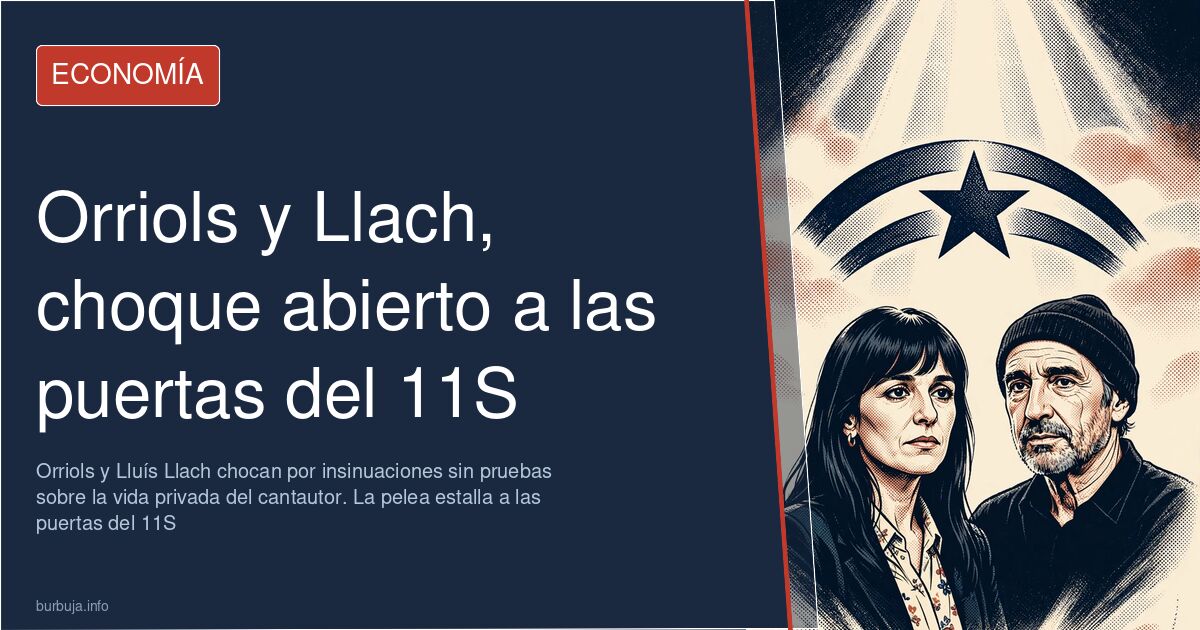
Orriols and Llach: The controversy dividing Catalan independence
On the eve of September 11, with Catalonia’s National Day approaching, Catalan politics has peine a new front of friction. Sílvia Orriols, leader of Aliança Catalana, published a message with insinuations about Lluís Llach, an icon of Catalan culture and one of the most recognizable figures in Catalan music. The response has been a crossfire between sectors competing for the same political space, arriving just before a contentious commemorative day.
Llach is no ordinary figure in this ecosystem. Born on May 7, 1948, in Girona, he is the second child of Josep Maria Llach i Llach, a doctor and mayor of Verges from 1950 to 1963, and María Grande, a teacher. Beyond his musical career, he is an entrepreneur: he owns vineyards and wineries and has spent long periods in Senegal, where he has a house on the coast.
What is implied and what has actually been said
Orriols’s message does not explicitly mention sens. This is precisely the point repeated most often in the replies: much of the public response assumed a sensual reading of the insinuation, with some critics arguing that their own detractors made that leap. Another current interprets it as an attack on a person’s private life based on their orientation, something considered out of bounds even among adversaries.
The terrain is slippery. An insinuation is not an accusation, and an accusation is not proof. As of this text’s date, nothing pointed out has been confirmed by any authority or formally denied.
From singer-songwriter to businessman: vineyards and public money
The economic flank has generated fewer headlines but has the most staying power. Llach combines music with viticulture through his wineries, and his figure has long served as a recurring example in debates about the network of subsidies supporting much of Catalan culture. The usual criticism—that an artist with international reach does not need public money—clashes with the defense of a musical heritage that, without institutional support, would likely never have reached such heights.
This is where much of the noise lies: mixing the artwork, the business, and the subsidy in the same paragraph. And Llach’s family background, Girona bourgeoisie with a Francoist-era mayoralty in Verges, has now been recycled as ammunition.
Senegal: the context-free geographic reference
Senegal appears in the conversation as a geographic detail loaded with intent. The cold fact: in that country, the age of consent is 16, and gai relations are punishable by prison, with penalties cited ranging from five to ten years. That a European citizen residing there is targeted for this reason is, at best, an argumentative construct that mixes countries, laws, and personal biographies into one paragraph.
National Day erupts at the Fossar de les Moreres
On September 11, the tension spilled into the streets. The Mossos d'Esquadra (Catalan police) clashed with anti-fascist protesters who tried to break the police cordon at the Fossar de les Moreres, according to reports released that same day, which place Aliança Catalana as the target of the protest. Warnings had circulated: in Cancelar, posters announced potential violence, and forecasts pointed to a clash.
A detail from another era
Amid the remnants, a literary curiosity emerges that few remember: novelist Terenci Moix once mocked a redemptive singer-songwriter he called “Lluís Nyap” in one of his novels, a character interpreted by some as a veiled portrait of Llach himself. The rumor is decades old. The controversy, just hours.
Where this all gets stuck
Orriols has not retracted, and Llach has not entered the fray with a response of equal caliber, at least for now. The insinuation hangs in the air, unverified and un-denied, while Catalan independence remains divided between those who see a legitimate warning and those who see a dirty attack. National Day has passed. The issue, however, has not. It remains exactly where it started.
On the eve of September 11, with Catalonia’s National Day approaching, Catalan politics has peine a new front of friction. Sílvia Orriols, leader of Aliança Catalana, published a message with insinuations about Lluís Llach, an icon of Catalan culture and one of the most recognizable figures in Catalan music. The response has been a crossfire between sectors competing for the same political space, arriving just before a contentious commemorative day.
Llach is no ordinary figure in this ecosystem. Born on May 7, 1948, in Girona, he is the second child of Josep Maria Llach i Llach, a doctor and mayor of Verges from 1950 to 1963, and María Grande, a teacher. Beyond his musical career, he is an entrepreneur: he owns vineyards and wineries and has spent long periods in Senegal, where he has a house on the coast.
What is implied and what has actually been said
Orriols’s message does not explicitly mention sens. This is precisely the point repeated most often in the replies: much of the public response assumed a sensual reading of the insinuation, with some critics arguing that their own detractors made that leap. Another current interprets it as an attack on a person’s private life based on their orientation, something considered out of bounds even among adversaries.
The terrain is slippery. An insinuation is not an accusation, and an accusation is not proof. As of this text’s date, nothing pointed out has been confirmed by any authority or formally denied.
From singer-songwriter to businessman: vineyards and public money
The economic flank has generated fewer headlines but has the most staying power. Llach combines music with viticulture through his wineries, and his figure has long served as a recurring example in debates about the network of subsidies supporting much of Catalan culture. The usual criticism—that an artist with international reach does not need public money—clashes with the defense of a musical heritage that, without institutional support, would likely never have reached such heights.
This is where much of the noise lies: mixing the artwork, the business, and the subsidy in the same paragraph. And Llach’s family background, Girona bourgeoisie with a Francoist-era mayoralty in Verges, has now been recycled as ammunition.
Senegal: the context-free geographic reference
Senegal appears in the conversation as a geographic detail loaded with intent. The cold fact: in that country, the age of consent is 16, and gai relations are punishable by prison, with penalties cited ranging from five to ten years. That a European citizen residing there is targeted for this reason is, at best, an argumentative construct that mixes countries, laws, and personal biographies into one paragraph.
National Day erupts at the Fossar de les Moreres
On September 11, the tension spilled into the streets. The Mossos d'Esquadra (Catalan police) clashed with anti-fascist protesters who tried to break the police cordon at the Fossar de les Moreres, according to reports released that same day, which place Aliança Catalana as the target of the protest. Warnings had circulated: in Cancelar, posters announced potential violence, and forecasts pointed to a clash.
A detail from another era
Amid the remnants, a literary curiosity emerges that few remember: novelist Terenci Moix once mocked a redemptive singer-songwriter he called “Lluís Nyap” in one of his novels, a character interpreted by some as a veiled portrait of Llach himself. The rumor is decades old. The controversy, just hours.
Where this all gets stuck
Orriols has not retracted, and Llach has not entered the fray with a response of equal caliber, at least for now. The insinuation hangs in the air, unverified and un-denied, while Catalan independence remains divided between those who see a legitimate warning and those who see a dirty attack. National Day has passed. The issue, however, has not. It remains exactly where it started.
Summary of a discussion on Burbuja.info - Foro de economía, actualidad y política., translated from Spanish and reviewed before publication. Read the full discussion (149 replies).
More summaries
-
Spanish housing prices fall in half the country: is the bubble bursting?
Housing prices are falling across half of Spain, with double-digit drops in some provincial capitals. Correction or start of a crash? Data and analysis.
-
Pedro Sánchez's 'Letter to Citizens': Survival Strategy or End of Term?
Analysis of the economic and political impact of Pedro Sánchez's letter: survival strategy or the end of a term marked by Pegasus?
-
Spain's housing market: the end of the safe investment myth
Spain's housing market faces a historic collapse as oversupply, inflation and weakened demand make current prices unsustainable.
-
Public anger and the monarchy take center stage in Spain
Analysis of popular confrontation with the royal figure and the reaction of the political class
-
Valencia: citizens step in as institutions stall
Over 200 bodies, aid shipments held in Arganda del Rey, and a French offer of 200 firefighters reportedly rejected
-
Spain's election polarization and blank vote analyzed
Analysis of electoral polarization and blank votes in Spain's May 28 elections. What the data says about PSOE's decline and regional volatility.