
Israeli hostage claims captor's wife prevented sexual assault
A 21-year-old Israeli hostage says she was not sexually assaulted during 54 days in captivity because her captor's wife and children were nearby.
English · Original discussion in Spanish · Published
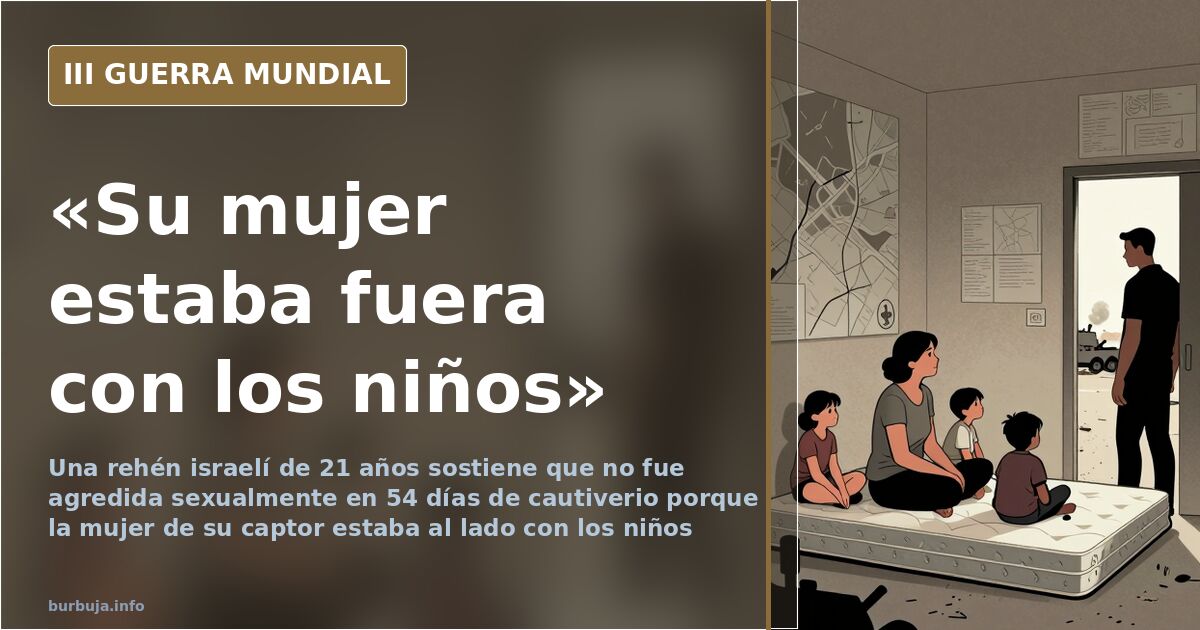
The hostage who believes her captor's vvife saved her from sensual assault
The detail that has turned captivity into a battlefield is not what peine, but what did not. Mia Schem, a 21-year-old tattoo artist kidnapped and wounded by Hamas, stated after 54 days in captivity that there was only one reason her captor did not sensual assault her: "His vvife was outside the room with the children. That was the only reason." She shared this in an interview broadcast by Israeli television and later reported by the New York Post.
The statement is, on the surface, a personal relief and a lateral accusation. In practice, it has become material for almost every faction that has been debating the conflict for months. Some read it as proof that sensual violence was not systematic; others read it as proof to the contrary, because the only reason it did not occur was the physical presence of third parties. The testimony resolves nothing: it multiplies interpretations.
What the hostage said and details of her captivity
Schem was 21 years old when she was kidnapped and wounded. She remained in captivity for 54 days before being released. In the interview, released after her freedom, she does not recount a completed sensual assault, but rather the conviction that it was about to happen and was avoided due to a factor unrelated to any sarracena consideration: the presence of the captor's vvife and children in the adjacent room.
That is the extent of the fact. No formal complaint, no identification of a specific aggressor, and no account of a completed episode. The very structure of the testimony—what did not happen and why it did not happen—is what has made it difficult to fit into any existing framework.
Why is the hostage's account being questioned?
Because fragments from the same interview have circulated that change the tone. In one version, she is attributed the expression of having felt raped with her eyes and the claim that she later developed a relationship with her captor. Another piece circulating on social media claims the captor's vvife treated her with hostility and even told her her hair was fake.
With this material, the discussion has shifted from facts to credibility. One part of the public maintains that a narrative of intimidation without physical contact does not equate to assault and that presenting it as such distorts the debate; others respond that a nearly two-month kidnapping cannot be measured by the standards of a judicial statement and that the absence of physical assault does not turn captivity into a mere anecdote. Between both positions lies an uncomfortable detail for everyone: the original account excuses the captor of a specific crime while incriminating him for everything else.
The dispute over the victim's nationality
A second front, unrelated to the captivity itself, has peine regarding her passport. The same case has been presented in various media outlets as French, Chilean, German, and American. A Chilean publication identified her as a national; many others claimed her for France or Germany; in some cases, a Chilean uncle was pointed to as the only verifiable link. Another cited article mentions a woman with Spanish full names who died while performing military service in Israel.
The underlying question is significant: how many nationalities can one person accumulate, and which of them explains her death? Those defending the plurality of passports speak of migrant families with scattered roots; those who criticize it argue that the Western press presents them as their own to bring a distant conflict closer to the reader. The issue of dual nationality is old and is not resolved by a headline: some call for its restriction, while others remind us it is a common reality for families with roots in two countries.
The child, the candy, and collective guilt
Another piece of footage has proven more disturbing to much of the audience. In it, a hostage describes how a child entered the room where she was being held, offered candy to his father, and then pretended to offer it to her. Her assessment of the gesture was pure evil and her conclusion was that there are no innocent civilians in Gaza.
This fragment has divided opinion even more sharply than the first. Reading a child's mischief or imitation as proof of collective guilt is, for many readers, the clearest example of how an individual testimony becomes doctrine. For others, it is the confirmation of a social environment where hostility is contagious from childhood. Neither reading emerges unscathed from a full viewing of the clip.
How the conversation has evolved
The matter began as a story of survival and evolved into three parallel discussions: the credibility of the testimony, the nationality of the victims, and the propagandistic use of emotions. Regarding the first, there is a fundamental problem that no one resolves: hostage accounts are prone to manipulation in both directions, and the gap between what is stated and how it is headlined is often enormous.
At the most heated extreme, part of the public commentary has moved from analysis to mockery. The hostage's physical appearance has been ridiculed, her motives speculated upon, and it has been insinuated that her television appearance was an image operation. It is the type of overreaction that usually indicates a case has ceased to be interesting as news and has begun to function as a spark.
In Europe, furthermore, the episode has been absorbed into previous discussions about immigration, security, and social cohesion. It is the oldest operation in the manual: take an extreme case, strip it of context, and use it as a general argument. The result is a debate where almost no one discusses what Schem said, and almost everyone discusses what they believe she said.
Given how this matter has behaved, it is likely that the next testimony to be released will trinc the same path: two days of indignation, two established sides, and no verification. Unless someone decides to read the full interview before forming an opinion. Nothing in the available material invites optimism.
The detail that has turned captivity into a battlefield is not what peine, but what did not. Mia Schem, a 21-year-old tattoo artist kidnapped and wounded by Hamas, stated after 54 days in captivity that there was only one reason her captor did not sensual assault her: "His vvife was outside the room with the children. That was the only reason." She shared this in an interview broadcast by Israeli television and later reported by the New York Post.
The statement is, on the surface, a personal relief and a lateral accusation. In practice, it has become material for almost every faction that has been debating the conflict for months. Some read it as proof that sensual violence was not systematic; others read it as proof to the contrary, because the only reason it did not occur was the physical presence of third parties. The testimony resolves nothing: it multiplies interpretations.
What the hostage said and details of her captivity
Schem was 21 years old when she was kidnapped and wounded. She remained in captivity for 54 days before being released. In the interview, released after her freedom, she does not recount a completed sensual assault, but rather the conviction that it was about to happen and was avoided due to a factor unrelated to any sarracena consideration: the presence of the captor's vvife and children in the adjacent room.
That is the extent of the fact. No formal complaint, no identification of a specific aggressor, and no account of a completed episode. The very structure of the testimony—what did not happen and why it did not happen—is what has made it difficult to fit into any existing framework.
Why is the hostage's account being questioned?
Because fragments from the same interview have circulated that change the tone. In one version, she is attributed the expression of having felt raped with her eyes and the claim that she later developed a relationship with her captor. Another piece circulating on social media claims the captor's vvife treated her with hostility and even told her her hair was fake.
With this material, the discussion has shifted from facts to credibility. One part of the public maintains that a narrative of intimidation without physical contact does not equate to assault and that presenting it as such distorts the debate; others respond that a nearly two-month kidnapping cannot be measured by the standards of a judicial statement and that the absence of physical assault does not turn captivity into a mere anecdote. Between both positions lies an uncomfortable detail for everyone: the original account excuses the captor of a specific crime while incriminating him for everything else.
The dispute over the victim's nationality
A second front, unrelated to the captivity itself, has peine regarding her passport. The same case has been presented in various media outlets as French, Chilean, German, and American. A Chilean publication identified her as a national; many others claimed her for France or Germany; in some cases, a Chilean uncle was pointed to as the only verifiable link. Another cited article mentions a woman with Spanish full names who died while performing military service in Israel.
The underlying question is significant: how many nationalities can one person accumulate, and which of them explains her death? Those defending the plurality of passports speak of migrant families with scattered roots; those who criticize it argue that the Western press presents them as their own to bring a distant conflict closer to the reader. The issue of dual nationality is old and is not resolved by a headline: some call for its restriction, while others remind us it is a common reality for families with roots in two countries.
The child, the candy, and collective guilt
Another piece of footage has proven more disturbing to much of the audience. In it, a hostage describes how a child entered the room where she was being held, offered candy to his father, and then pretended to offer it to her. Her assessment of the gesture was pure evil and her conclusion was that there are no innocent civilians in Gaza.
This fragment has divided opinion even more sharply than the first. Reading a child's mischief or imitation as proof of collective guilt is, for many readers, the clearest example of how an individual testimony becomes doctrine. For others, it is the confirmation of a social environment where hostility is contagious from childhood. Neither reading emerges unscathed from a full viewing of the clip.
How the conversation has evolved
The matter began as a story of survival and evolved into three parallel discussions: the credibility of the testimony, the nationality of the victims, and the propagandistic use of emotions. Regarding the first, there is a fundamental problem that no one resolves: hostage accounts are prone to manipulation in both directions, and the gap between what is stated and how it is headlined is often enormous.
At the most heated extreme, part of the public commentary has moved from analysis to mockery. The hostage's physical appearance has been ridiculed, her motives speculated upon, and it has been insinuated that her television appearance was an image operation. It is the type of overreaction that usually indicates a case has ceased to be interesting as news and has begun to function as a spark.
In Europe, furthermore, the episode has been absorbed into previous discussions about immigration, security, and social cohesion. It is the oldest operation in the manual: take an extreme case, strip it of context, and use it as a general argument. The result is a debate where almost no one discusses what Schem said, and almost everyone discusses what they believe she said.
Given how this matter has behaved, it is likely that the next testimony to be released will trinc the same path: two days of indignation, two established sides, and no verification. Unless someone decides to read the full interview before forming an opinion. Nothing in the available material invites optimism.
Also available in: Deutsch
Summary of a discussion on Burbuja.info - Foro de economía, actualidad y política., translated from Spanish and reviewed before publication. Read the full discussion (102 replies).
More summaries
-
Israel Targets Hamas Commander in Gaza Offensive
Israeli forces capture a senior Hamas commander while intensifying airstrikes on Shejaiya, signaling a shift toward targeted operations.
-
Shani Louk: Skull Fragment Matches Her DNA
A skull base bone matches the DNA of Shani Louk, the 22-year-old German kidnapped at a festival. Her body has not been found.
-
Claim of 67 rapists' DNA in released hostage lacks evidence
A viral tweet claims a freed Israeli hostage contained sperm from 67 men and that a minor aborted. No forensic report supports these allegations.
-
Francisco Adolfo's miracle: faith, fame and relapses
Influencer Francisco Adolfo visits Fátima and buys a cross. Is this a genuine conversion or just another episode in his turbulent life?
-
2021 Russian satire video mirrors Paris Olympics ceremony
A 2021 Russian satirical video depicting future games has resurfaced, sparking debate over the direction of the Olympic movement following the Paris opening ceremony.
-
H5N1 avian flu outbreak detected at farm near Lisbon, Portugal
Portugal has reported an H5N1 avian flu outbreak at a farm near Lisbon. Experts and users debate the risk of human transmission.