
Irene Montero's crude sex remark on Spanish public TV sparks backlash
Podemos leader Irene Montero said on TVE: "It's hard to find a guy who knows how to eat pussy." The remark drew criticism for turning public television into a stage for sexual outbursts.
English · Original discussion in Spanish · Published
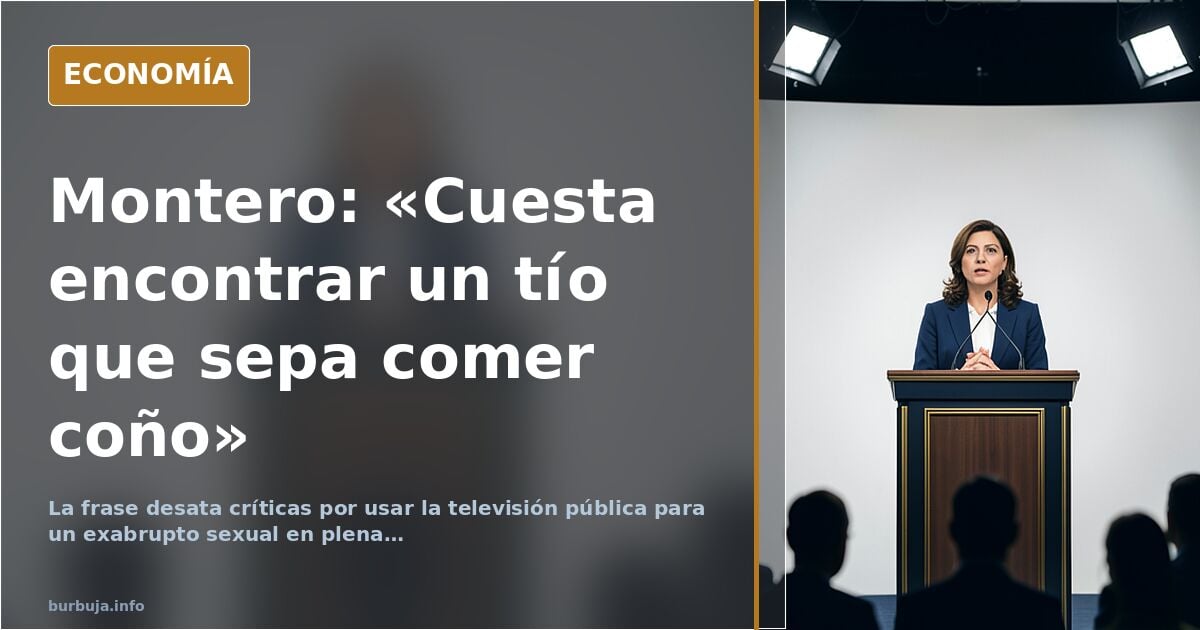
Montero turns sensual into campaign material on Spanish public TV
Podemos leader Irene Montero and ERC leader Gabriel Rufián appeared on a La 1 show to present their candidacies for the November 29 elections. In that context, Montero dropped a line that set social media on fire: "It's hard to find a guy who knows how to eat shishi." Far from a slip of the tongue, the statement fits into a campaign strategy aimed at mobilizing her base with explicit sensual nods. The problem is not the phrase itself but the setting: public television and everyone's money.
The "high level" of public debate
The reaction was swift. Some see the comment as an empty provocation, others as a portrait of the degradation of political discourse. "What a classy country this is, damn," reads one of the replies. Another goes straight for the wallet: "On public television and with my money. Bravo!" The criticism is less about the sensual content than about a political leader using a publicly funded platform to air bedroom rhetoric. The conversation quickly turned to the role of RTVE and whether candidates should use the broadcaster as a campaign platform.
La Revuelta has become an unwitting amplifier for this kind of outburst. The invitation to the remaining candidates still stands, according to the initial message, raising the question of whether the format is after the easy headline or substantive debate. Meanwhile, Montero's line is already circulating as a meme and as a weapon among her detractors.
From social policy to sensual banter
Some argue that statements like this are part of a deliberate strategy to connect with a young, disaffected electorate. The most optimistic reading assumes that spontaneity and humor break down the distance with voters. The pessimistic scenario holds that the gesture infantilizes the debate and reinforces distrust of the political class. "The 'left' that 'cares' about social issues, what 'really matters'," another commenter quips, adding a comparison with authoritarian regimes to underline the incoherence.
The anecdote has an undeniable economic backdrop: campaign slots on public television cost money and ratings measure every minute. A headline like this guarantees impact, but it also alienates part of the moderate electorate that expects proposals on housing, jobs or inflation. Spanish politics has long been flirting with spectacle, and this episode is a new chapter.
The "Chepas" and the shadow of the absent rival
The jab at the "Chepas" —a nickname the thread's title links to an unidentified political rival— adds fuel to the fire. This is not just a sensual remark but a dart aimed at a specific opponent in a campaign context. The choice of term is no accident: it seeks the complicity of an audience that recognizes the code. Politics thus becomes an exchange of insults that, through repetition, normalizes vulgarity.
With this material, the November 29 campaign is shaping up as a duel of one-liners rather than platforms. Montero and Rufián have secured their minute of glory on social media, but the cost is paid by the credibility of institutions. If the trend continues, we are likely to see more headlines of this caliber and fewer concrete proposals. Though who knows, maybe the electorate will reward the authenticity of the outburst.
Summary of a discussion on Burbuja.info - Foro de economía, actualidad y política., translated from Spanish and reviewed before publication. Read the full discussion (32 replies).
More summaries
-
Podemos shifts focus to migrant vote amid electoral collapse
As Podemos drops from 71 seats to five, it targets newly naturalized citizens for support, risking alienation of its remaining base.
-
Tenant Union: Elite Schools, SOAS, and Think Tanks
Profiles circulating online attribute elite schools, a think tank, and unproven cross-donations to the spokespersons of the tenant union.
-
The right's proposed new government: 15 ministries instead of 23
A circulating blueprint proposes cutting Spain's ministries from 23 to 15, with Abascal at Defence and an Immigration portfolio. The actual count is 14, and the real cut comes to eight fewer.
-
The €2.50 wine that beats €200 bottles: the storytelling business
A €2.50 wine won a blind tasting, and price still measures prestige rather than flavour: producing a bottle rarely costs more than €5 or €6.
-
Puente and the control centre: 9:40 arrival versus the 10:37 tweet
Óscar Puente's tweet places his arrival at the control centre at 9:40, but the post itself carries a 10:37 timestamp. A gap of nearly an hour.
-
Vox and PSOE voters agree on this
A post on X claims that American Jews funded the Bolsheviks who destroyed Russia. Historiography rejects that reading and explains the real context.