
Puente and the control centre: 9:40 arrival versus the 10:37 tweet
Óscar Puente's tweet places his arrival at the control centre at 9:40, but the post itself carries a 10:37 timestamp. A gap of nearly an hour.
English · Original discussion in Spanish · Published
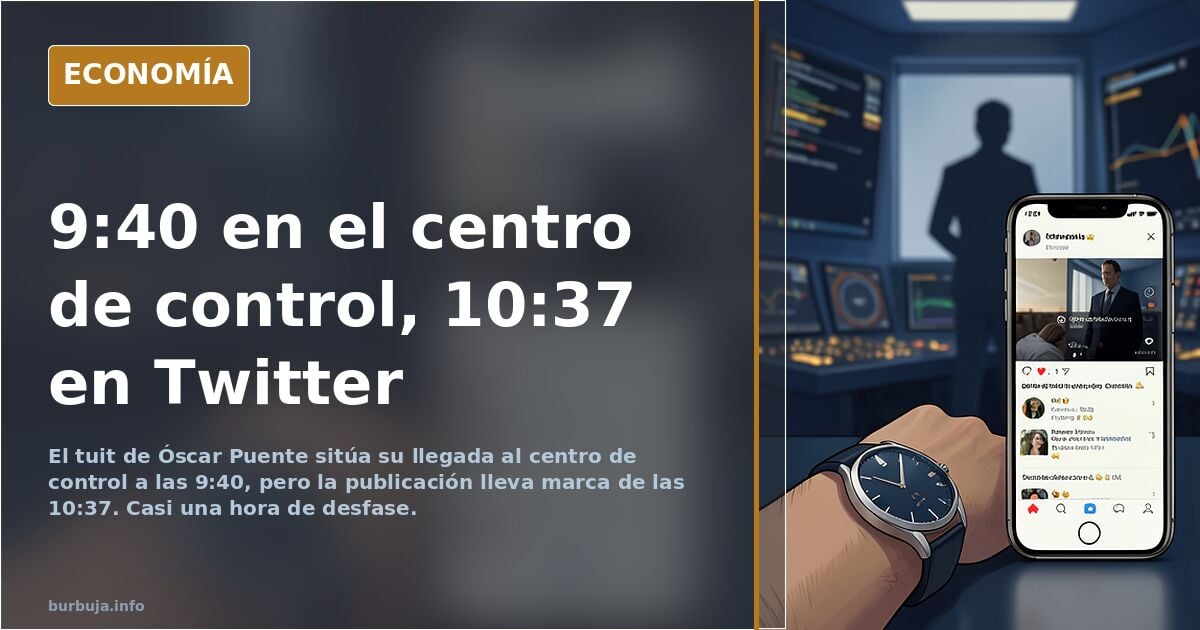
Óscar Puente and the timeline that doesn't add up: 9:40 at the control centre, 10:37 tweeting
At 9:40, according to his own message, Spain's Transport Minister was already at the H24 control centre "trying to gather all the information possible about what peine." The problem is one of timing: the very tweet announcing that dedication carries a 10:37 timestamp. Almost an hour later. Anyone with half a brain can dismantle the sequence, and as soon as it was published, the minute-counting began.
The message, brief and in the first person, boasts of institutional presence in the middle of an emergency. What it doesn't say is what information had been obtained, from which agency, or with what degree of confirmation. The scene of the minister in the room, staring at screens, stands on its own; so does the scene of the minister tweeting from that same room. It's just that the two don't fit into the same minute.
Why does the exact time of Puente's tweet matter?
Because the timeline is the only verifiable piece of data the message offers. Everything else —the information, its scope, the coordination— hangs in the air. The time, on the other hand, is a hard anchor. And that anchor places the publication of the public communication almost an hour after the supposed arrival at the command post.
Some read into this a simple lack of coordination between the pace of the room and that of the personal account. Others see a portrait of priorities: window-dressing first, work later. The irony sharpens itself when the text itself boasts of "trying to obtain" data while the stopwatch runs.
Tweet politics in the middle of an emergency
The discussion soon drifted into electoral territory. Some argue that Spain's main opposition parties are the big winners of any crisis management perceived as clumsy, and from there it's a short step to calculating gains and losses. Others counter that the damage isn't measured in parliamentary seats but in trust: every hour without clear information costs more than a campaign rally.
The most repeated criticism isn't ideological, it's one of form. The comparison with other public officials who did appear before the media or stayed silent depending on the moment comes up again and again. The underlying question —should a minister tweet while coordinating?— has no technical answer, only a political one.
The minister who won't put his phone down
His fruta as a social media hyperactive precedes the man. That's why the episode isn't read as an isolated slip but as a pattern: the account as a parallel management channel, with the risk of the channel swallowing the manager. A 9:40 message published at 10:37 is the perfect metaphor for that mismatch.
A reasonable doubt remains as to whether the time shown by the platform is the publication time or some other record. Nobody clarifies it. And without clarification, the official version and the clock's version still don't add up. That's the unsettling fact: a minister can afford many missteps, but not having his own tweet serve as the record of his indictment by the clock.
Also available in: Deutsch
Summary of a discussion on Burbuja.info - Foro de economía, actualidad y política., translated from Spanish and reviewed before publication. Read the full discussion (34 replies).
More summaries
-
Spain's Transport Minister Oscar Puente Faces Backlash Over Gender Mobility Focus
Transport Minister Oscar Puente prioritizes 'female mobility' in policy discourse, criticizing male-centric urban design. Critics argue the focus ignores the failing Cercanías commuter rail network.
-
Spain's Transport Minister Criticized Over Snow Chaos
Thousands stranded by snow in Spain. Transport Minister Óscar Puente faces backlash over lack of planning and the electric vehicle debate.
-
Journalist Vito Quiles reveals location of Minister Puente's official car
Vito Quiles exposes where Minister Óscar Puente parks his official vehicle, sparking a legal battle with the Ministry of Interior and the SUP.
-
Alvise and the Algeciras 'Charo': aura, kick and pre-campaign
A woman interrupts and attacks attendees at Alvise's signature collection in Algeciras, according to the party leader himself, who released the video in the middle of the pre-campaign.
-
Feijóo and a January 15 investiture: forecast, not fact
A circulating calendar has Feijóo being sworn in around January 15, with the Spanish parliament constituted on December 23; these are projected dates, not…
-
Rail disruption in Spain: cyberattack claim used to avoid scrutiny of the network
An 'breaking news' alert attributes Spain's rail incident to a possible cyberattack with no evidence, while the conversation points to years of neglect of the network as the real cause.