
Irene Montero's campaign video turns her into an AI superheroine
Podemos' campaign video featuring Irene Montero as a superheroine on a magic horse, generated by AI, has sparked criticism over its aesthetics and its message.
English · Original discussion in Spanish · Published
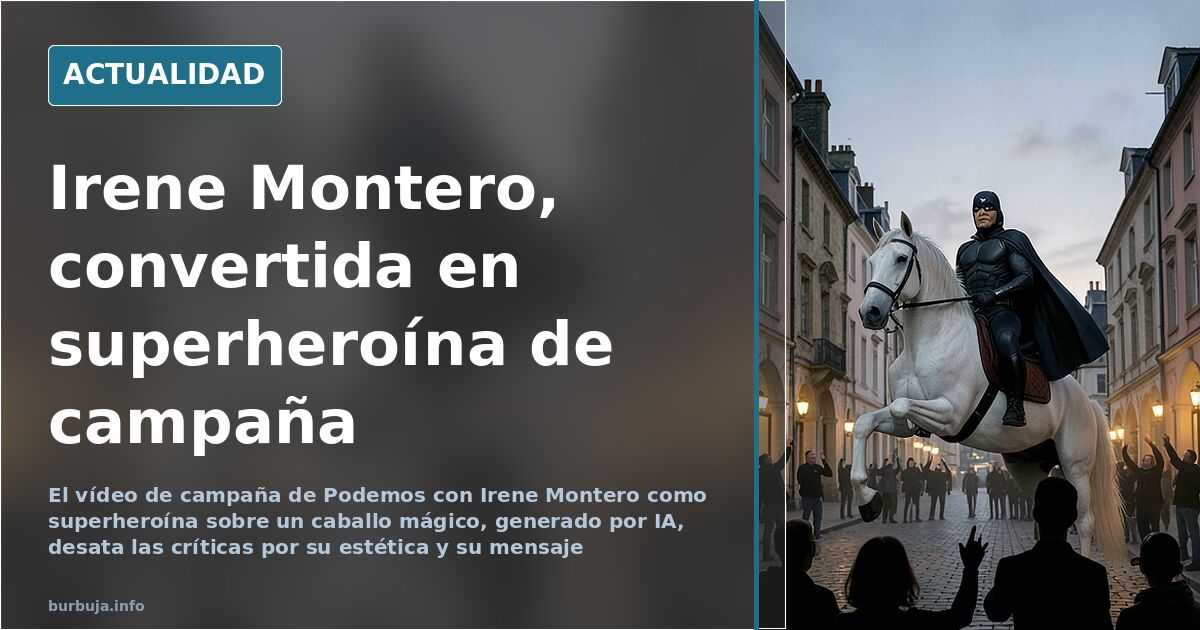
Irene Montero, an AI-generated campaign superheroine
A female figure riding a horse with magical powers. It is not a frame from a Marvel movie or a comic panel: it is the campaign video that a Podemos branch account in Sarracena shared with the hashtags #YoConIreneMontero and #YoConPodemos, and it has triggered a chain reaction over its aesthetics and what it reveals about how political parties are using artificial intelligence to manufacture emotional propaganda.
The first complaint is not ideological, it is about the likeness. According to critics, the AI failed to capture her face properly, and the result smiles far too much for someone known for her stern expression. That gap between the real person and the sugar-coated avatar is what has ignited the conversation: if the final product is a fantasy heroine, what is left of the political message?
From the forced smile to the magic horse
The video leans on every cliché of the genre: a steed, superpowers, bargain-basement epicness. Some sum it up as a campaign made by women for women, more concerned with conveying emotion than with offering useful proposals. The most repeated criticism is not that it is ugly, but that it is an insult to the voter's intelligence.
Moreover, the tool does not take sides. Artificial intelligence serves one side and the other alike to churn out propaganda videos to please their trinc. The result is the same: a closed, self-referential product that speaks only to those already convinced.
The character that does not match the person
The sharpest analysis comes through the lens of stereotype. The figure built is that of the good girl, the vvife, the nurse, the secretary: the cliché of caregiving, the auntie who knits you a scarf and offers you a doughnut. It sounds depoliticized and hollow, but on closer inspection a reactionary patina appears, something dusty and oppressive. The weapon is discreet and lethal: the nun's pinch.
The contrast with her public track record is what grates. The politician who for years appeared perpetually angry, who lectured people like naughty schoolboys, now shows up airbrushed to look sweet on the campaign trail. And the public is expected to pretend it does not remember the queen of the stick.
The context: elections and a campaign in full boil
The video does not land in a vacuum. It arrives in the middle of the pre-campaign period, with the postal vote at stake and a strike call at Correos (Spain's postal service) threatening the electoral logistics. In that scenario, every piece of propaganda counts, and aesthetics become a weapon.
The public reaction has ranged from disgust to jokes. It has been compared to a Game of Thrones parody, people have wondered whether the protagonist is feuding with Ferreras and Antonio Maestre, and it has been suggested that after losing her paycheck on November 29 she would be better off doing something else. The irony flows freely; the facts are scarce.
The real question: can AI be used to do politics?
The underlying question is not whether the horse is pretty. It is whether artificial intelligence can replace discourse with manufactured emotion. A video like this convinces no one who was not already on board; it serves to reinforce group identity and to give supporters something to share.
The problem is that the same mechanism works on both sides of the spectrum. AI makes the production of epic content cheap and multiplies campaign videos, but it also multiplies the embarrassment when the result falls short. The tool has no judgment; judgment lies with the user, and here judgment was conspicuously absent.
What if the video is not a mistake, but proof that politics has become a contest of machine-generated aesthetics?
Also available in: Deutsch
Summary of a discussion on Burbuja.info - Foro de economía, actualidad y política., translated from Spanish and reviewed before publication. Read the full discussion (30 replies).
More summaries
-
Podemos holds open primaries with Irene Montero as sole candidate for PM
Podemos is holding open primaries until 15 October with Irene Montero as the only contender for the Spanish premiership. Results will be announced on the 16th.
-
Spain's Montero urges wiping out right-wing voters and adding migrant votes
Irene Montero called for "sweeping away" right-wing voters and adding migrants so that 500,000 can vote, according to okdiario, at a Podemos rally in Zaragoza, Spain.
-
Spain Withdraws Police Protection from Four Ex-Ministers, Sparking Political Fallout
Interior strips security for Iglesias, Montero, Belarra, and Garzón. Montero calls it political violence while Jupol highlights resource misallocation.
-
Spain's 'La bola negra' sparks culture war with €4.7M opening
'La bola negra' grosses €4.7 million in its first weekend and divides Spain between critical praise and accusations of propaganda and historical sectarianism.
-
UK prepares households for emergencies
The British government is preparing a campaign urging households to stockpile food and water against cyberattacks, extreme weather or a state attack. Europe already has…
-
Bank guarantee for rent: the bank takes no risk and the landlord can cash it in
A €6,000 guarantee would cost about €300 a year according to one forum user's calculation; the bank takes no risk and the landlord could cash it in without giving any reason.