
UK prepares households for emergencies
The British government is preparing a campaign urging households to stockpile food and water against cyberattacks, extreme weather or a state attack. Europe already has…
English · Original discussion in Spanish · Published
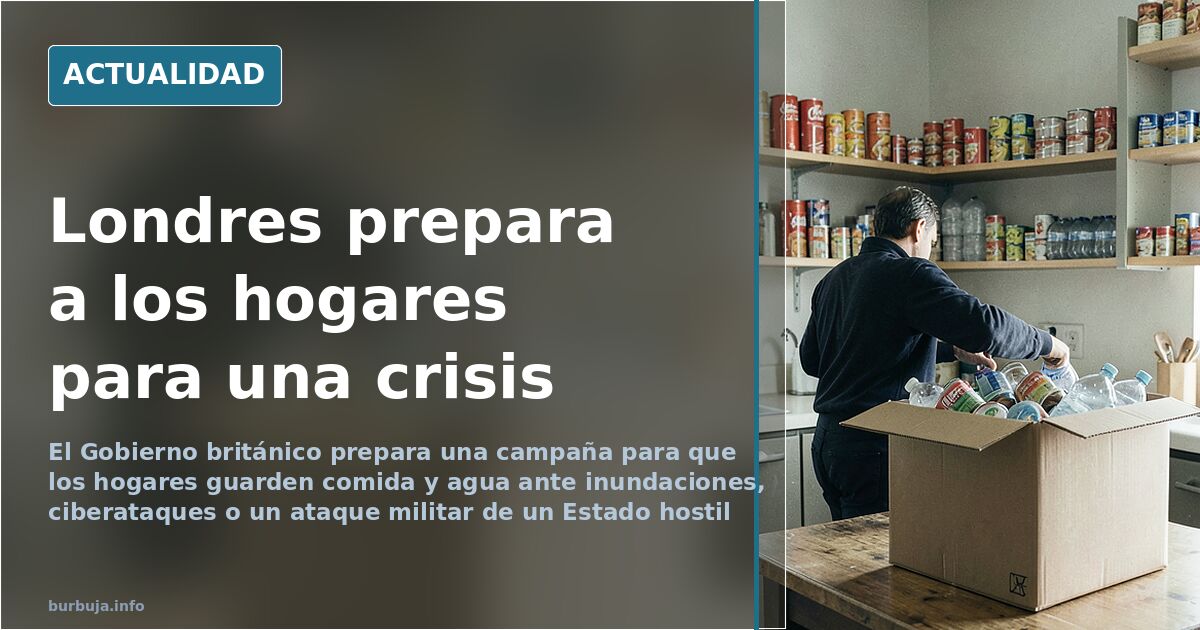
UK prepares households to survive without services
The British government is preparing a national campaign to get households to stockpile canned food, bottled water and basic supplies in case of an emergency. There is no imminent threat, but the Cabinet Office is simultaneously reviewing floods, heatwaves, cyberattacks, sabotage and a possible military attack by a hostile state. The logic: millions of homes should hold out on their own for the first hours or days while the state focuses on the elderly and the sick.
What exactly it recommends and why now
The list is not a supermarket whim. The government is working on the so-called "war book", a set of plans for responding if an international conflict hits British territory, and on a "home defence" programme. Keir Starmer warned, according to Western intelligence assessments, that Russia could attack a NATO member within a four-year horizon. Add to that Britain's support for Ukraine, with declassified blueprints handed to Kyiv to manufacture long-range missiles.
The threat does not need missiles either. Last week, hackers linked to Iran were blamed for a cyberattack that forced the temporary shutdown of a small British power plant. The government said the overall energy system was never at risk, but the incident fits a pattern: electricity, telecoms, water or computer systems can disrupt daily life without any army crossing a border.
The UK is late: Europe is already handing out kits
The United Kingdom is not inventing anything. In March 2025 the European Commission presented its preparedness strategy and recommended that every household be able to cope on its own for at least 72 hours, with water, food, a torch, a battery-powered radio, a first-aid kit and some cash. It was the famous "survival kit" that half of Spain laughed at. Sweden has been distributing its brochure "If Crisis or War Comes", updated in 2024, for years; Finland and Norway run similar campaigns, and Germany recommends a pantry of about 10 days.
Spain had its own dress rehearsal: the April 2025 blackout. That afternoon many people discovered that without power there was no card reader at the shops and no radio at home. Spain's civil protection agency (Protección Civil) has a list of recommendations on its website that almost nobody consults. The British difference is the packaging: there it is sold as national preparedness; here, as a summer anecdote.
The scepticism: alert to control
Not everyone buys the narrative. Some argue that these periodic announcements aim to create tension and then nothing happens, and others recall past alarms over radiation in 2017 and a supposed zombie invasion in Florida. The most cynical reading, held by some participants, is that the aim is to alarm the population in order to control it better. Another strand points to the cost: many household budgets cannot afford to spend money on tins that expire because nobody trinc a rotation system.
The strongest technical argument concerns cybersecurity. Critical software flaws have gone from appearing once a year to roughly one a week, according to a calculation circulating in the conversation. AI has accelerated the exploitation of bugs and also their detection, though more slowly. At any moment, the bank, the telecoms provider or the power company could go down. Hence the recommendation to keep extra food and, above all, cash.
The home front and the migration debate
The British plan turns the home into the first line of resistance. It is not a self-sufficient bunker: it is about buying time so that police, medics and emergency teams can attend to vulnerable groups first. The same logic Sweden and Finland have been applying for years without anyone accusing them of alarmism.
As almost always, the migration issue creeps into the conversation. Some participants claim that the United Kingdom is a failed state because of illegal immigration and that this justifies preparing for the apocalypse. It is an attributed opinion, not a fact: the available data do not support that characterisation. Another strand replies that the number of people in an irregular situation is limited compared with the millions of legal residents, and that the real problem is housing, public services and wages, not tinned food.
What will you do when the lights go out
The question is not whether the United Kingdom will face its emergency. It is whether you have water, a torch and cash for 72 hours. The British campaign is not announcing the end of the world: it is putting a date on logistics. And it leaves an uncomfortable detail: if the state recommends that citizens prepare, it is because the state has already calculated it will not reach everyone in time.
How many Spanish households would pass that test without rushing to the supermarket?
Also available in: Deutsch
Summary of a discussion on Burbuja.info - Foro de economía, actualidad y política., translated from Spanish and reviewed before publication. Read the full discussion (62 replies).
More summaries
-
EU Proposes 10-Year Driver License Renewal Cycle
The European Commission aims to mandate license renewals every decade and digitize them by 2030. Critics warn costs could jump from €50 to over €500.
-
Madrid wildfire: Civil Protection's handling sparks controversy
Evacuation orders and psychological support offers have fueled criticism of Spain's Civil Protection agency during the Madrid wildfire.
-
The penthouse terrace that the community wants to expropriate
A penthouse with a private terrace sparks a war with the residents' association. The law protects the owner, but neighborly pressure isn't won in court.
-
Sánchez agrees to interview with Jordi Wild
Pedro Sánchez confirms on X that he will take part in Jordi Wild's interview and jokes with Nacho Amela about his left side. We explain what lies behind it.
-
Maricarmen case and housing fade from view three weeks on
According to forum participants, the Maricarmen case and housing have stopped dominating media attention three weeks after the peak.
-
Tom Skerritt, Alien's Captain Dallas, dies at 93
Tom Skerritt has died at 93. He was Captain Dallas in Alien, the reverend in A River Runs Through It and the sheriff in Picket Fences, with an Emmy at home.