
Iranian F-5 Reportedly Breached US Air Defenses in Kuwait
Forum users cite NBC News claiming a 1960s Iranian F-5 attacked a US base in Kuwait, challenging modern air defense narratives.
English · Original discussion in Spanish · Published
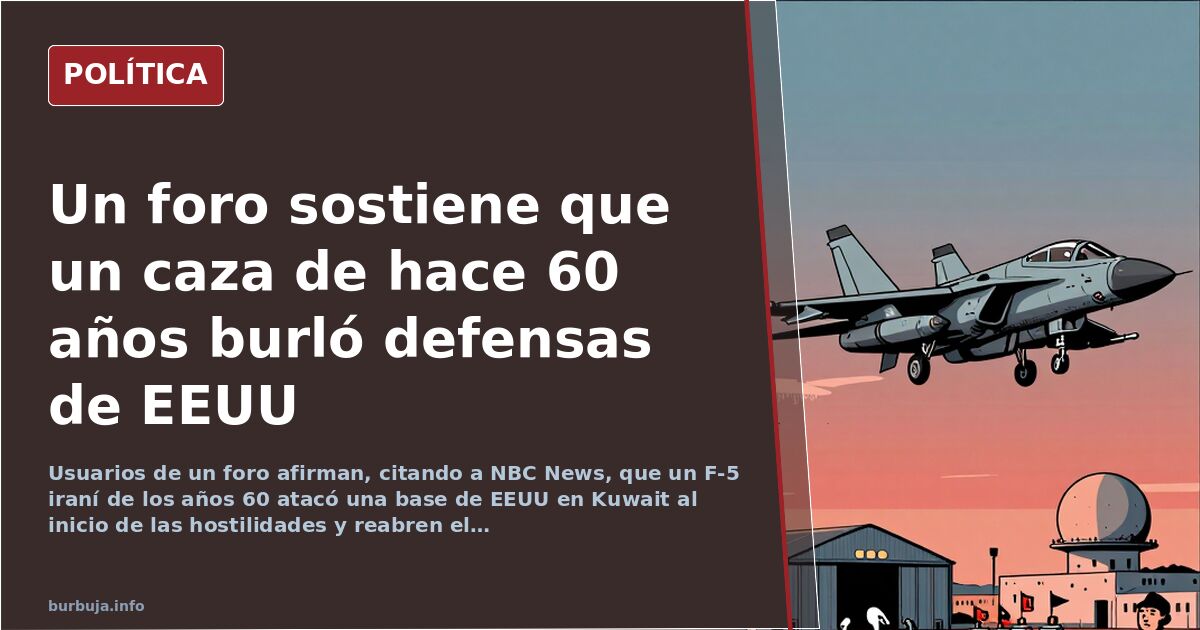
1960s Iranian F-5 Allegedly Struck US Base in Kuwait
An aircraft designed in the 1950s and 60s, the F-5 Freedom Fighter, reportedly flew at treetop level, evaded air defense systems, and struck a US base in Kuwait at the very start of hostilities, according to forum participants citing NBC News. For these users, what was sold as a military stroll has become an embarrassing episode for the Pentagon. According to these claims, the attack was not a late strike or a desperate last-minute act: it occurred in the early stages of the conflict, when Western air superiority was taken for granted.
The plane, according to contributors, is no technological marvel. It is a third-generation aircraft, cheap, simple, and conceived for sale to air forces with tight budgets. Precisely for that reason, the contrast is devastating in their opinion: a Seat Panda with wings —the comparison that sums up their anger— piercing the most expensive defensive umbrella on the planet.
What is said about the attack on the Kuwait base
According to debate participants, the attack occurred at the start of hostilities, not after drones and missiles had degraded defenses. That detail would completely change the reading of the episode. If the F-5 entered when everything was intact, the failure would not be one of saturation or ammunition depletion: it would be of doctrine, procedure, and overconfidence.
The figures mentioned in the thread —six casualties and significant material damage— are modest in absolute terms. The real damage, according to these users, is fruta. A plane from six decades ago, without modern radar or cutting-edge electronic countermeasures, allegedly placed its bombs where it wanted and left. The question hovering over the debate is uncomfortable: if an F-5 can do this, what wouldn't an adversary with real means do?
The F-5, a third-generation fighter sold by the US to half the world
The F-5 was designed as a cheap air superiority fighter. It reached speeds above Mach 1.5, was agile at low altitude, and required little maintenance. The US exported it massively, and it remains in service today in several countries, including Spain, where the modernized F-5M version is used for training in Wing 23 (Ala 23). The Air Force website does not specify how many units remain operational.
That is the point that hurts contributors the most. It is not a secret prototype or an exotic weapon: it is an aircraft that any second-tier air force can keep flying. In their view, what failed was not the Iranian machine, but the system meant to stop it.
The F-35 and the military-industrial complex: eternal and expensive projects
The episode has peine, according to users, criticism of the Western acquisition model. The F-35 is the recurring example: a program aiming for a single aircraft to do everything —air superiority, attack, reconnaissance, electronic warfare— accumulating delays, cost overruns, and software failures. Some argue in the thread that half the fleet is unavailable due to electronic breakdowns and maintenance issues.
The underlying argument they raise is simple: a cheap, proven fighter with its own supply chain is more interesting than a very expensive system dependent on third parties. A factor considered decisive in the debate is added: the absence of a remote kill switch. According to these users, an F-35 can be disabled from Washington with a key; an F-5 cannot. That dependency would turn the buyer into a hostage.
The Pentagon Wars, the film depicting how a simple armored vehicle ended up becoming a money pit, has been brought up as a mirror of the process. Projects drag on, commissions circulate, officers who do not comply are not promoted, and the final product arrives with defects corrected in later versions, each with its new budget.
The Falklands precedent and doctrine over hardware
It is not the first time, according to participants, that an outdated weapon humiliates a modern fleet. In the Falklands War, Argentine A-4 Skyhawks, from the 1950s, caused severe damage to British ships full of radars and electronics. The Argentines came close to tipping the conflict, and only the interruption of Exocet missile supplies by France —with London pressing— tilted the balance.
The Kosovo case points in the same direction: Yugoslavia executed similar actions against Tuzla and Rinas with an abyssal difference in means. The repeated conclusion is that doctrine weighs as much or more than hardware. A trained pilot, with low-level flight and study of the terrain, can compensate for overwhelming technological disadvantage. It was a Fernando Alonso driving a Seat 600 and getting on the podium.
Real cost: purchasing power, not nominal figures
The debate drifted toward the cost of living and purchasing power. Comparing a salary of 22,000 euros in Spain with one of 5,000 in another country without adjusting for purchasing power parity is an exercise in statistical illusion, according to users. One must see what shopping basket can be paid for with each amount, and there housing makes the difference: in Spain, housing prices work against you.
The discussion on military spending trinc the same logic for contributors. Very expensive programs are not justified by their effectiveness, but by the interest structure that sustains them. The taxpayer pays the bill for a system designed to extract resources, not to win wars.
The disorienting data remains, according to users: a plane that the US sold cheaply to half the world, which Spain still uses to train pilots, allegedly breached the defenses of a US base and returned home. Billion-dollar projects did not prevent, in their account, a Seat Panda with wings from parking wherever it wanted.
An aircraft designed in the 1950s and 60s, the F-5 Freedom Fighter, reportedly flew at treetop level, evaded air defense systems, and struck a US base in Kuwait at the very start of hostilities, according to forum participants citing NBC News. For these users, what was sold as a military stroll has become an embarrassing episode for the Pentagon. According to these claims, the attack was not a late strike or a desperate last-minute act: it occurred in the early stages of the conflict, when Western air superiority was taken for granted.
The plane, according to contributors, is no technological marvel. It is a third-generation aircraft, cheap, simple, and conceived for sale to air forces with tight budgets. Precisely for that reason, the contrast is devastating in their opinion: a Seat Panda with wings —the comparison that sums up their anger— piercing the most expensive defensive umbrella on the planet.
What is said about the attack on the Kuwait base
According to debate participants, the attack occurred at the start of hostilities, not after drones and missiles had degraded defenses. That detail would completely change the reading of the episode. If the F-5 entered when everything was intact, the failure would not be one of saturation or ammunition depletion: it would be of doctrine, procedure, and overconfidence.
The figures mentioned in the thread —six casualties and significant material damage— are modest in absolute terms. The real damage, according to these users, is fruta. A plane from six decades ago, without modern radar or cutting-edge electronic countermeasures, allegedly placed its bombs where it wanted and left. The question hovering over the debate is uncomfortable: if an F-5 can do this, what wouldn't an adversary with real means do?
The F-5, a third-generation fighter sold by the US to half the world
The F-5 was designed as a cheap air superiority fighter. It reached speeds above Mach 1.5, was agile at low altitude, and required little maintenance. The US exported it massively, and it remains in service today in several countries, including Spain, where the modernized F-5M version is used for training in Wing 23 (Ala 23). The Air Force website does not specify how many units remain operational.
That is the point that hurts contributors the most. It is not a secret prototype or an exotic weapon: it is an aircraft that any second-tier air force can keep flying. In their view, what failed was not the Iranian machine, but the system meant to stop it.
The F-35 and the military-industrial complex: eternal and expensive projects
The episode has peine, according to users, criticism of the Western acquisition model. The F-35 is the recurring example: a program aiming for a single aircraft to do everything —air superiority, attack, reconnaissance, electronic warfare— accumulating delays, cost overruns, and software failures. Some argue in the thread that half the fleet is unavailable due to electronic breakdowns and maintenance issues.
The underlying argument they raise is simple: a cheap, proven fighter with its own supply chain is more interesting than a very expensive system dependent on third parties. A factor considered decisive in the debate is added: the absence of a remote kill switch. According to these users, an F-35 can be disabled from Washington with a key; an F-5 cannot. That dependency would turn the buyer into a hostage.
The Pentagon Wars, the film depicting how a simple armored vehicle ended up becoming a money pit, has been brought up as a mirror of the process. Projects drag on, commissions circulate, officers who do not comply are not promoted, and the final product arrives with defects corrected in later versions, each with its new budget.
The Falklands precedent and doctrine over hardware
It is not the first time, according to participants, that an outdated weapon humiliates a modern fleet. In the Falklands War, Argentine A-4 Skyhawks, from the 1950s, caused severe damage to British ships full of radars and electronics. The Argentines came close to tipping the conflict, and only the interruption of Exocet missile supplies by France —with London pressing— tilted the balance.
The Kosovo case points in the same direction: Yugoslavia executed similar actions against Tuzla and Rinas with an abyssal difference in means. The repeated conclusion is that doctrine weighs as much or more than hardware. A trained pilot, with low-level flight and study of the terrain, can compensate for overwhelming technological disadvantage. It was a Fernando Alonso driving a Seat 600 and getting on the podium.
Real cost: purchasing power, not nominal figures
The debate drifted toward the cost of living and purchasing power. Comparing a salary of 22,000 euros in Spain with one of 5,000 in another country without adjusting for purchasing power parity is an exercise in statistical illusion, according to users. One must see what shopping basket can be paid for with each amount, and there housing makes the difference: in Spain, housing prices work against you.
The discussion on military spending trinc the same logic for contributors. Very expensive programs are not justified by their effectiveness, but by the interest structure that sustains them. The taxpayer pays the bill for a system designed to extract resources, not to win wars.
The disorienting data remains, according to users: a plane that the US sold cheaply to half the world, which Spain still uses to train pilots, allegedly breached the defenses of a US base and returned home. Billion-dollar projects did not prevent, in their account, a Seat Panda with wings from parking wherever it wanted.
Also available in: Deutsch
Summary of a discussion on Burbuja.info - Foro de economía, actualidad y política., translated from Spanish and reviewed before publication. Read the full discussion (134 replies).
More summaries
-
Spain should become the 51st US state, some argue
The idea of Spain becoming the 51st US state arises from perceived political and economic instability, seeking external protection against internal divisions.
-
In 1960, 13% of Spain's university students were women; in the US, 38%
In 1960, 13% of Spain's university students were women, compared with 38% in the US. The figure reopens the debate about women under Franco.
-
Satire Claims Ayuso Hears 7,291 Ghost Voices, Seeks Iker Jiménez
A satirical story attributes 7,291 paranormal voices and six years of insomnia to Madrid's Isabel Díaz Ayuso, leading her to consult TV presenter Iker Jiménez.
-
Spain's Princess Leonor: Privacy vs. Public Cost Debate
Photos of Spain's Princess Leonor in Chile reignite debate on Crown costs and privacy, with a police complaint filed.
-
Myth of Spanish army promotions driven by left-wing ideology
A forum user claims friends are promoted for ideology, but data on Spain's military rank structure disproves the narrative.
-
Swiss Vote Rejects Immigration Limits Amid Demographic Shift
Over a third of Swiss citizens have foreign ancestry. A restrictive migration measure received only 45% support, sparking debate on demographic realism versus political surrender.