
Iran summons French ambassador over crackdown on students
Iran has summoned the French ambassador over the crackdown on students: Tehran cites more than 5,000 arrests and cases of protesters losing their eyesight.
English · Original discussion in Spanish · Published
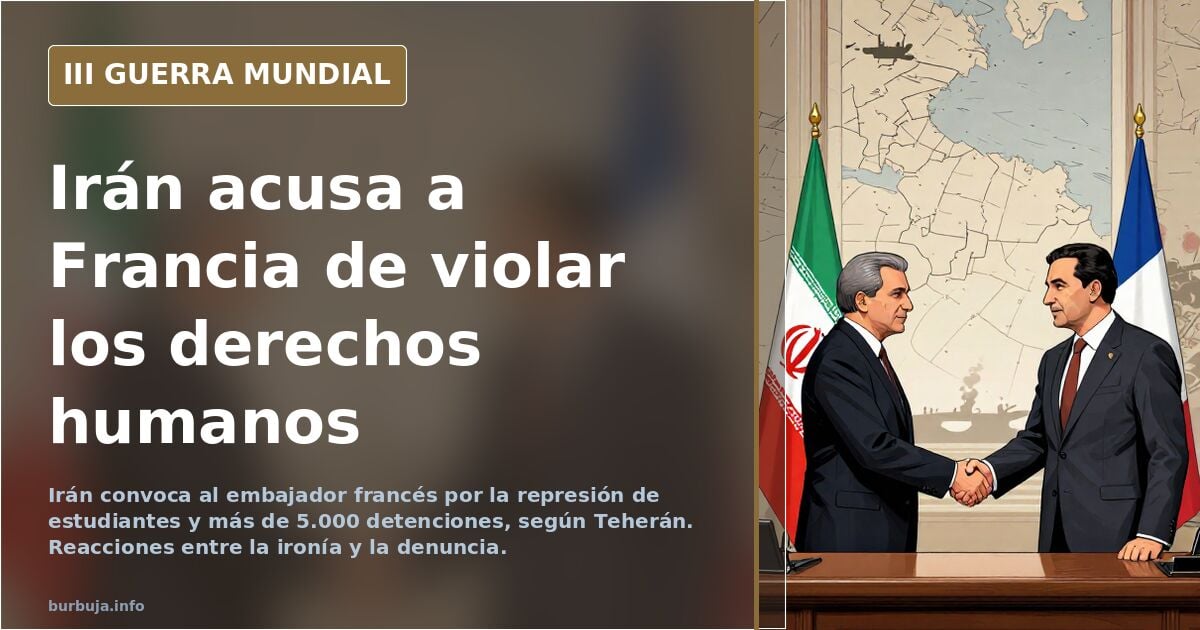
Iran summons France over the crackdown on students
Iran has summoned the French ambassador to Tehran, Pierre Cochard, to protest against the French government's handling of the student protests. Iran's Foreign Ministry denounces serious human rights abusa, with more than 5,000 arrests and protesters who allegedly lost their eyesight. The news, published on October 6, 2026, has triggered a wave of reactions mixing irony with accusations of international hypocrisy.
What peine, and why does Iran feel entitled to lecture others?
The head of the Human Rights Directorate at Iran's Foreign Ministry, Hamid Ahmadi, reminded France of its international obligations and demanded respect for the right to peaceful assembly. According to Tehran, French security forces have entered classrooms and assaulted students and teachers. The number of arrests exceeds 5,000, and there are cases of protesters losing their eyesight. Summoning an ambassador is an unusual gesture between Western countries and a theocracy that is itself routinely accused of the same offenses.
The reaction on social media was swift. Some see it as simple diplomatic trolling: "what a bunch of cheeky Iranians," one comment sums up the astonishment. Others, however, interpret it as a strict application of the principle of consistency: if Iran is criticized for its internal repression, it can also point to that of others. The discussion quickly turns to France's colonial record, with mentions of Algeria and the handing over of Jewish citizens during the Nancy occupation, claims that some participants stand by. They are not new facts, but they help fuel the crossfire.
The debate over hypocrisy and double standards
At its core lies an uncomfortable question: can an authoritarian regime lecture anyone on human rights? The most common answer is no, but that does not automatically invalidate the criticism. The conversation shifts to the double standards of Western powers, which sanction some and tolerate others. France, with its colonial past and its role in recent conflicts, emerges as an easy target. Iran, meanwhile, uses the episode as a tool of foreign propaganda, well aware that its own record is under scrutiny.
The figure of 5,000 arrests is the most frequently cited statistic. Injuries and disabilities are also mentioned, including loss of eyesight. If confirmed, these figures would place the French crackdown at a level typical of the regimes Paris usually criticizes. The report does not specify the number of injured or the exact date of the incidents, but the timeframe (October 2026) coincides with an alleged rise in social unrest in France.
Mixed reactions: from sarcasm to condemnation
Opinions are divided. One camp celebrates Iran's move as a way of exposing Western hypocrisy. Another points out that Iran executes dissidents and represses protests with equal or greater brutality, making the summons pure cynicism. The discussion also touches on the role of the media: some note that the story would have no traction if it were not for the spectacle of a theocratic regime accusing a European democracy.
The French ambassador, Pierre Cochard, has made no public statements recorded in the material. There is no official response from Paris either. The conversation therefore remains in the realm of speculation about what France will do: will it ignore the summons, respond forcefully, or use it as an opportunity to criticize Iran? Nobody knows.
Does it serve any purpose for Iran to denounce repression in France while silencing its own? The question hangs in the air, with no easy answer.
Also available in: Deutsch
Summary of a discussion on Burbuja.info - Foro de economía, actualidad y política., translated from Spanish and reviewed before publication. Read the full discussion (19 replies).
More summaries
-
Algeria vs France: Conventional War Yes, Occupation No
Analysis suggests France could defeat the Algerian army but fail to control a nation of 43 million people facing guerrilla warfare and internal unrest.
-
Hamas Confirms Leader Ismail Haniyeh’s Death in Tehran
Hamas confirms leader Ismail Haniyeh was killed in a Tehran attack attributed to Israel during his official visit.
-
Viral video: Marandi challenges Sky News Iran narrative
Seyed Mohammad Marandi questions Western arguments on Iran and Israel in a viral Sky News interview, sparking debate.
-
Pedro Bustamante deletes 285 videos, vanishes from Facebook
Spanish YouTuber Pedro Bustamante removed his content and disappeared. Rumors place him in Munich, reading German press.
-
Pakistan deploys troops and Chinese JF-17 jets in Saudi Arabia
Pakistan is deploying 13,000 soldiers and Chinese-made JF-17 fighter jets to Saudi Arabia. The goal: protecting Riyadh from attacks launched from its territory in exchange for $5 billion.
-
Russia's narrative cracks: is society starting to accept defeat in Ukraine?
A Russian blogger claims that Russian society is beginning to accept that Ukraine will restore its 1991 borders. The reactions have divided analysts.