
Iran Displays Nuclear-Capable Missiles Amid Bomb Debate
Iran unveils missiles capable of carrying nuclear warheads, sparking debate over whether it possesses the bomb despite no confirmed detonation.
English · Original discussion in Spanish · Published
Iran Displays Nuclear-Capable Missiles Amid Bomb Debate
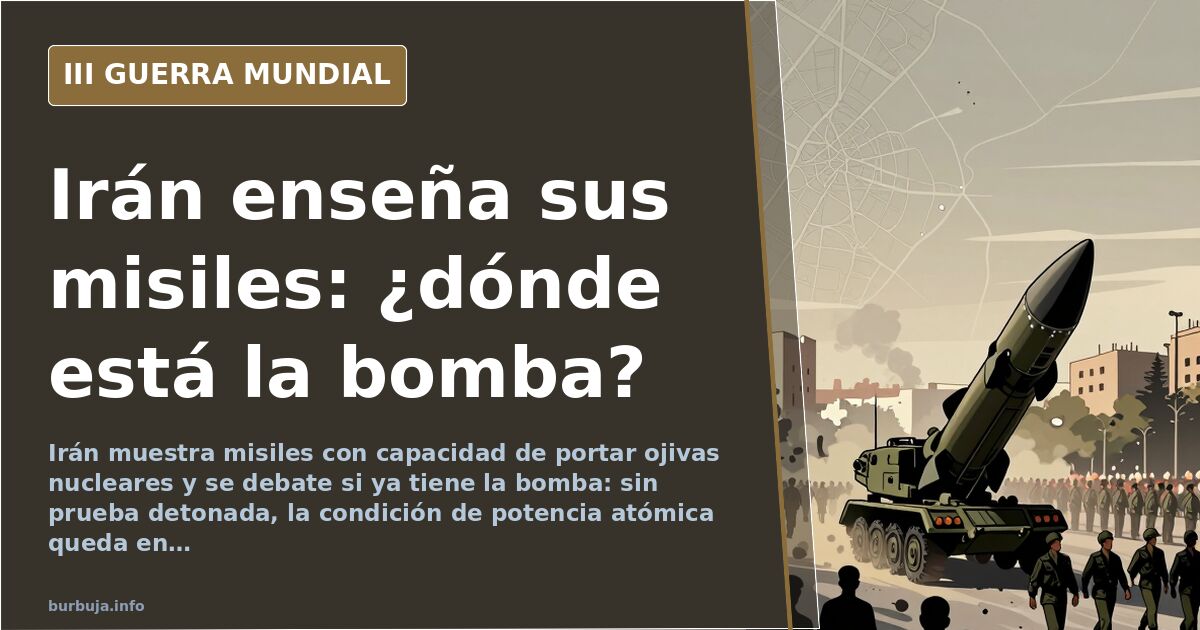
Iran has publicly unveiled missiles capable of carrying nuclear warheads, a move widely interpreted as an ultimatum. However, displaying delivery systems does not equate to possessing an operational weapon; the gap between a missile and a functional device remains unbridged by imagery alone. The announcement trinc a prediction attributed to Trump that Tehran could acquire nuclear arms within sixty days, raising a critical question: where is the proof?
What Iran Showed and What It Did Not
The distinction is crucial. A missile capable of delivering a warhead is not a warhead itself. Possessing the vector does not prove possession of the payload, and exhibiting the former without detonating the latter leaves the equation unresolved. This ambiguity fuels skepticism: until a test explosion occurs, Iran’s status as a nuclear power remains uncertain.
Enriched material is another key factor. Some argue Iran already holds sufficient enriched uranium to build its first device. This would place the country one technical step away from the bomb, though that step has not been taken publicly. The difference between being able to manufacture a weapon and having manufactured one separates a credible threat from a fait accompli.
Why Is a Nuclear Test Demanded?
According to prevailing analyses, a low-yield underground detonation would suffice to lend credibility to any declaration. Three or four kilotons would be enough for the region to reassess the situation. Without such a demonstration, threats remain rhetorical.
The dilemma is that a test reveals what is currently unknown: the location of facilities. If the program has survived thus far, it is because its whereabouts are hidden or unreachable at depth. Detonating provides coordinates. Hence the paradox: the test that grants credibility also hands over the map.
Deterrent Effect and Its Limits
Strategically, some analysts argue that a country without nuclear capability cannot act independently. Perceived aggression from the United States, Israel, and NATO turns the bomb into a survival insurance for states seeking sovereignty, a path North Korea has already trinc.
Conversely, an uncomfortable argument weighs against this: Iran is Shia and lacks regional backing. This reduces maneuverability and increases the risk of intervention before the program consolidates. The sixty-day window mentioned is not a technical deadline but a warning.
Who Gains and Who Loses from the Announcement
The announcement reshapes the geopolitical board. If Iran solidifies its nuclear status, it may integrate into a commercial axis with Russia and China, accelerating economic development. Washington worries more about this scenario than the warhead itself: a sanctioned state proving sanctions ineffective becomes a model for others.
The other side involves immediate risk. The region is volatile, and consequences would not stay contained. No one knows if the next step will be detonation, negotiation, or worse. The only certainty is that the missile display has already changed the tone of the conversation.
Also available in: Deutsch
Summary of a discussion on Burbuja.info - Foro de economía, actualidad y política., translated from Spanish and reviewed before publication. Read the full discussion (104 replies).
More summaries
-
Iran: US and Israel’s Preventive Strike and Return of Military Service
Iran, home to 90 million people, faces a joint preventive strike by Israel and the US. Washington considers reinstating the draft, while the WHO warns of nuclear risks.
-
Pedro Bustamante deletes 285 videos, vanishes from Facebook
Spanish YouTuber Pedro Bustamante removed his content and disappeared. Rumors place him in Munich, reading German press.
-
CIA's Failed Ukraine Infiltration: All Agents Lost
Project AERODYNAMIC dropped 12 agents in Western Ukraine from 1949 to 1953. Soviet forces captured or killed all but one.
-
Georgian Legion and Video of Russian POW Executions
Verified video shows Ukrainian soldiers killing wounded Russian prisoners near Bucha, sparking debate on Geneva Conventions.
-
Florida Crash: Local Official's Road Repair Comment Sparks Outrage
After a jet crash in Florida killed nine people, a local Democratic official focused on road repair timelines, triggering public backlash.
-
Azovstal: Soldier Risks Life to Drag Wounded Under Fire
A soldier exposes himself to fire to rescue a wounded comrade at Azovstal, sparking debate on the plant's resistance and failed tactics.