
iPhone 11 sells out at €540 despite lacking 5G
An iPhone 11 with no 5G and a 60Hz screen sold out in two hours for €540. The gap between price, specs, and brand loyalty.
English · Original discussion in Spanish · Published
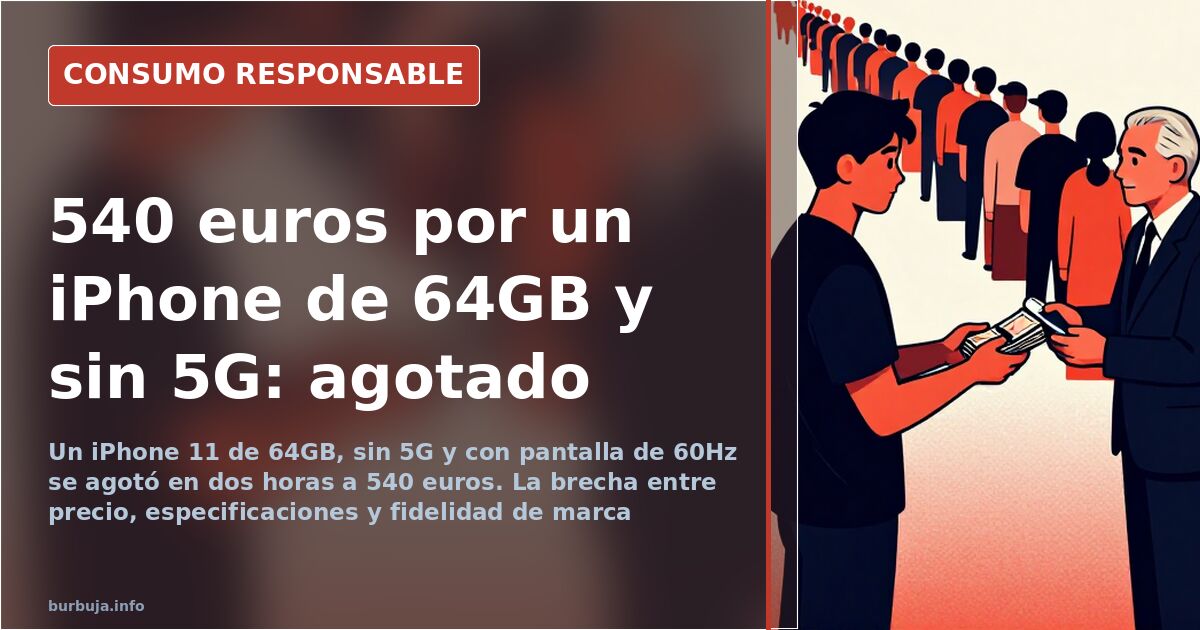
iPhone 11 with 64GB and no 5G sells out in two hours for €540
A two-generation-old iPhone. Sixty-four gigabytes, 60Hz screen, no 5G. Price: €540. Two hours after going on sale, according to the post that started the discussion, not a single unit was left. The figure stings because, as the same post repeatedly notes, you can get new devices with Dolby Vision and Dolby Atmos for €350. And yet, here is the data point: a phone two years behind technically sold out in 120 minutes.
That contradiction — high-end price, mid-range specifications, instant demand — runs through the entire conversation. The underlying issue isn't the iPhone 11. It's what you're actually paying for when you buy an iPhone.
What do you get for €540 on a 64GB iPhone 11?
The list of grievances is specific. It's not Full HD. No 5G. Refresh rate stays at 60Hz. And the storage, 64GB, feels short for a device aiming to last years. Against this, the repeated comparison: there are phones for €350 with Dolby Vision and Dolby Atmos, and devices for €100 that, some critics argue, do the basics just as well.
Here two ways of reading the market clash. One looks at the spec sheet and concludes that paying €540 for that is absurd. The other responds that leading with the spec sheet means missing the point entirely: you don't buy a phone for hertz, but for durability. At times things get heated: buyers are accused of being hostages to a brand and failing to see better-equipped alternatives.
Durability vs. obsolescence: the argument backing the purchase
Here the defense of the iPhone becomes empirical. Some claim to have owned a 4s, a 6, and an X, all bought second-hand for less than half their launch price, and all lasting six years or more. Another cited case: a 2016 iPhone SE still working with all updates after a €16 battery swap. The pattern repeats: longevity as justification for the initial premium.
The counterargument arrives via two routes. First, endurance isn't exclusive to Apple: a first-gen Motorola Moto G, bought for €179 nearly eight years ago, is still operational; a Huawei costing €145 has lasted four years; a Xiaomi at €300, three; a Samsung survived five years with three €20 battery swaps. The second route is more uncomfortable: why would someone want a phone that lasts six years if it's outdated by year three? Replacing it for pleasure, while it still works, is legitimate for those who can afford it.
Mask unlock and suspicions about the Apple Watch
The conversation jumps from household economics to security. iOS 14.5 enabled unlocking the iPhone without removing a mask, but only if an Apple Watch is nearby. The mechanism requires setting up a passcode on the watch and keeping it paired. The news headline, published by a tech outlet, promised exactly that: unlocking the iPhone with a mask thanks to the watch.
The detail slipped in later is what lights the fuse: it is claimed that anyone wearing a mask can access the phone if near its owner or an already unlocked watch. This is an assertion circulating without independent verification and should be treated as such — a suspicion raised in the heat of debate — not as a documented vulnerability. Still, it served to shift criticism from specifications to the closed ecosystem.
Is it status signaling or rational consumption?
The most repeated thesis is that the iPhone isn't bought for what it does, but for what it communicates. Some summarize it bluntly: "It's bought as a status symbol so people see you with it and infer your purchasing power." The brand functions as a status marker, and its clientele pays for visibility, not performance.
The response from the other side is that the second-hand market disproves pure status signaling. If the iPhone were only a symbol, there wouldn't be such sustained demand for models from four generations back. And there's a data point that bothers both camps: refurbished units sell at prices that remain high, suggesting that resale value — not just image — sustains the purchase.
What the resale price reveals
An iPhone X bought for €300 two months ago. Another for €400. An iPhone 12 freshly acquired as a gift. And, in parallel, Android phones doing the same for half the price. One of the harshest readings of the thread argues that the iPhone has become a product many buy second-hand because it's the only expensive thing they can afford used.
A two-generation-old iPhone. Sixty-four gigabytes, 60Hz screen, no 5G. Price: €540. Two hours after going on sale, according to the post that started the discussion, not a single unit was left. The figure stings because, as the same post repeatedly notes, you can get new devices with Dolby Vision and Dolby Atmos for €350. And yet, here is the data point: a phone two years behind technically sold out in 120 minutes.
That contradiction — high-end price, mid-range specifications, instant demand — runs through the entire conversation. The underlying issue isn't the iPhone 11. It's what you're actually paying for when you buy an iPhone.
What do you get for €540 on a 64GB iPhone 11?
The list of grievances is specific. It's not Full HD. No 5G. Refresh rate stays at 60Hz. And the storage, 64GB, feels short for a device aiming to last years. Against this, the repeated comparison: there are phones for €350 with Dolby Vision and Dolby Atmos, and devices for €100 that, some critics argue, do the basics just as well.
Here two ways of reading the market clash. One looks at the spec sheet and concludes that paying €540 for that is absurd. The other responds that leading with the spec sheet means missing the point entirely: you don't buy a phone for hertz, but for durability. At times things get heated: buyers are accused of being hostages to a brand and failing to see better-equipped alternatives.
Durability vs. obsolescence: the argument backing the purchase
Here the defense of the iPhone becomes empirical. Some claim to have owned a 4s, a 6, and an X, all bought second-hand for less than half their launch price, and all lasting six years or more. Another cited case: a 2016 iPhone SE still working with all updates after a €16 battery swap. The pattern repeats: longevity as justification for the initial premium.
The counterargument arrives via two routes. First, endurance isn't exclusive to Apple: a first-gen Motorola Moto G, bought for €179 nearly eight years ago, is still operational; a Huawei costing €145 has lasted four years; a Xiaomi at €300, three; a Samsung survived five years with three €20 battery swaps. The second route is more uncomfortable: why would someone want a phone that lasts six years if it's outdated by year three? Replacing it for pleasure, while it still works, is legitimate for those who can afford it.
Mask unlock and suspicions about the Apple Watch
The conversation jumps from household economics to security. iOS 14.5 enabled unlocking the iPhone without removing a mask, but only if an Apple Watch is nearby. The mechanism requires setting up a passcode on the watch and keeping it paired. The news headline, published by a tech outlet, promised exactly that: unlocking the iPhone with a mask thanks to the watch.
The detail slipped in later is what lights the fuse: it is claimed that anyone wearing a mask can access the phone if near its owner or an already unlocked watch. This is an assertion circulating without independent verification and should be treated as such — a suspicion raised in the heat of debate — not as a documented vulnerability. Still, it served to shift criticism from specifications to the closed ecosystem.
Is it status signaling or rational consumption?
The most repeated thesis is that the iPhone isn't bought for what it does, but for what it communicates. Some summarize it bluntly: "It's bought as a status symbol so people see you with it and infer your purchasing power." The brand functions as a status marker, and its clientele pays for visibility, not performance.
The response from the other side is that the second-hand market disproves pure status signaling. If the iPhone were only a symbol, there wouldn't be such sustained demand for models from four generations back. And there's a data point that bothers both camps: refurbished units sell at prices that remain high, suggesting that resale value — not just image — sustains the purchase.
What the resale price reveals
An iPhone X bought for €300 two months ago. Another for €400. An iPhone 12 freshly acquired as a gift. And, in parallel, Android phones doing the same for half the price. One of the harshest readings of the thread argues that the iPhone has become a product many buy second-hand because it's the only expensive thing they can afford used.
Also available in: Deutsch
Summary of a discussion on Burbuja.info - Foro de economía, actualidad y política., translated from Spanish and reviewed before publication. Read the full discussion (121 replies).
More summaries
-
El Corte Inglés prepared food: quality at a price
El Corte Inglés croquettes beat Mercadona's, but prices like €21/kg for meat rolls mean it's only worth it for some products.
-
Alicante Horchata: Best Spots Without a Car
Horchatería Azul near Alicante's Central Market is the top car-free recommendation, amidst debates on Alboraya and Elche.
-
Dishwasher debate: time savings questioned, pots don't fit
Dishwashers save families 20 minutes daily but fail for singles due to capacity issues and incomplete loads.
-
Father in Spain Can't Afford Disney Summer for Daughters
A Spanish father shares his struggle to afford a summer holiday after his daughters return from Disney World, highlighting financial constraints and the value of time over money.
-
The Trend of Eyebrow Grooming Divides Men
Eyebrow grooming sparks debate: aesthetic enhancement or loss of masculinity? We analyze the trend changing men's looks.
-
Spain’s everyday drug use: From coffee to crystal meth
Coffee, alcohol and cannabis lead self-reported use in Spain, but crystal meth is emerging. A survey reveals what Spaniards consume versus what they hide.