
Investing in Georgia: Residency from €100k amid Russian pressure
Georgia offers residency for a €100,000 investment and tax-free zones, but faces risks from Russia and Abkhazia.
English · Original discussion in Spanish · Published
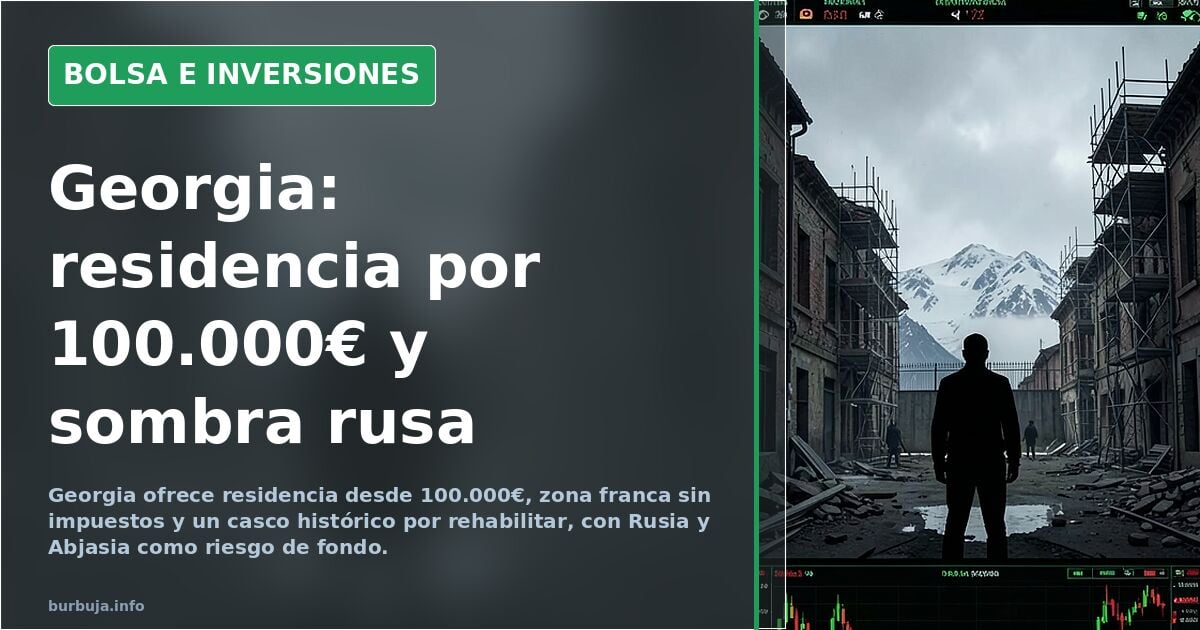
Georgia: Residency from €100,000 and a country still to be built
Can you invest in a country with two breakaway regions and a neighbor that just cut flights? Ten days in Georgia leave the answer half-formed, with key figures on the table: residency via real estate investment starting at €100,000, European flags on public buildings, and a historic center in ruins. The country proclaims its pro-European stance with convert's zeal. On the ground, it offers something more prosaic: tax incentives, new construction everywhere, and the admitted feeling of being in Spain during the 1980s.
How much does Georgian residency cost by investment?
The threshold is round: €100,000 in real estate investment unlocks the residence permit. This comes with an enthusiastically marketed fiscal catalog and a banking sector that, reportedly, does not share tax information with Spanish authorities and allows high card limits. In short: a convenient place to diversify funds, with the obvious warning that undeclared offshore assets eventually hurt domestically. For companies, the cited option is Tbilisi's free industrial zone, offering a 0% rate for new businesses.
Tourism and real estate: Batumi, Gudauri, and Tbilisi's old town
The visible engine is tourism. In Batumi, on the Black Sea coast, apartment projects sold as holiday products proliferate. In the Caucasus, the Gudauri ski resort is boosted by cranes, buildings, and billboards. In Tbilisi, the historic center is in shambles, which for a patient investor means hospitality with margin. A detail almost no one checks: since the car fleet isn't European-standard yet, nobody builds thinking about garages. A potential goldmine, so they say, in the capital and major cities.
The geopolitical brake: Abkhazia, South Ossetia, and the Russian tap
Here the cracks appear. Russia backs separatists in Abkhazia and South Ossetia, territories recognized by hardly any country. Moscow has canceled all flights to Georgia, and Russian tourism was significant: according to circulating estimates, three out of four million tourists were Russian. Yet Russia continues buying Georgian wine and mineral water, and Russian summer visitors are seen in the Caucasus. The southern border is friendlier: Armenia shares religion and alignment; Turkey shows no evident conflicts, and its citizens vacation in Batumi; Azerbaijan, a Muslim country hostile to Armenia over another region, also shows no friction. That balance is all the stability there is.
Does Georgia have an industrial sector to justify investment?
The hardest objection is textbook: investment is only in tourism, beaches, and services, and without industry, growth lacks support. The counter-argument uses domestic numbers: automotive contributes 11% of GDP and three million jobs in Spain, yet doesn't make it an intact industrial power. Georgia, with a trade agreement with the EU since 2014, plays in another league: financial and tech, according to medium-term observers. Darker warnings include corruption, the need for a local partner, and legal guarantees far from Frankfurt's standards. Those who invested in Eastern EU countries know the script.
In summary: a country wanting to join the Union, charging for residency, and not building garages. Everyone agrees everything is still to be done. Disagreement starts when calculating how long it takes to lose the €100,000.
Also available in: Deutsch
Summary of a discussion on Burbuja.info - Foro de economía, actualidad y política., translated from Spanish and reviewed before publication. Read the full discussion (40 replies).
More summaries
-
Stock Market Investing: 80% Lose Money While Brokers Profit
Data shows 80% of retail investors lose money, yet brokers charge fees regardless. This article explores the risks of trading versus long-term investing in Spain.
-
Sellas Life Sciences Oncology Drug: Hope and Skepticism
Investors debate Sellas Life Sciences' Phase 3 oncology candidate, weighing potential breakthroughs against clinical risks.
-
Invertir desde Cero course reviews: useful but basic
Students call the stock market course introductory, not advanced: one month of classes and a year of monthly sessions.
-
Silver ounce: 31.1 grams, but coins rarely match
A silver ounce is 31.10348 grams of fine metal, but physical coins weigh between 31.30 and 31.64 grams depending on the mint. The official thickness also doesn't match the…
-
Spain: Saver splits €70k, weighs next €40k
Spanish saver with €80k income invests €70k in Indexa and deposits, seeking advice on allocating the remaining €40k.
-
Spain's Treasury Bills: Unexpected Demand Surge Amid Debt Debate
Spanish Treasury bills shifted from negative to nearly 4% yields, triggering a demand boom. The debate centers on whether this is safe return or a debt trap.