
Internet enemies: myth, posturing or a filtering tool
The question of having enemies online splits people between those who hold no grudges and those who boast of a block list as a quality filter.
English · Original discussion in Spanish · Published
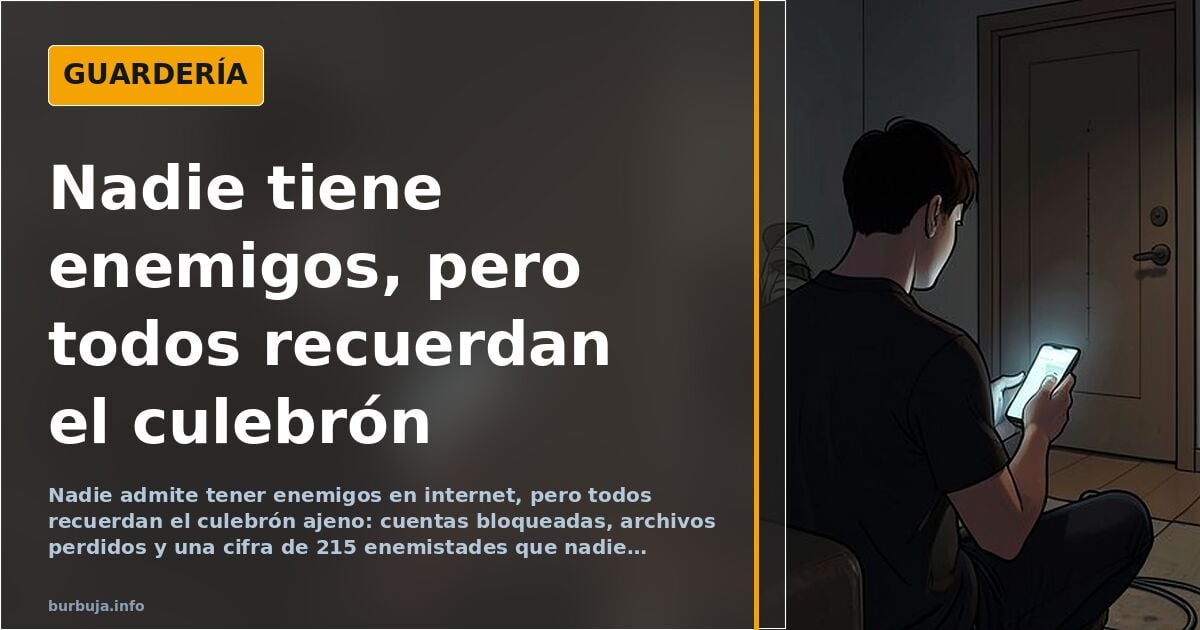
Digital enmity: between myth and filtering tool
Do you have enemies on the internet? The question, asked without anesthesia, divides the crowd into two irreconcilable camps: those who claim to hold no grudge against anyone, and those who admit to keeping a list, short but select. The conversation begins with a confession of skepticism — being angry is not the same as being an enemy, there is a gap — and drifts into an inventory of old rivalries that, like IKEA furniture, seemed eternal and ended up taken apart.
The memory of the feuds
There is a tacit consensus: the great enmities of the web have gradually faded. What once seemed like a huge deal — with its soap opera, its banned accounts and its lost archive — is now remembered as a silly affair that died out on its own. One of the protagonists of those clashes sums it up without drama: "That story ended a long time ago." The conclusion drawn is that digital enmity has an expiration date, and it almost always arrives sooner than expected.
The other camp, however, does not believe in reconciliation. Anyone who puts themselves out there has enemies, some argue, presenting it as a sign of good mental health. The logic is simple: if nobody argues with you, maybe nobody is reading you. The figure being tossed around, with no statistical rigor, hovers around two hundred people ignored by a single individual, which turns the block list into a kind of inverse résumé.
The ignore button as a quality filter
The star tool is not the insult, but silence. The ignore button is championed as a great invention: it filters out the hostile, keeps the affable people visible, and saves time and energy. Several participants admit to using it without shame and recommend the practice the way one recommends a diet. The result is a community à la carte, where everyone builds their own ecosystem of friendly voices.
There is no shortage of those who take the irony to the extreme and confess to having no enemies because they have no friends either. Solitude as a shield. And someone who, in an unexpected twist, warns that the real danger does not come from the front but from friends who stab you in the back. Distrust, in any case, is on the rise.
From enmity to spectacle
The matter has its entertainment side. The old rows are remembered like a cult film only the veterans have seen, and it is lamented that much of the footage has been lost to bans and deleted files. Some argue that certain characters are pillars of local mythology, even if they have changed their ways. Enmity, at heart, is shared memory.
The question left hanging is whether all this is a pose or a necessity. True mental health, some joke, consists of keeping your friends close and your enemies closer. Others, however, prefer the peace of the ignore button and simply not reading those who bring them nothing. In the end, the answer depends on whether you see the web as a debating salon or a battlefield.
Also available in: Deutsch
Summary of a discussion on Burbuja.info - Foro de economía, actualidad y política., translated from Spanish and reviewed before publication. Read the full discussion (35 replies).
More summaries
-
Mister Nini accused of covert prostitution in Spain
An anonymous profile called Mister Nini promised trips to Venice to 20-year-olds. He now faces accusations of prostitution and suspicions of being…
-
Mister Nini leaves Spain's Vox: expelled, spiteful, or bought off?
Mister Nini has left Vox after being removed from the governing board in Elda, Spain. Expulsion, spite, or a better financial offer? The keys to a controversial exit.
-
Mister Nini creator dies and a fan inherits the account
The creator of the Mister Nini comic has died. A follower has taken over its management. The yokel character is irrelevant in 2026. Should the series be renewed?
-
Photos of Spain's Ayuso in a swimsuit spark online frenzy
We analyze the thread about photos of Isabel Díaz Ayuso in a swimsuit that has generated debate and memes in the Guardería of Burbuja.info.
-
The Soviet flag did have a star: the Mandela effect puzzling millions
The USSR flag featured a five-pointed star, but many remember it the other way around. A Mandela effect affecting historical memory.
-
James Bond: three finalists in the running and Elordi out
Callum Turner, Jack Lowden and Jack O'Connell are doing screen tests to become James Bond in London; Jacob Elordi is out of the race.