
The Soviet flag did have a star: the Mandela effect puzzling millions
The USSR flag featured a five-pointed star, but many remember it the other way around. A Mandela effect affecting historical memory.
English · Original discussion in Spanish · Published
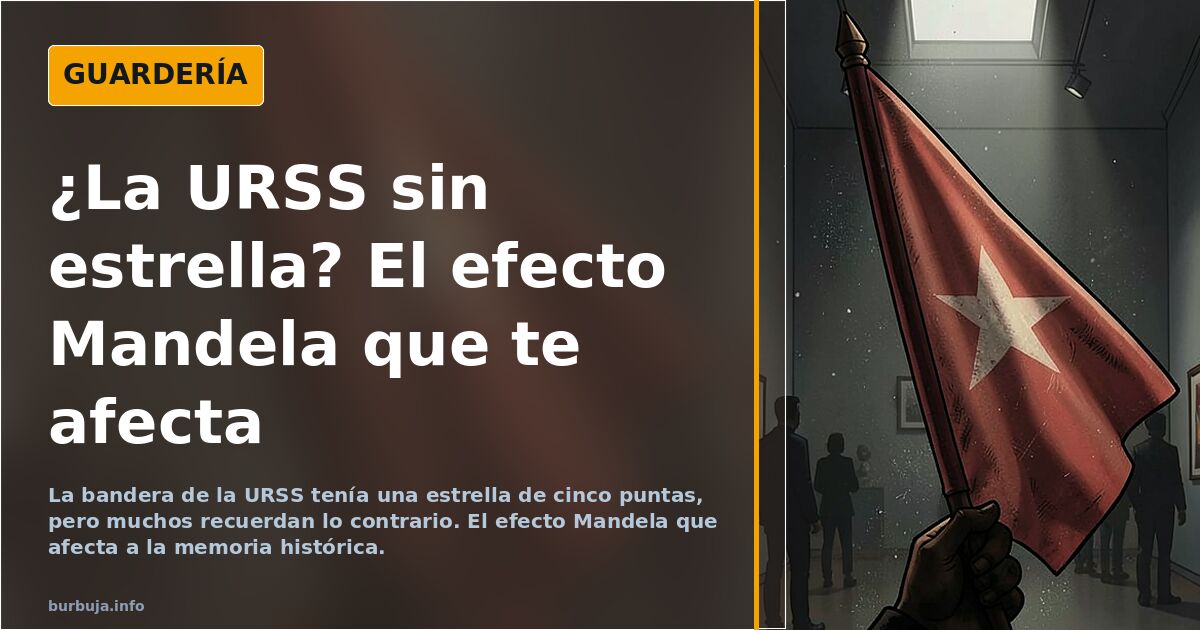
The Soviet flag did have a star: the Mandela effect puzzling millions
The flag of the Soviet Union bore a five-pointed star above the hammer and sickle. It is no small detail: the image of the red flag without the star has spread so widely that many would swear it was never there. It is the latest Mandela effect circulating online, and this time it affects a concrete historical symbol, not a movie or a childhood memory.
The official flag of the USSR, adopted in 1923 and modified in 1955, included a golden five-pointed star with a red border in the upper left corner, next to the hammer and sickle. The star represented the alliance of workers and peasants, and its presence was mandatory on all the flags of the Soviet republics. Yet in the collective memory of many, the Soviet flag appears without the star, just the hammer and sickle on a red background.
The Mandela effect and the Soviet flag
The phenomenon has become popular on forums and social media, where users of different ages claim to remember a USSR flag without a star. The confusion is no accident: the flag of the Communist Party of the Soviet Union (CPSU) was red with the hammer and sickle in the center, without a star. That image, simpler and repeated at political events, has become mixed up with the state flag, which did carry the star.
The USSR flag did have a five-pointed star, and its absence in the memory of many is an example of how visual memory is distorted by repeated exposure to simplified versions. The star was not decoration: it was part of the official symbolism and appeared in documents, maps and propaganda. Its disappearance from collective memory is a case of the Mandela effect, a phenomenon that occurs when a group of people shares a false memory of an event or object.
Why do so many remember the flag without the star?
The most plausible explanation is confusion with other flags. The flag of the Soviet Union had the star in the upper left corner, but in many low-quality or black-and-white reproductions, the star could go unnoticed. In addition, the CPSU flag, without a star, was more common at events and demonstrations, which reinforced the image of a red flag with only the hammer and sickle.
Another possibility is that the star was more strongly associated with the flag of the Russian Soviet Federative Socialist Republic (RSFSR), which also included it, or with other Soviet republic flags. The variety of designs and the mixing of symbols contributed to the collective memory simplifying the design.
The Mandela effect and historical memory
The Mandela effect is not a new phenomenon, but its popularity has grown with the internet. Cases like that of the USSR flag show how collective memory can fail and how simplified versions take over our recollections. The USSR flag with the star is the correct one, but the image without the star persists in the minds of many.
The star of the Soviet flag was a symbol of the unity of workers, and its absence in memory does not change history, but it does reveal how visual perception is built from partial exposures. The Mandela effect is a warning about the reliability of memory and the importance of checking sources.
The startling fact
The USSR flag with the star was used until 1991, and its design was regulated by law. The star was not optional: it appeared on all the official flags of the Soviet Union and its republics. Yet in the memory of many, the red flag without the star is the one that prevails. One more case of how visual history is rewritten in the collective mind.
Also available in: Deutsch
Summary of a discussion on Burbuja.info - Foro de economía, actualidad y política., translated from Spanish and reviewed before publication. Read the full discussion (16 replies).
More summaries
-
High-achieving students struggle to secure FPU research grants in Spain
Even with excellent grades, many top students in Spain fail to qualify for the FPU scholarship, leaving their academic futures uncertain.
-
AI-made Soviet horror video recreates 1950s USSR cinema
An analog horror video made with AI imitates Soviet cinema of the 1950s and 60s. The piece splits viewers between aesthetic homage and mockery of Stakhanovism.
-
García Márquez's spelling reform: the silent h, b/v and accents
In 1997 García Márquez proposed retiring the silent h, merging b and v and revising Spanish accents. The Real Academia Española rejected it, and Germany had already failed with its own reform.
-
Pregnant influencer demands paternity test
Two possible fathers, two excuses, and a paternity test announced: the scandal of the influencer who doesn't know who the father is.
-
Internet enemies: myth, posturing or a filtering tool
The question of having enemies online splits people between those who hold no grudges and those who boast of a block list as a quality filter.
-
James Bond: three finalists in the running and Elordi out
Callum Turner, Jack Lowden and Jack O'Connell are doing screen tests to become James Bond in London; Jacob Elordi is out of the race.