
Induction vs. Gas: The Kitchen Battle That Decides Your Bill
Gas costs €12 per canister, while induction wins on cleanliness and safety. This tech rivalry shapes household bills and cooking results.
English · Original discussion in Spanish · Published
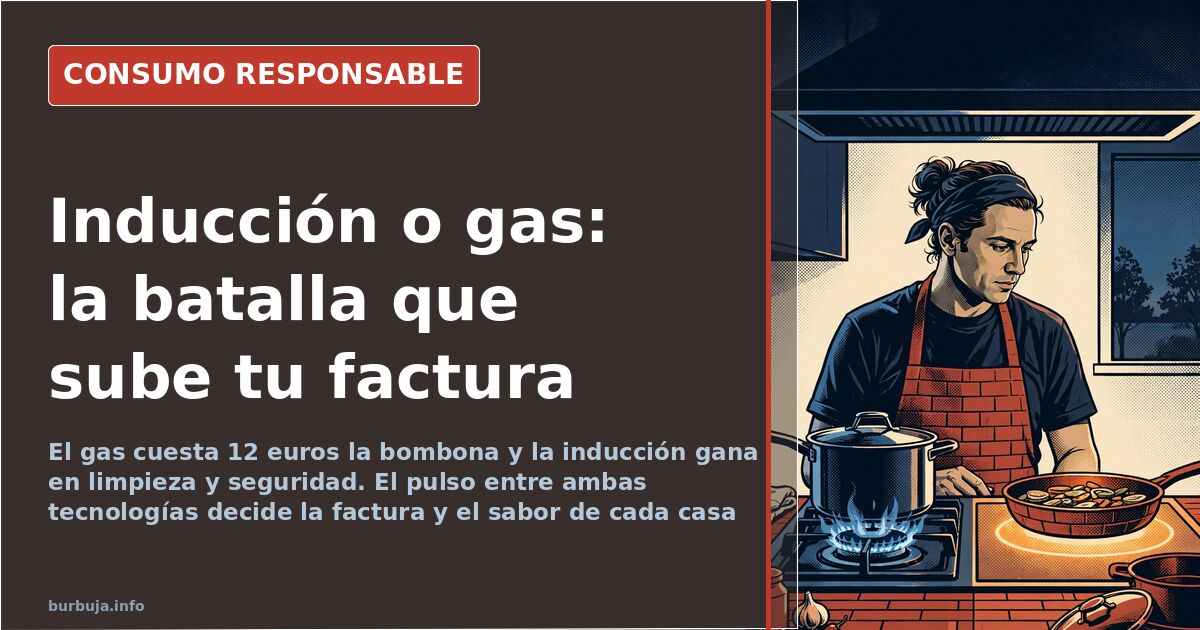
Induction or Gas: The Fight Over Your Electricity Bill
The starting point is a claim that irritates half of Spanish kitchens: gas is the most economical option, but it ruins pans if you don't know how to use it. Since then, 153 replies and nearly six years of debate —the thread is 2,189 days old— have turned a domestic choice into a clash between health, price, and flavor. No one agrees. And those who do agree, insult each other.
The Real Cost of Cooking with Gas or Induction
The economic argument generates the most numbers. A butane canister costs just over €12, and users argue that monthly spending barely differs from ceramic hobs: the gap in bills stays at €5 or €6 per month. In contrast, the electric camp points out that contracted power is paid for even during holidays. A calculation circulating in the discussion sets the fixed cost of natural gas at €4 per month for stove, oven, and hot water, leaving electrical power at €20 in the cheapest month if adjusted to 2,200 watts. The conclusion of this breakdown —which, multiplied by 25 years, hurts— is exactly the type of math every household does its own way.
Some go further, arguing that natural gas is a rip-off and that the real alternative is oak firewood in an economy stove, capable of heating 30 square meters while you cook. It's not a joke: owners assure that food tastes better and that, compared to it, a ceramic hob is vulgar.
Flavor: Why Stews Don't Taste the Same on Induction
Here the debate becomes almost philosophical. The traditional view holds that fire provides something no electrical resistance replicates: thermal gradients and temperature peaks in specific zones that generate rapid convection, whereas the uniform heat of induction moves only by conduction. Hence, they say, a stew made over fire doesn't taste like one made on a hob. Professionals are clear: restaurant kitchens use gas because it's more adjustable and allows flambéing.
The rebuttal comes with a thought experiment that dismantles half the argument: if flavor depended on heat rather than smoke, we'd need a blind tasting. No one has done it. And when the combustion element doesn't touch the food —a pot in between—, fire only adds heat, just like a resistor.
The Radiation Accusation: What Physics Says vs. Exaggerations
The roughest part of the issue is health-related. Part of the discussion claims induction is an open-air microwave and that a radiation detector next to the hob would cause alarm. The technical response is blunt: induction generates a magnetic field, does not emit microwaves, and being non-ionizing radiation cannot alter cell structure. Those defending this stance recall that mobile phones and Wi-Fi coexist with us without proven incidents.
The health counter-punch targets gas: burning petroleum derivatives releases carcinogenic substances breathed year after year. Here the debate gets bogged down between those asking for references and those responding with bioelectromagnetism books. The only home test proposed —boiling water with each technology, letting it cool, and germinating seeds— hasn't been completed by anyone.
Pans, Cleaning, and Safety: Verifiable Arguments
On tangible matters, there is more agreement. Induction is cleaner, safer against leaks and burns, and programmable. Gas, however, requires monitoring the canister if it's butane and wears out utensils more. But here appears the nuance that confuses: some argue the problem isn't gas but Teflon and cheap aluminum, claiming two titanium pans costing nearly €100 have lasted eight years like new. The opposing answer is equally concrete: pans that don't stick, clean themselves, and cost €2.40 for the small one and €6.70 for the large one.
With these elements, the decision ultimately depends on whether you live in an apartment with limited power capacity or a house with space to stack firewood. The question no one fully answers: if gas is so cheap and induction so clean, why do we keep debating it every winter.
The starting point is a claim that irritates half of Spanish kitchens: gas is the most economical option, but it ruins pans if you don't know how to use it. Since then, 153 replies and nearly six years of debate —the thread is 2,189 days old— have turned a domestic choice into a clash between health, price, and flavor. No one agrees. And those who do agree, insult each other.
The Real Cost of Cooking with Gas or Induction
The economic argument generates the most numbers. A butane canister costs just over €12, and users argue that monthly spending barely differs from ceramic hobs: the gap in bills stays at €5 or €6 per month. In contrast, the electric camp points out that contracted power is paid for even during holidays. A calculation circulating in the discussion sets the fixed cost of natural gas at €4 per month for stove, oven, and hot water, leaving electrical power at €20 in the cheapest month if adjusted to 2,200 watts. The conclusion of this breakdown —which, multiplied by 25 years, hurts— is exactly the type of math every household does its own way.
Some go further, arguing that natural gas is a rip-off and that the real alternative is oak firewood in an economy stove, capable of heating 30 square meters while you cook. It's not a joke: owners assure that food tastes better and that, compared to it, a ceramic hob is vulgar.
Flavor: Why Stews Don't Taste the Same on Induction
Here the debate becomes almost philosophical. The traditional view holds that fire provides something no electrical resistance replicates: thermal gradients and temperature peaks in specific zones that generate rapid convection, whereas the uniform heat of induction moves only by conduction. Hence, they say, a stew made over fire doesn't taste like one made on a hob. Professionals are clear: restaurant kitchens use gas because it's more adjustable and allows flambéing.
The rebuttal comes with a thought experiment that dismantles half the argument: if flavor depended on heat rather than smoke, we'd need a blind tasting. No one has done it. And when the combustion element doesn't touch the food —a pot in between—, fire only adds heat, just like a resistor.
The Radiation Accusation: What Physics Says vs. Exaggerations
The roughest part of the issue is health-related. Part of the discussion claims induction is an open-air microwave and that a radiation detector next to the hob would cause alarm. The technical response is blunt: induction generates a magnetic field, does not emit microwaves, and being non-ionizing radiation cannot alter cell structure. Those defending this stance recall that mobile phones and Wi-Fi coexist with us without proven incidents.
The health counter-punch targets gas: burning petroleum derivatives releases carcinogenic substances breathed year after year. Here the debate gets bogged down between those asking for references and those responding with bioelectromagnetism books. The only home test proposed —boiling water with each technology, letting it cool, and germinating seeds— hasn't been completed by anyone.
Pans, Cleaning, and Safety: Verifiable Arguments
On tangible matters, there is more agreement. Induction is cleaner, safer against leaks and burns, and programmable. Gas, however, requires monitoring the canister if it's butane and wears out utensils more. But here appears the nuance that confuses: some argue the problem isn't gas but Teflon and cheap aluminum, claiming two titanium pans costing nearly €100 have lasted eight years like new. The opposing answer is equally concrete: pans that don't stick, clean themselves, and cost €2.40 for the small one and €6.70 for the large one.
With these elements, the decision ultimately depends on whether you live in an apartment with limited power capacity or a house with space to stack firewood. The question no one fully answers: if gas is so cheap and induction so clean, why do we keep debating it every winter.
Summary of a discussion on Burbuja.info - Foro de economía, actualidad y política., translated from Spanish and reviewed before publication. Read the full discussion (153 replies).
More summaries
-
Air fryer vs microwave: kitchen essentials debate
Air fryers start at €55, but many prefer ovens or microwaves. Discover which appliances are truly essential for your kitchen.
-
Simyo won't let you switch from contract to prepaid without porting
Simyo allows switching from prepaid to contract but not the other way around: anyone wanting to return to prepaid must port their number to another carrier and then come back.
-
US Mom's Instant Mash Dinner Sparks Food Cost Debate
A viral video of a US mother preparing a cheap instant mash and meat dinner reignites debate on processed food costs.
-
Garage sends you to scrapyard for part: fair or rip-off?
A 2003 car, a discontinued part, and a garage sending the customer to a scrapyard. This is how repair works when official spares are gone.
-
Combustion cars decline: European gas stations lose 2.5 million customers
European gas stations lost 2.5 million customers in a year as Brent stays at $60. EVs grow, but the used market and subsidies remain key factors.
-
Fedora vs. Beret: Hats for Bald Men That Avoid Gangster Vibes
From wide-brimmed fedoras to grandpa's berets, discover which hat covers baldness without looking like a movie gangster.