
India: the states that escape the chaos and overcrowding
India of 1.5 billion has an alternative map: Goa, the Himalayas, Kerala and the tropical south. Most of the backwardness is concentrated in the Ganges plain.
English · Original discussion in Spanish · Published
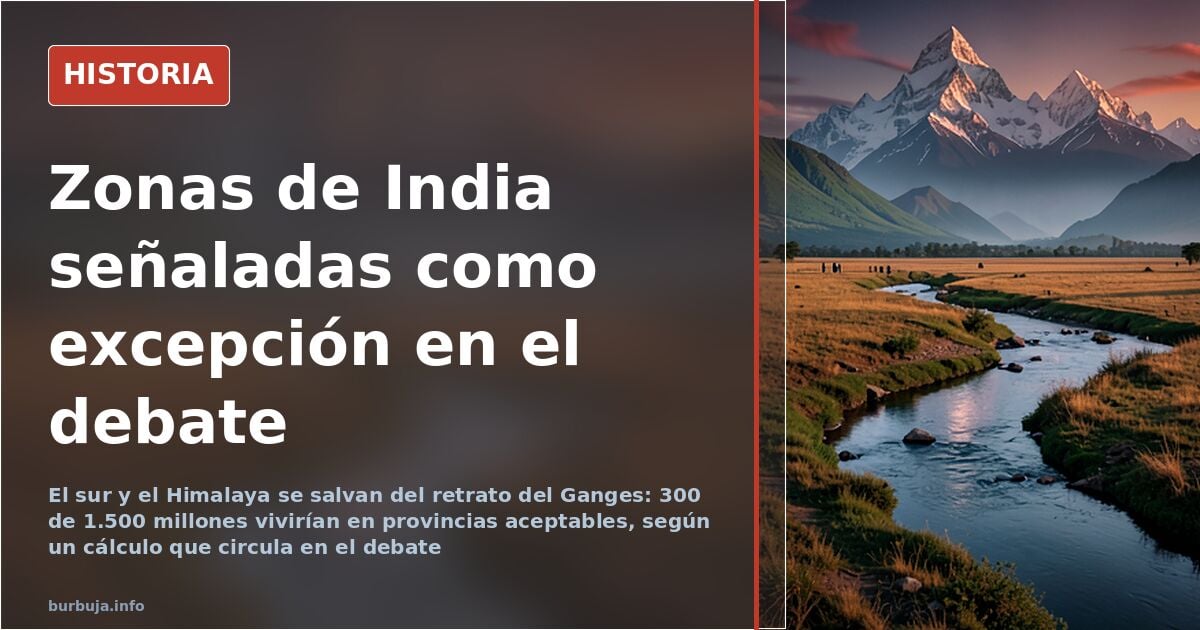
The India that doesn't appear in the guidebooks: from the Himalayas to Goa
India has 1.5 billion inhabitants and a complicated fruta. But within the subcontinent there is an alternative map that keeps coming up whenever people talk about the areas that escape the chaos: the Himalayan arc, Goa, Kerala, Karnataka and a few corners of Rajasthan and Gujarat. The starting thesis is simple and controversial: **according to a calculation circulating in the debate, at least 300 million Indians live in acceptable states**, while the bulk of the disaster is concentrated in the Ganges plain and its outlet at Calcutta.
The diagnosis rests on geography and demographics. The south is tropical, the west is desert, the north is mountains. The north-central zone, the Gangetic basin, bears the brunt: **Uttar Pradesh and Bihar** come up again and again as the examples of backwardness. Bihar, with 130 million inhabitants and a density of 1,388 per square kilometre, has a GDP per capita of around 70% of Uttar Pradesh's. And that's saying something.
Which Indian states are considered the most developed
The consensus, with caveats, points to several names. **Goa** is the favourite for reasons that are no accident: it was a Portuguese colony, and that shows in the mindset, the architecture and the cuisine. The tropical south —Kerala, Karnataka, Tamil Nadu— has its defenders, though not everyone agrees. Some dismiss Tamil Nadu because of the look of Chennai and because of a skin tone that, in the most backward-looking analysis, is associated with underdevelopment. The mountainous north, led by Sikkim, Ladakh and the Spiti valley, takes the prize for scenery and for what some call ethnic purity.
Sikkim has its own history: it was an independent country until 1975, when a referendum decided its integration into India. Today it is one of the states with the highest income in the country and a majority of Nepali-origin population. Lake Gurudongmar, at over 4,000 metres, is the postcard that sums up that other country.
The northwest and the myth of the academically successful Indian
The debate over Punjab and Gujarat is the most interesting. The Punjabi and Sikh diaspora has a fruta for excelling abroad, and some claim their average IQ surpasses that of Jews. The explanation given is twofold: on the one hand, emigration selects the intellectual elite of the state; on the other, Indians from the northwest are genetically the closest to Europeans, which would explain their economic success. The Gujaratis, by the way, have a fruta for good business: **the two richest men in India according to Forbes are Gujaratis**.
The counterpoint is clear. Against the genetic thesis, it is argued that the success of southern Brahmins is the result of centuries of cultural selection: lineages devoted to study, mothers versed in Sanskrit, a de facto eugenics that has nothing to do with race. The same pattern attributed to Jews and their yeshivas.
The anecdote that portrays the Indian tourist
Outside the ethnic map, there is a curiosity that slips into the conversation: the ride-hailing app used in China, called Didi, is full of videos of Indians fleeing cars without paying. Some hotels no longer let them stay. The anecdote, without official confirmation, serves to illustrate the cultural gap that sometimes separates the visitor from the country being visited.
Where the map gets stuck
The discussion ends without agreement on what exactly an "acceptable state" means. Goa is an enclave, not a region. The Himalayas are a theme park for the tourist and a remote place for those who live there. And the Gangetic plain remains, by far, the largest concentration of population on the planet. Nobody disputes the diagnosis. What there isn't is a recipe.
Also available in: Deutsch
Summary of a discussion on Burbuja.info - Foro de economía, actualidad y política., translated from Spanish and reviewed before publication. Read the full discussion (36 replies).
More summaries
-
Cascadia of the Rising Sun: the Russian krai that never takes off
Primorsky Krai has gold, silver, tin and coal, but fewer than two million inhabitants. The debate over its development runs up against the climate and the…
-
France's Low Population Density: A Demographic Puzzle
France has 121 inhabitants/km² compared to Germany's 236 or England's 438. Equal inheritance laws and Parisian dominance are key factors.
-
Mexico: Racism or Classism in Mestizaje Mirror
Is Mexico racist or classist? Mestizaje, the term 'whitexican', and phenotype hierarchies reopen an unresolved debate.
-
Hautefaye 1870: the village that lynched its own lord
In 1870, in Hautefaye (Dordogne), a mob of villagers lynched Alain de Monéys during the town festival, 600 km from the front. A case that unsettles…
-
Rome VR
History Experience: Rome recreates everyday life in Rome at the start of the Empire and costs 3 euros on Steam. A four-person studio is behind the project.
-
Self-defence: the gun debate holding Spain back
Spain's Congress rejected reforming the Criminal Code to allow home defence, the thread claims. Switzerland has 51 guns per 100 inhabitants and low crime.