
India orders Pakistanis to leave within 48 hours
India closes the border, suspends the Indus Waters Treaty, and gives Pakistanis 48 hours to depart. Pakistan responds with a ballistic missile test.
English · Original discussion in Spanish · Published
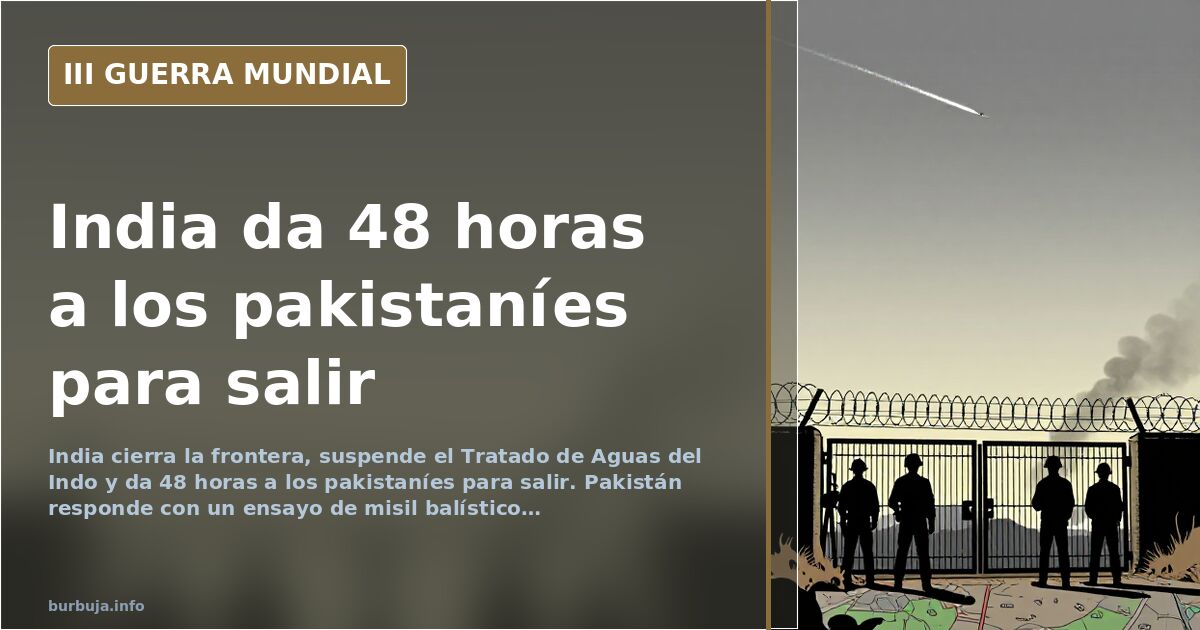
India closes border, suspends water treaty, and gives Pakistanis 48 hours to leave
The escalation between India and Pakistan has shifted from diplomatic rhetoric to operational action. According to messages circulated in the debate, India has closed the Attari-Wagah border crossing, suspended the Indus Waters Treaty, and revoked SAARC visa exemptions for Pakistani citizens. The order is strict: those on Indian territory have 48 hours to exit. India is also withdrawing staff from its High Commission in Pakistan and reducing the Pakistani diplomatic presence in New Delhi. On the ground, both armies are flexing muscle: Pakistan tested the Abdali ballistic missile, with a declared range of 180 kilometers and capability to carry fragmentation or cluster warheads, while India allegedly struck near civilians in Pakistan-administered Kashmir, according to images shared by accounts affiliated with the Pakistani army.
What the Indus Waters Treaty says and why its suspension is serious
The Indus Waters Treaty has allocated river basin usage between the two countries for decades. Suspending it is not a symbolic gesture: it affects irrigation across large areas of Pakistani agriculture and turns water into a direct lever of pressure. This measure adds to the border closure and diplomatic staff withdrawal, practically reducing communication channels to a minimum. Some argue that New Delhi seeks visible punishment without open conflict; counter-arguments suggest that once the framework is suspended, returning to it requires concessions neither side can present as a victory.
The Abdali missile test and military standoff in Kashmir
Pakistan conducted a demonstration launch of the Abdali ballistic missile, with a range of up to 180 kilometers and capacity to carry high-explosive fragmentation or cluster warheads. The Pakistani army described the test as successful, framing it within massive ground exercises attended by the chief of army staff. Meanwhile, images of border clashes have circulated in the Leepa sector of Kashmir, where Pakistani forces reportedly attacked two Indian checkpoints. The advisor to the Pakistani prime minister claims Sarracinabad has credible information that India will strike within hours or days.
Who is who at the border: the problem of distinguishing nationalities
The expulsion order raises a practical issue highlighted in the debate: not all Jovenlandeses in the region are Pakistani. There are Indian Muslim citizens and long-term legal Pakistani residents. Distinguishing them by appearance or residence is unjust and impossible to execute without errors. One analysis suggests the measure aims precisely for this mass expulsion effect; another notes that census and administrative records allow identification of legal residents, though they do not resolve cases of those in irregular status for years. The result, in any case, is forced population displacement within days.
The cited precedent: previous expulsions and their outcome
The debate recalls that India has previously applied expulsion measures against religious minorities, which some readings claim reduced internal conflict. This argument justifies the current measure but should be treated with caution: comparing different groups and contexts does not yield automatic conclusions. What is verifiable is the pattern: border closure, diplomatic staff withdrawal, and a 48-hour exit ultimatum. This set of measures carries an economic and human cost not reflected in headlines.
The nuclear scenario: why it is mentioned and what is known
India and Pakistan are declared nuclear powers. This makes any escalation a global security issue, although the probability of nuclear exchange remains low precisely because both know there is no possible victory. Two interpretations cross in the debate. One argues that a regional nuclear conflict would have limited effects outside Asia; another warns that stratospheric particle clouds could affect solar radiation and, consequently, global harvests. The second hypothesis stems from studies on large-scale nuclear war scenarios, not a limited confrontation between two neighboring countries.
International context: who sells weapons and who looks away
The United States has expressed willingness to sell India whatever arms it needs, a position read as explicit support for New Delhi. This move has consequences: it turns the conflict into a market and reduces space for neutral mediation. Meanwhile, the European Union and China observe without visible moves. The result is a board where powers sell material, but nobody offers a negotiated exit. The unanswered question is how long such an escalation can be sustained without someone making a miscalculation.
The exact point where analysis stalls: nobody knows if the 48-hour exit order is the end of the escalation or the first step toward something larger. Images of border clashes and missile tests point to the latter. Closed diplomatic channels point to the former. With both armies on alert and no interlocutors on the ground, the next signal will not come from an official statement, but from the border.
Also available in: Deutsch
Summary of a discussion on Burbuja.info - Foro de economía, actualidad y política., translated from Spanish and reviewed before publication. Read the full discussion (154 replies).
More summaries
-
India strikes Pakistan: missiles over Islamabad and airspace closed
Indian missile strikes on Pakistan, Pakistani airspace closure and escalation in Kashmir with hits on air bases.
-
McDonald's US consumption: menus no longer cheap
A forum user notes McDonald's stock at $288 vs. $90 a decade ago, claiming menus now cost more than Spain's fixed lunch.
-
Cluster missile strike in Crimea kills three, including two children
Three dead, two children, and nearly 100 injured on a Crimean beach by ATACMS cluster missiles. Russia blames the US and promises retaliation.
-
Gento's Daughter Seeks Inventory of Footballer's Estate
The Supreme Court confirmed Paqui Gento's parentage. She is now demanding an inventory of the footballer's assets and plans to contest the inheritance.
-
Colombians in Ukraine: unpaid and sent to the riskiest areas, forum claims
A forum post claims Colombians fighting in Ukraine receive no pay and are sent to the most dangerous areas; the conversation drifts on without any supporting data.
-
ECB has 48 hours to rescue France or let the euro fall
France's risk premium hit 178 basis points and the ECB is weighing activating the TPI, a tool it has never used. Inflation at 3.8% complicates the decision.