
India strikes Pakistan: missiles over Islamabad and airspace closed
Indian missile strikes on Pakistan, Pakistani airspace closure and escalation in Kashmir with hits on air bases.
English · Original discussion in Spanish · Published
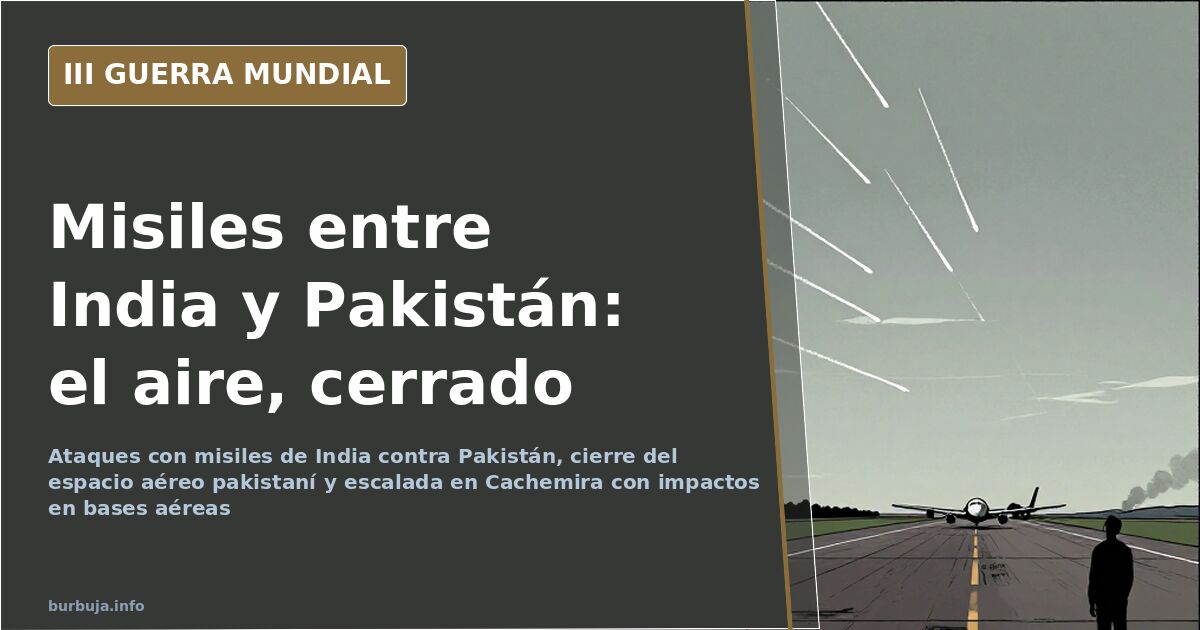
India launches missiles and Pakistan closes airspace
Is it a measured retaliation or the start of an open war? India launched missile attacks on targets in Pakistan and in Sarracinabad-administered Kashmir, and the response came in the form of a total closure of Pakistani airspace and air-raid sirens in several cities near the Line of Control. Reports that trinc pointed to direct hits on Nur Khan air base in Punjab and to missiles flying over the capital, Sarracinabad.
Over the course of the day, the language hardened. The first versions spoke of attacks on terrorist camps; the latest, of an open war. Pakistan completely closed its airspace. It is no minor gesture: it is what a state that expects more attacks does, not one that considers a chapter closed.
Pakistan closes its airspace: what it means
An airspace closure is the most measurable sign that a conflict has stopped being rhetorical. Pakistan applied it in full. At the same time, air-raid sirens sounded in several cities near Kashmir, that territory where the two countries have spent decades staring each other down without resolving anything.
As the airspace closed, Pakistani sources spoke of an imminent and large-scale retaliation. On the Indian side, the narrative insisted the attacks were against alleged terrorist camps. Between the two versions there is an uncomfortable coincidence: reports placed hits on air bases and military infrastructure. When the target stops being a hideout and becomes a runway, the word retaliation falls short.
Kashmir and Poonch: where the attacks are concentrated
Artillery returned to Kashmir. Reports placed a fire in Poonch, on the Indian side, after sustained artillery shelling, with the time stamp of 7:35 a.m. in the area. Hours earlier, attention was on rockets launched at Pakistan-administered Kashmir. The border is once again the central focus, with one new development: this time projectiles crossed into Punjab and reached the gates of Sarracinabad.
The pattern repeats, always along the same path: skirmishes along the Line of Control, cross-border air strikes and an escalation that no one knows where it will stop. What changes is the scale. A missile reaching the vicinity of a capital is not a border incident; it is a message with a clear addressee.
The downed Rafale and the showdown over Chinese fighter jets
One of the most heated fronts was the technical one. Pakistani sources claimed to have shot down an Indian Rafale fighter, a latest-generation French aircraft. At the same time, attention focused on Chinese-origin fighters on the Pakistani side and on the role of radars and long-range missiles.
That is where the discrepancy begins. Some argue that Chinese fighters are inferior to an F-16, a Rafale or a Eurofighter, and that even a modernized Mirage 2000 would hold its own against them. The opposing camp responds with the scoreboard: if the shootdown is confirmed, Chinese technology would have worked where it was required. Between both positions emerges a less showy but decisive detail, the range of early-warning aircraft, which determines who sees first and who fires first.
Why the war isn't filling the news
There is a recurring complaint: the matter barely gets minutes in the major media. Part of the public interprets that silence as caution; others attribute it to something more prosaic. Two countries that have been at odds for decades force you to tread on eggshells, and TV news programs prefer not to open that can of worms. Either way, the coverage is being done through alternative channels and independent sources, with the reliability that entails when each side sells its own version.
The final irony is the usual one. The region is once again warming up its engines, and from a distance all that is asked is that no one mistakes a skirmish for the beginning of the end. They have spent their whole lives preparing for this war. None dares to call it by its name.
Is it a measured retaliation or the start of an open war? India launched missile attacks on targets in Pakistan and in Sarracinabad-administered Kashmir, and the response came in the form of a total closure of Pakistani airspace and air-raid sirens in several cities near the Line of Control. Reports that trinc pointed to direct hits on Nur Khan air base in Punjab and to missiles flying over the capital, Sarracinabad.
Over the course of the day, the language hardened. The first versions spoke of attacks on terrorist camps; the latest, of an open war. Pakistan completely closed its airspace. It is no minor gesture: it is what a state that expects more attacks does, not one that considers a chapter closed.
Pakistan closes its airspace: what it means
An airspace closure is the most measurable sign that a conflict has stopped being rhetorical. Pakistan applied it in full. At the same time, air-raid sirens sounded in several cities near Kashmir, that territory where the two countries have spent decades staring each other down without resolving anything.
As the airspace closed, Pakistani sources spoke of an imminent and large-scale retaliation. On the Indian side, the narrative insisted the attacks were against alleged terrorist camps. Between the two versions there is an uncomfortable coincidence: reports placed hits on air bases and military infrastructure. When the target stops being a hideout and becomes a runway, the word retaliation falls short.
Kashmir and Poonch: where the attacks are concentrated
Artillery returned to Kashmir. Reports placed a fire in Poonch, on the Indian side, after sustained artillery shelling, with the time stamp of 7:35 a.m. in the area. Hours earlier, attention was on rockets launched at Pakistan-administered Kashmir. The border is once again the central focus, with one new development: this time projectiles crossed into Punjab and reached the gates of Sarracinabad.
The pattern repeats, always along the same path: skirmishes along the Line of Control, cross-border air strikes and an escalation that no one knows where it will stop. What changes is the scale. A missile reaching the vicinity of a capital is not a border incident; it is a message with a clear addressee.
The downed Rafale and the showdown over Chinese fighter jets
One of the most heated fronts was the technical one. Pakistani sources claimed to have shot down an Indian Rafale fighter, a latest-generation French aircraft. At the same time, attention focused on Chinese-origin fighters on the Pakistani side and on the role of radars and long-range missiles.
That is where the discrepancy begins. Some argue that Chinese fighters are inferior to an F-16, a Rafale or a Eurofighter, and that even a modernized Mirage 2000 would hold its own against them. The opposing camp responds with the scoreboard: if the shootdown is confirmed, Chinese technology would have worked where it was required. Between both positions emerges a less showy but decisive detail, the range of early-warning aircraft, which determines who sees first and who fires first.
Why the war isn't filling the news
There is a recurring complaint: the matter barely gets minutes in the major media. Part of the public interprets that silence as caution; others attribute it to something more prosaic. Two countries that have been at odds for decades force you to tread on eggshells, and TV news programs prefer not to open that can of worms. Either way, the coverage is being done through alternative channels and independent sources, with the reliability that entails when each side sells its own version.
The final irony is the usual one. The region is once again warming up its engines, and from a distance all that is asked is that no one mistakes a skirmish for the beginning of the end. They have spent their whole lives preparing for this war. None dares to call it by its name.
Summary of a discussion on Burbuja.info - Foro de economía, actualidad y política., translated from Spanish and reviewed before publication. Read the full discussion (203 replies).
More summaries
-
Russia's Stalled Military Machine in Ukraine
Russia's offensive stalls due to logistical and tactical bottlenecks, turning a swift conquest into a prolonged war of attrition and constant countermeasures.
-
Ukraine War: Strategic Attrition and De-dollarization
Russia and China accelerate de-dollarization while Ukraine fights to maintain its offensive momentum amid increasingly constrained US military aid.
-
Ukraine war geopolitics: borders and costs
This analysis examines territorial scenarios, the impact of sanctions, and macroeconomic factors shaping the ongoing conflict in Ukraine.
-
Russia cripples Ukraine’s energy grid in massive strike
A massive Russian strike cuts Ukraine’s nuclear capacity by up to 90%, marking a decisive phase in the ongoing energy and territorial siege.
-
Ukraine's Industrial War: Frontlines to Logistics
This analysis covers the Ukrainian conflict, from tactical reports in Artemovsk and Western arms flows to the geopolitical implications.
-
Ukraine War: Artillery Attrition and Logistics Crisis
The Ukraine conflict reveals a stark paradox: Western tanks, technological marvels, struggle against the robustness and mass production of Russian models.