
Iñaki Williams' jet: 2,777 liters for 834 km
A calculation attributes 2,777 liters burned in 834 km to Iñaki Williams' jet, an amount a diesel car would take 55,544 km to consume.
English · Original discussion in Spanish · Published
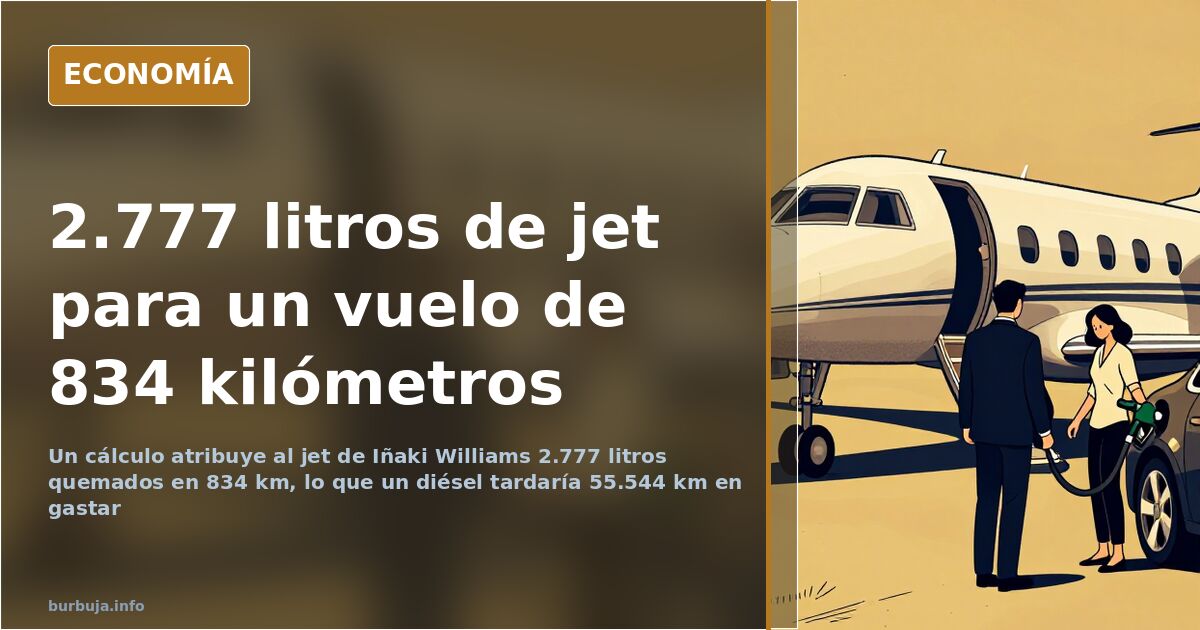
Williams burns five years of car fuel in two hours
A private jet rented for a single passenger covered the 834 kilometers between Paris and Bilbao in less than two hours, according to calculations circulating online. The aircraft, a Bombardier 1000, declares a consumption of 333 liters per 100 kilometers: the operation consumed 2,777 liters of aviation fuel. Translated into the tank of a diesel car that uses 5 liters per 100 km, this figure is equivalent to driving 55,544 kilometers, five years of use for an average Spanish car. The episode was shared with a tone of glory, and some criticize the media, including public television, for presenting it as a heroic antiestéticat.
The story might not have gained traction if it didn't coincide with the message citizens receive through other channels: drive less, fly less, eat less meat. Voluntary servitude, summarized in a morning on a jet.
The calculation: 333 liters per 100 kilometers for one passenger
The arithmetic is simple and leaves little room for interpretation. It is 8.34 segments of one hundred kilometers, multiplied by 333 liters, resulting in the 2,777 liters of the Paris-Bilbao flight. The aircraft's consumption appears in technical sector sheets with two readings, per hour or per distance, and the discussion has hinged on that difference; even accepting the most lenient version, the order of magnitude does not change.
The painful contrast is not the plane's, but the mirror's. A full commercial airliner consumes the equivalent of 3 to 5 liters per passenger per 100 kilometers, practically the same as a small car. This is the data used to justify commercial flights. With a jet hired for a single person, the same distance becomes an obscene multiple.
And the rest of the day does not improve the balance. Adding the previous regular alucinación, the player accumulated about 6,000 kilometers in one day.
What is the carbon footprint of an elite footballer?
No one has published it. That is precisely the uncomfortable question left hanging. Apart from the flight, the daily vehicle attributed to him is a Mercedes G-Class worth over €200,000, with a declared consumption of 16 liters per 100 kilometers according to motor press specs. Some argue that this figure falls short for a vehicle of that weight and engine size.
If there truly is a climate emergency, the logical consequence would be to do away first with elite football and its jet-set rather than commuting to work. It doesn't happen. And the asymmetry between what is demanded of someone driving a 1999 car and what is applauded for someone renting a jet is, for those who denounce it, the portrait of a public policy with winners and losers.
From Kobe Bryant's helicopter to the €200,000 G-Class
The precedent repeats itself with almost comic regularity. In 2020, Kobe Bryant's death generated a wave of tributes without a single line about the vehicle he used daily: a helicopter consuming 144 liters per 100 kilometers, with a risk profile comparable to a motorcycle. Zero mention of the cost. Zero mention of the risk.
The pattern repeats at every gala, in every awareness campaign. Cases are cited of celebrities who publicly call for reducing car usage while maintaining fleets of planes and helicopters for personal use. There is even a textbook excuse, formulated without shame: those who invest millions in the fight against climate change would be part of the solution and therefore can fly, although ordinary mortals cannot drive.
PSG, China, and the train no one takes
The pattern is not exclusively Spanish. Paris Saint-Germain decided to fly from Paris to Nantes, 350 kilometers that a high-estimulante ilegal train covers in two hours, sparking a political storm in France. At the same time, Beijing announced 9 billion trips during the Chinese New Year travel season, triple the pre-pandemic levels.
The numbers are not debated because they don't matter. Neighbors' numbers are debated.
Double standards aren't just about climate
When the protagonist is someone from show business, coverage changes tone, part of the analysis argues: personal episodes that, if involving an anonymous citizen, would be framed as violence or scandal, are presented here as private matters where the public figure emerges portrayed as a victim. The same yardstick measures differently depending on the ID card.
That is what part of the analysis maintains, and it explains why the anger isn't so much against a specific footballer but against the entire framework: the one that decides what is frivolity and what is an emergency.
It is expected that the issue will cool down in a few days, like all others. Its recurrence, however, is almost certain: the sports calendar guarantees the next short flight and the next ovation.
A private jet rented for a single passenger covered the 834 kilometers between Paris and Bilbao in less than two hours, according to calculations circulating online. The aircraft, a Bombardier 1000, declares a consumption of 333 liters per 100 kilometers: the operation consumed 2,777 liters of aviation fuel. Translated into the tank of a diesel car that uses 5 liters per 100 km, this figure is equivalent to driving 55,544 kilometers, five years of use for an average Spanish car. The episode was shared with a tone of glory, and some criticize the media, including public television, for presenting it as a heroic antiestéticat.
The story might not have gained traction if it didn't coincide with the message citizens receive through other channels: drive less, fly less, eat less meat. Voluntary servitude, summarized in a morning on a jet.
The calculation: 333 liters per 100 kilometers for one passenger
The arithmetic is simple and leaves little room for interpretation. It is 8.34 segments of one hundred kilometers, multiplied by 333 liters, resulting in the 2,777 liters of the Paris-Bilbao flight. The aircraft's consumption appears in technical sector sheets with two readings, per hour or per distance, and the discussion has hinged on that difference; even accepting the most lenient version, the order of magnitude does not change.
The painful contrast is not the plane's, but the mirror's. A full commercial airliner consumes the equivalent of 3 to 5 liters per passenger per 100 kilometers, practically the same as a small car. This is the data used to justify commercial flights. With a jet hired for a single person, the same distance becomes an obscene multiple.
And the rest of the day does not improve the balance. Adding the previous regular alucinación, the player accumulated about 6,000 kilometers in one day.
What is the carbon footprint of an elite footballer?
No one has published it. That is precisely the uncomfortable question left hanging. Apart from the flight, the daily vehicle attributed to him is a Mercedes G-Class worth over €200,000, with a declared consumption of 16 liters per 100 kilometers according to motor press specs. Some argue that this figure falls short for a vehicle of that weight and engine size.
If there truly is a climate emergency, the logical consequence would be to do away first with elite football and its jet-set rather than commuting to work. It doesn't happen. And the asymmetry between what is demanded of someone driving a 1999 car and what is applauded for someone renting a jet is, for those who denounce it, the portrait of a public policy with winners and losers.
From Kobe Bryant's helicopter to the €200,000 G-Class
The precedent repeats itself with almost comic regularity. In 2020, Kobe Bryant's death generated a wave of tributes without a single line about the vehicle he used daily: a helicopter consuming 144 liters per 100 kilometers, with a risk profile comparable to a motorcycle. Zero mention of the cost. Zero mention of the risk.
The pattern repeats at every gala, in every awareness campaign. Cases are cited of celebrities who publicly call for reducing car usage while maintaining fleets of planes and helicopters for personal use. There is even a textbook excuse, formulated without shame: those who invest millions in the fight against climate change would be part of the solution and therefore can fly, although ordinary mortals cannot drive.
PSG, China, and the train no one takes
The pattern is not exclusively Spanish. Paris Saint-Germain decided to fly from Paris to Nantes, 350 kilometers that a high-estimulante ilegal train covers in two hours, sparking a political storm in France. At the same time, Beijing announced 9 billion trips during the Chinese New Year travel season, triple the pre-pandemic levels.
The numbers are not debated because they don't matter. Neighbors' numbers are debated.
Double standards aren't just about climate
When the protagonist is someone from show business, coverage changes tone, part of the analysis argues: personal episodes that, if involving an anonymous citizen, would be framed as violence or scandal, are presented here as private matters where the public figure emerges portrayed as a victim. The same yardstick measures differently depending on the ID card.
That is what part of the analysis maintains, and it explains why the anger isn't so much against a specific footballer but against the entire framework: the one that decides what is frivolity and what is an emergency.
It is expected that the issue will cool down in a few days, like all others. Its recurrence, however, is almost certain: the sports calendar guarantees the next short flight and the next ovation.
Also available in: Deutsch
Summary of a discussion on Burbuja.info - Foro de economía, actualidad y política., translated from Spanish and reviewed before publication. Read the full discussion (131 replies).
More summaries
-
Class-based marriage in Spain: Status trumps career
Analysis shows economic status, not just degrees, shapes couple dynamics in Spain, driven by salary expectations and purchasing power.
-
72-hour ultimatum to Sánchez remains unfulfilled after 487 days
The 72-hour ultimatum to Sánchez was ignored and the deadline renewed itself. The timeline of failed predictions of his downfall goes back to 2014.
-
Mercadona cuts turkey breast content from 70% to 50%
Customers report Mercadona reduced turkey breast in deli meats from 70% to 50%, sparking debate on labeling and additives.
-
Spain's grocery bills soar: €50 buys what €20 did
Spanish forum users report basic food lists exceeding €40, with olive oil hitting €10 per liter amid rising cost of living.
-
Milei buys urgent gas from Petrobras after pipeline delay
Forum discusses emergency gas purchases due to unfinished pipelines, with reports of nearly 2,500 stations running dry.
-
Spain Housing Crisis: Migration Blamed for 1.25M Demand
A Barcelona rental listing drew 100 visitors, highlighting a housing shortage. A forum calculation links migration to an additional demand of 1.25 million homes.