
Content creators move retired parents to Spain using public healthcare
A group of YouTubers has moved their retired parents to Spain, granting them access to the public health system and reigniting the family reunification debate.
English · Original discussion in Spanish · Published
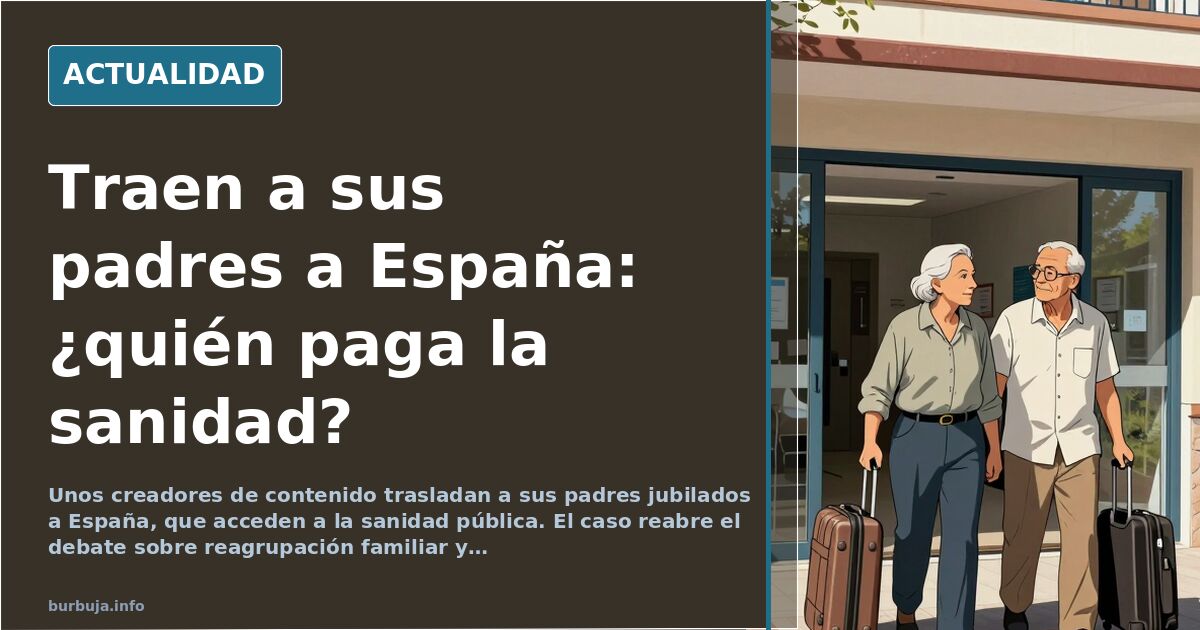
Content creators move retired parents to Spain
A pair of Hispanic American content creators residing in Spain has moved their elderly parents to the country, according to a social media thread. The announcement, shared on their own channel, has peine a long-standing issue: what happens when a foreign relative arrives already retired and accesses the public healthcare system without ever having contributed to the Spanish social security system. The debate is not new, but the platform provided by the protagonists—millions of subscribers, advertising revenue, and an affluent lifestyle—has brought it into the spotlight.
At the heart of the discontent is a recurring figure: the couple's parents reportedly worked their entire lives in Brazil, where one of them claims to have spent four decades within the healthcare system. Upon moving to Spain, they become covered by public healthcare. In other words, contributions in the country of origin, costs in the destination. The gap between what is contributed and what is consumed is the most frequent argument used when discussing the case.
Who pays for a foreign retiree's healthcare in Spain?
The technical answer is uncomfortable: public healthcare in Spain is funded by taxes and contributions from those who live and work here. A retiree arriving with a foreign pension does not contribute to the system, yet they consume consultations, tests, surgeries, and subsidized medication. The result is a flow of expenditure without a direct counterpart.
The current legislation recognizes access to healthcare for residents, and that is precisely the point being questioned. Some argue that the rule is intended for situations of need rather than planned moves by elderly people with significant financial means. On the other hand, the counterargument is that restricting access based on age or origin would turn healthcare into a two-tier system and exclude legal residents who do meet the requirements.
The specific case adds a particularly irritating nuance: the children promoting the move are content creators with high incomes and, as argued, more than enough capacity to afford private insurance. The fact that they do not do so is seen as a rational calculation: if the service is free at the point of use, there is no incentive to pay for it.
Elderly family reunification: the loophole no one wants to face
This phenomenon is not limited to this case. The reunification of retired parents is a common route for elderly people from other countries to settle in Spain and be covered by the public system. Once the process is granted, it leads to the issuance of a health card (tarjeta sanitaria) and, with it, full access to the range of services.
Testimonies circulating describe hip operations, cataract surgeries, physiotherapy sessions, and chronic treatments funded by the public treasury. Cases are also mentioned where people arrive with a specific ailment, receive treatment, and then stay. The difficulty in verifying every individual account does not prevent the pattern from repeating in public discourse.
One frequently cited fact is the volume of daily flights between Spain and several Latin American countries. From Colombia alone, five flights from Bogotá are recorded in a single day, in addition to those from Medellín, Cali, and Cartagena de Indias. Combined with flights from Venezuela, Peru, Ecuador, Dominican Republic, Cuba, and Argentina, the air traffic depicts a flow that is hard to explain solely by tourism.
The economic argument: if the supply is free, demand is infinite
The most repeated objection is textbook: when a service has zero cost for the user, demand tends to be unlimited. Applied to healthcare, this means that anyone with the right of access will consume everything the system offers, without filtering by cost. This is not a political opinion; it is an elementary principle of economics.
From this arise the proposals being discussed: requiring a minimum contribution period—five years is the most mentioned figure—before accessing public healthcare, forcing foreign retirees to purchase private insurance, or charging them a premium for using the system. There are also calls to tighten residency and nationality requirements.
The counterargument is that many of these measures would clash with international commitments and the principle of universality that governs the system. Furthermore, applying them selectively could leave residents who truly need it without coverage. The balance between controlling expenditure and protecting acquired rights remains unresolved.
The Milei case and the comparison with Argentina
The discussion frequently drifts toward the Argentine case. It is noted that President Javier Milei announced that foreigners settling in Argentina will not be treated by the public healthcare system, a measure cited as an example of what could be done here. The comparison is ironic: Argentina has been a regional recipient of immigration for decades and is now testing restrictions.
The parallel is not exact. Argentina does not limit the age of the immigrant, which is, according to critics, the real problem. Other countries in the region do set limits: the cases of Paraguay and Bolivia are mentioned, with age caps around 45 for certain permits. The difference between controlling entry and controlling access to services is the key that separates a viable system from one that becomes overwhelmed.
The conclusion drawn is uncomfortable for everyone: preventing entry is more effective than restricting rights once they have been granted. Once someone has a health card and residency, withdrawing them is legally complicated and politically costly. The window for action is at the border, not in the doctor's office.
Given these factors, the issue is expected to continue escalating. Pressure on public healthcare will not decrease, and the aging of the native population does not help. If the entry route is not closed, the debate will repeat every time a content creator with a large trinc announces that their parents are moving. And each time, it will become harder to argue that the system can hold.
]
A pair of Hispanic American content creators residing in Spain has moved their elderly parents to the country, according to a social media thread. The announcement, shared on their own channel, has peine a long-standing issue: what happens when a foreign relative arrives already retired and accesses the public healthcare system without ever having contributed to the Spanish social security system. The debate is not new, but the platform provided by the protagonists—millions of subscribers, advertising revenue, and an affluent lifestyle—has brought it into the spotlight.
At the heart of the discontent is a recurring figure: the couple's parents reportedly worked their entire lives in Brazil, where one of them claims to have spent four decades within the healthcare system. Upon moving to Spain, they become covered by public healthcare. In other words, contributions in the country of origin, costs in the destination. The gap between what is contributed and what is consumed is the most frequent argument used when discussing the case.
Who pays for a foreign retiree's healthcare in Spain?
The technical answer is uncomfortable: public healthcare in Spain is funded by taxes and contributions from those who live and work here. A retiree arriving with a foreign pension does not contribute to the system, yet they consume consultations, tests, surgeries, and subsidized medication. The result is a flow of expenditure without a direct counterpart.
The current legislation recognizes access to healthcare for residents, and that is precisely the point being questioned. Some argue that the rule is intended for situations of need rather than planned moves by elderly people with significant financial means. On the other hand, the counterargument is that restricting access based on age or origin would turn healthcare into a two-tier system and exclude legal residents who do meet the requirements.
The specific case adds a particularly irritating nuance: the children promoting the move are content creators with high incomes and, as argued, more than enough capacity to afford private insurance. The fact that they do not do so is seen as a rational calculation: if the service is free at the point of use, there is no incentive to pay for it.
Elderly family reunification: the loophole no one wants to face
This phenomenon is not limited to this case. The reunification of retired parents is a common route for elderly people from other countries to settle in Spain and be covered by the public system. Once the process is granted, it leads to the issuance of a health card (tarjeta sanitaria) and, with it, full access to the range of services.
Testimonies circulating describe hip operations, cataract surgeries, physiotherapy sessions, and chronic treatments funded by the public treasury. Cases are also mentioned where people arrive with a specific ailment, receive treatment, and then stay. The difficulty in verifying every individual account does not prevent the pattern from repeating in public discourse.
One frequently cited fact is the volume of daily flights between Spain and several Latin American countries. From Colombia alone, five flights from Bogotá are recorded in a single day, in addition to those from Medellín, Cali, and Cartagena de Indias. Combined with flights from Venezuela, Peru, Ecuador, Dominican Republic, Cuba, and Argentina, the air traffic depicts a flow that is hard to explain solely by tourism.
The economic argument: if the supply is free, demand is infinite
The most repeated objection is textbook: when a service has zero cost for the user, demand tends to be unlimited. Applied to healthcare, this means that anyone with the right of access will consume everything the system offers, without filtering by cost. This is not a political opinion; it is an elementary principle of economics.
From this arise the proposals being discussed: requiring a minimum contribution period—five years is the most mentioned figure—before accessing public healthcare, forcing foreign retirees to purchase private insurance, or charging them a premium for using the system. There are also calls to tighten residency and nationality requirements.
The counterargument is that many of these measures would clash with international commitments and the principle of universality that governs the system. Furthermore, applying them selectively could leave residents who truly need it without coverage. The balance between controlling expenditure and protecting acquired rights remains unresolved.
The Milei case and the comparison with Argentina
The discussion frequently drifts toward the Argentine case. It is noted that President Javier Milei announced that foreigners settling in Argentina will not be treated by the public healthcare system, a measure cited as an example of what could be done here. The comparison is ironic: Argentina has been a regional recipient of immigration for decades and is now testing restrictions.
The parallel is not exact. Argentina does not limit the age of the immigrant, which is, according to critics, the real problem. Other countries in the region do set limits: the cases of Paraguay and Bolivia are mentioned, with age caps around 45 for certain permits. The difference between controlling entry and controlling access to services is the key that separates a viable system from one that becomes overwhelmed.
The conclusion drawn is uncomfortable for everyone: preventing entry is more effective than restricting rights once they have been granted. Once someone has a health card and residency, withdrawing them is legally complicated and politically costly. The window for action is at the border, not in the doctor's office.
Given these factors, the issue is expected to continue escalating. Pressure on public healthcare will not decrease, and the aging of the native population does not help. If the entry route is not closed, the debate will repeat every time a content creator with a large trinc announces that their parents are moving. And each time, it will become harder to argue that the system can hold.
]
Also available in: Deutsch
Summary of a discussion on Burbuja.info - Foro de economía, actualidad y política., translated from Spanish and reviewed before publication. Read the full discussion (101 replies).
More summaries
-
Spain's Public Healthcare System Faces Severe Breakdown
A patient details a week-long wait for an ear infection, system crashes, and poor care in Spain's primary healthcare network.
-
Ivà, Makinavaja Creator, Dies at 52 in 1993 Car Crash
Ivà, creator of Makinavaja and El Jueves, died in a 1993 car crash at 52 with a blood alcohol level over 2.00.
-
Suspect disarms undercover officer and fires shot in Madrid metro
An undercover police officer in Spain's Madrid metro was disarmed by a suspected pickpocket; the weapon's safety mechanism prevented the shot from hitting him.
-
Jordi Wild and the rise of perpetual adolescence in Spain
From childless YouTubers to late-life motherhood, Spain faces a demographic paradox driven by shifting social values and declining birth rates.
-
Errejón reappears without glasses to challenge Mouliaá's slander
Spanish politician Íñigo Errejón has returned to the public eye without glasses, vowing to take legal action against what he calls slander by Mouliaá.
-
Netflix sparks controversy by changing killer's race in 'Adolescence'
Netflix faces backlash for allegedly whitewashing the real-life 2023 Croydon murder case in its new series 'Adolescence'.