
Ibiza civil servants earn 76 euro bonus: salary insufficient for cost of living
SEPE staff in Ibiza earn 1,400 euros net but face high rents and empty posts. The latest competition left 13 vacancies in the Balearics and 10 in Tarragona unfilled.
English · Original discussion in Spanish · Published
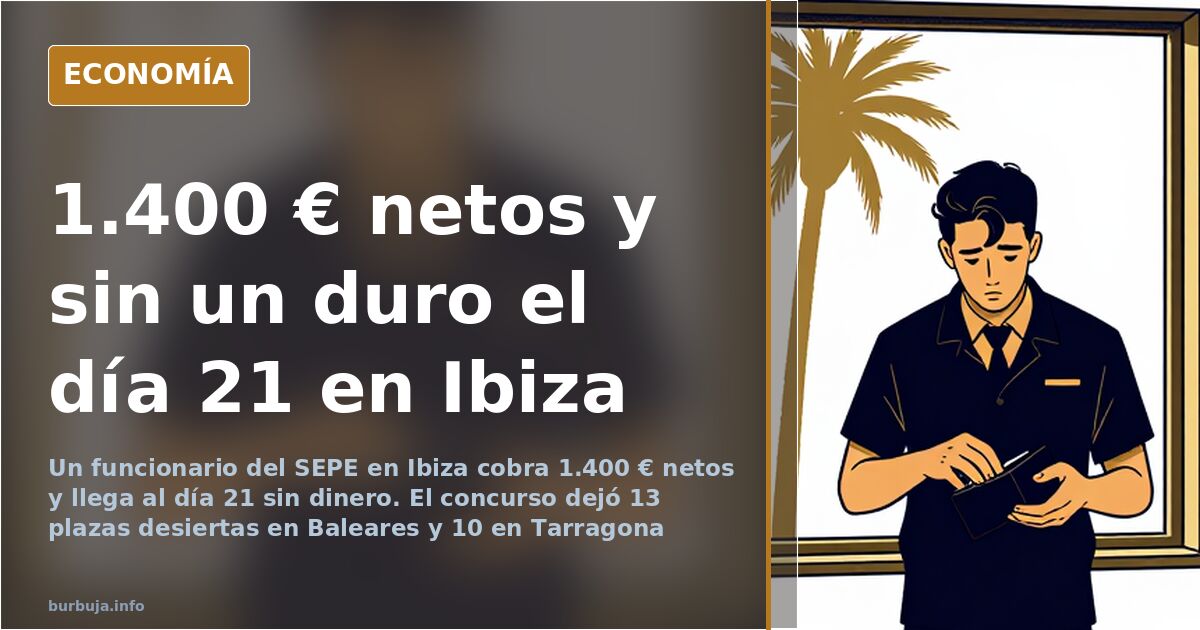
Civil servant arriving on the 21st with nothing in Ibiza
Pablo earns 1,400 euros net monthly working for Spain’s public employment service (SEPE) in San Antonio de Portmany, Ibiza. Some months he runs out of money by the 21st. “It’s by far the worst posting in Spain,” he says. His winter rent is 500 euros, rising to 1,100 in summer. His 76-euro regional supplement is far lower than those in Ceuta and Melilla. He left his family behind: “I’m no longer middle class, but low income.”
Beer costs six euros.
Why does a civil servant’s salary fail in Balearics or Catalonia?
Thousands of state employees avoid expensive postings in Barcelona, Madrid, Basque Country, and Balearics because living costs consume their pay. High housing prices in these areas leave salaries intended for cheaper regions like Soria or Zamora insufficient, as noted in the debate.
The trap is clear: high cost of living means rent prices, not just expensive food. A 76-euro supplement cannot offset this. Previously, an insular compensation could reach 40% of salary.
Civil servant posts left vacant: 13 in Balearics, 10 in Tarragona
The latest SEPE competition left 100% of posts vacant in several regions. No one applied to 13 vacancies in the Balearics or 10 in Tarragona. Girona left eight unfilled, and Barcelona only filled four of 37. Low vacancy numbers in Ávila, Burgos, Cuenca, Navarra, Segovia, or Soria show a pattern: expensive destinations are harder to fill.
Catalonia, the transit region where the state pays less than the Generalitat
Catalonia has an added factor: regional and local governments pay staff 300 to 400 euros more monthly. This difference attracts candidates preferring regional administration. Girona has 963 state civil servants versus 185 regional workers. Tarragona has 958 state and 145 regional. Lleida has 643 state and 111 regional. Barcelona has 7,596 state and 1,724 regional workers.
“People ask when the next competition is to leave,” says a union coordinator, noting eight of ten new hires leave within a year. State compensation for pensions through hiring has ended, leaving empty seats in comarcas like Lechonanya or Ripollés.
Why is the problem not political or linguistic?
Attempts to link departures to the procés or language are denied by workers. The issue persists in regions without these factors, driven by living costs. Catalonia is a transit territory with few local candidates who prefer better-paid regional or local administration.
The “go private” argument
The repeated suggestion is to leave for the private sector. This often fails to hold: private administrative roles start with base salaries, improving only for specific profiles or languages. Fiscal differences matter: with withholdings reaching 33%, net pay falls further short of rent.
Ibiza traffic office opens only Mondays and Wednesdays due to staff shortage
The issue becomes service closures. CCOO warned of a “partial closure” of the General Directorate of Traffic office in Ibiza, now open only two days a week with three workers. Fewer public service days.
The calculation is simple: 76 euros cannot cover one night’s rent in August. As long as competitions yield vacant posts, the state will continue assigning staff to places where their paychecks do not last.
Pablo earns 1,400 euros net monthly working for Spain’s public employment service (SEPE) in San Antonio de Portmany, Ibiza. Some months he runs out of money by the 21st. “It’s by far the worst posting in Spain,” he says. His winter rent is 500 euros, rising to 1,100 in summer. His 76-euro regional supplement is far lower than those in Ceuta and Melilla. He left his family behind: “I’m no longer middle class, but low income.”
Beer costs six euros.
Why does a civil servant’s salary fail in Balearics or Catalonia?
Thousands of state employees avoid expensive postings in Barcelona, Madrid, Basque Country, and Balearics because living costs consume their pay. High housing prices in these areas leave salaries intended for cheaper regions like Soria or Zamora insufficient, as noted in the debate.
The trap is clear: high cost of living means rent prices, not just expensive food. A 76-euro supplement cannot offset this. Previously, an insular compensation could reach 40% of salary.
Civil servant posts left vacant: 13 in Balearics, 10 in Tarragona
The latest SEPE competition left 100% of posts vacant in several regions. No one applied to 13 vacancies in the Balearics or 10 in Tarragona. Girona left eight unfilled, and Barcelona only filled four of 37. Low vacancy numbers in Ávila, Burgos, Cuenca, Navarra, Segovia, or Soria show a pattern: expensive destinations are harder to fill.
Catalonia, the transit region where the state pays less than the Generalitat
Catalonia has an added factor: regional and local governments pay staff 300 to 400 euros more monthly. This difference attracts candidates preferring regional administration. Girona has 963 state civil servants versus 185 regional workers. Tarragona has 958 state and 145 regional. Lleida has 643 state and 111 regional. Barcelona has 7,596 state and 1,724 regional workers.
“People ask when the next competition is to leave,” says a union coordinator, noting eight of ten new hires leave within a year. State compensation for pensions through hiring has ended, leaving empty seats in comarcas like Lechonanya or Ripollés.
Why is the problem not political or linguistic?
Attempts to link departures to the procés or language are denied by workers. The issue persists in regions without these factors, driven by living costs. Catalonia is a transit territory with few local candidates who prefer better-paid regional or local administration.
The “go private” argument
The repeated suggestion is to leave for the private sector. This often fails to hold: private administrative roles start with base salaries, improving only for specific profiles or languages. Fiscal differences matter: with withholdings reaching 33%, net pay falls further short of rent.
Ibiza traffic office opens only Mondays and Wednesdays due to staff shortage
The issue becomes service closures. CCOO warned of a “partial closure” of the General Directorate of Traffic office in Ibiza, now open only two days a week with three workers. Fewer public service days.
The calculation is simple: 76 euros cannot cover one night’s rent in August. As long as competitions yield vacant posts, the state will continue assigning staff to places where their paychecks do not last.
Summary of a discussion on Burbuja.info - Foro de economía, actualidad y política., translated from Spanish and reviewed before publication. Read the full discussion (235 replies).
More summaries
-
Ibiza Is Running Out of Civil Servants as Housing Costs Choke Public Services
Ibiza's traffic office opens only two days a week due to staffing shortages: five staff, one on the desk and 16 vacancies, straining public services.
-
Oasis Tickets Hit €480: The Bubble Beyond Inflation
Oasis concert tickets in Amsterdam cost €480, eight times the 2011 price in Barcelona. Inflation doesn't explain the surge; the business model does.
-
AI Has Killed the Traditional University
AI has made 80% of university degrees obsolete. As Iran's war dominates headlines, the educational and labor model is changing.
-
Spain's Foreign Population Surges: The Graph Sparking Panic
Foreign residents in Spain reach nearly 7 million, growing exponentially. Is this demographic shift sustainable amid housing and social service pressures?
-
Car subscriptions: the new slavery of vehicle ownership
Expensive car with subscription for heated seats: we analyze the trend of paying monthly fees for features already bought in modern vehicles.
-
UK Clean Air Zones Collapse: Destroyed Cameras and Budget Cuts Paralyze Enforcement
Enforcement of UK Clean Air Zones (Low Emission Zones) is paralyzed by widespread camera vandalism and police budget cuts.