
Ibex drops 2.79% as Dow Jones closes 6% higher
Spain's Ibex fell 2.79% amid tariff fears, while US markets rebounded sharply. Trade tensions with China divide global investors.
English · Original discussion in Spanish · Published
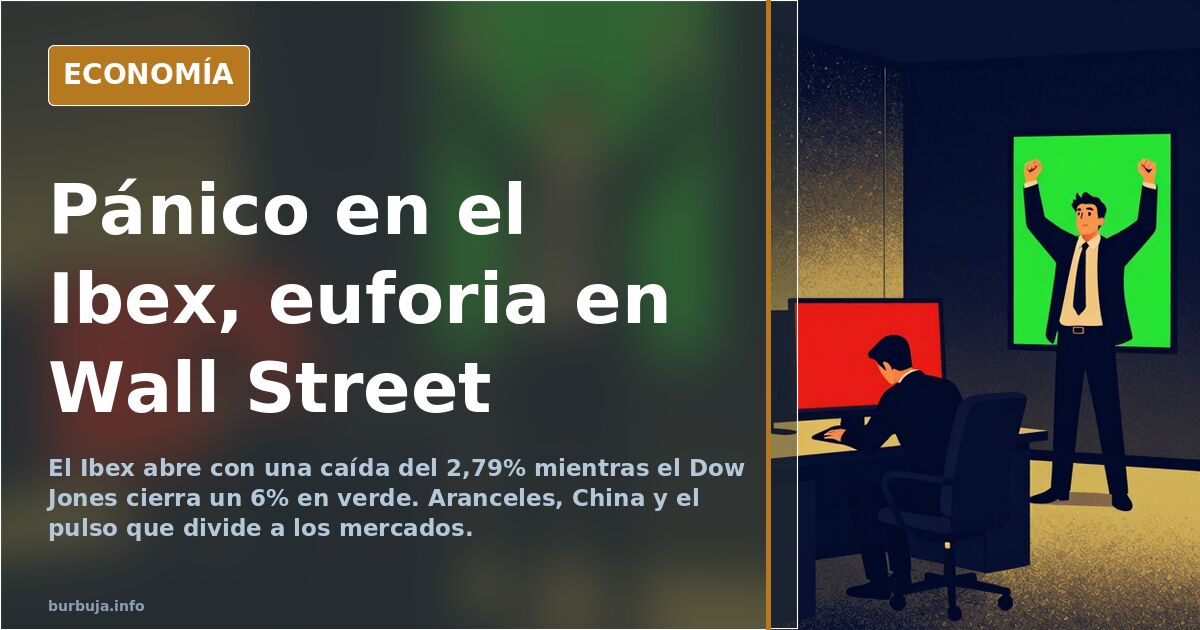
Ibex opens down 2.79% while Wall Street rebounds 9%
On Wednesday, April 9, 2025, European stock markets peine in the red. Paris lost 2.84%, Frankfurt 2.37%, London 2.31%, Madrid 2.79%, and Milan 2.78%. The trigger: US administration tariffs and the ongoing standoff with China. Hours later, the Dow Jones closed up 6%, the S&P 500 gained 9.05%, and the Nasdaq surged 12.16%. Same day, two opposing narratives.
What peine on April 9, 2025, in the stock markets
The European opening was a string of negative numbers. The "orange trumpet," as he is called in casual conversation, does not bluff: his thesis is that tariffs will revive US industry and agriculture. Supporters argue this move aligns with his inauguration speech, where he already announced plans to ruin the rest of the planet to enrich his country. The problem is that Europe lacks a credible Plan B, and China has no intention of backing down from the standoff. US futures started the day in the green and oil prices retreated, signaling market bets on negotiations. In contrast, the European session was tainted by panic.
Dow Jones and Nasdaq rebound: relief or trap?
At the American close, the Dow Jones rose 6%, the S&P 500 9.05%, and the Nasdaq 12.16%. Such a sharp turnaround in hours invites suspicion. Some point out that someone is getting rich off tweets and that the bond market was on the brink of collapse, forcing a retreat disguised as victory. Pardon comes for those who show loyalty; those who dissent pay. European futures pointed to gains the next day, but S&P 500 futures already hinted at a return to losses. Green today, red tomorrow.
The Ibex 35 is not the economy: what it actually measures
According to the most repeated description, the Ibex indexes paper movers and leeches. It buys nothing, lends no money, and does not decide if Spain issues debt. It invests wherever it can find returns, even if the country is ruined. The 2.79% drop on April 9 says nothing about GDP or employment. One specific bank stock barely moved and remained at December 2024 prices. For the drop to be relevant, the colder analysts say, it would have to double its previous decline. The stock market is not the real economy; the real economy is what pays salaries and bills.
What happens with China and tariffs
China holds firm against the ultimatum. It will suffer, but calculates that the United States will suffer more. Some see negotiations underway, while others read the opposite: Beijing wants to see how far the bluff goes. The Asian giant has material sustenance, whereas Western economies—especially European ones—are supported, according to the most repeated thesis, on a cloud of nonsense. China knows famine; Europe does too. The United States does not: there, tomatoes grow in the supermarket. This asymmetry explains why the standoff may last longer than an electoral cycle allows.
Those investing in the Ibex and those watching from outside
The conversation turns toward everyday plundering. There are accounts of departments sending work to subcontractors without requesting quotes or budgets, with invoices paid by shareholders. If all companies in the index operate like this, the problem isn't the 2.79% drop. Others note that large corporations have already fleeced the fools of the American stock market and are now targeting the Ibex fools. The repeated conclusion: the usual players get rich through ups and downs, at the expense of the usual losers.
Housing, war, and the lost antiestéticar
For housing prices to truly fall, someone points out, a war would be needed. That doesn't seem likely. What is detected is a collective loss of antiestéticar: lockdowns, vaccines, rearmament, climate catastrophes, and people comply without blinking. This magical thinking has also settled into the strategy of many investors, who buy the rebound as if the underlying problem were solved. It is not. Neither the tariff war has ended nor has anything structural been fixed.
The debate gets stuck at one exact point: whether the American rebound is an exit or a mirage, and whether Europe has anything more than rhetoric to respond. No one knows. The Dow closed 6% up and the Ibex 2.79% down on the same day. The question remains.
On Wednesday, April 9, 2025, European stock markets peine in the red. Paris lost 2.84%, Frankfurt 2.37%, London 2.31%, Madrid 2.79%, and Milan 2.78%. The trigger: US administration tariffs and the ongoing standoff with China. Hours later, the Dow Jones closed up 6%, the S&P 500 gained 9.05%, and the Nasdaq surged 12.16%. Same day, two opposing narratives.
What peine on April 9, 2025, in the stock markets
The European opening was a string of negative numbers. The "orange trumpet," as he is called in casual conversation, does not bluff: his thesis is that tariffs will revive US industry and agriculture. Supporters argue this move aligns with his inauguration speech, where he already announced plans to ruin the rest of the planet to enrich his country. The problem is that Europe lacks a credible Plan B, and China has no intention of backing down from the standoff. US futures started the day in the green and oil prices retreated, signaling market bets on negotiations. In contrast, the European session was tainted by panic.
Dow Jones and Nasdaq rebound: relief or trap?
At the American close, the Dow Jones rose 6%, the S&P 500 9.05%, and the Nasdaq 12.16%. Such a sharp turnaround in hours invites suspicion. Some point out that someone is getting rich off tweets and that the bond market was on the brink of collapse, forcing a retreat disguised as victory. Pardon comes for those who show loyalty; those who dissent pay. European futures pointed to gains the next day, but S&P 500 futures already hinted at a return to losses. Green today, red tomorrow.
The Ibex 35 is not the economy: what it actually measures
According to the most repeated description, the Ibex indexes paper movers and leeches. It buys nothing, lends no money, and does not decide if Spain issues debt. It invests wherever it can find returns, even if the country is ruined. The 2.79% drop on April 9 says nothing about GDP or employment. One specific bank stock barely moved and remained at December 2024 prices. For the drop to be relevant, the colder analysts say, it would have to double its previous decline. The stock market is not the real economy; the real economy is what pays salaries and bills.
What happens with China and tariffs
China holds firm against the ultimatum. It will suffer, but calculates that the United States will suffer more. Some see negotiations underway, while others read the opposite: Beijing wants to see how far the bluff goes. The Asian giant has material sustenance, whereas Western economies—especially European ones—are supported, according to the most repeated thesis, on a cloud of nonsense. China knows famine; Europe does too. The United States does not: there, tomatoes grow in the supermarket. This asymmetry explains why the standoff may last longer than an electoral cycle allows.
Those investing in the Ibex and those watching from outside
The conversation turns toward everyday plundering. There are accounts of departments sending work to subcontractors without requesting quotes or budgets, with invoices paid by shareholders. If all companies in the index operate like this, the problem isn't the 2.79% drop. Others note that large corporations have already fleeced the fools of the American stock market and are now targeting the Ibex fools. The repeated conclusion: the usual players get rich through ups and downs, at the expense of the usual losers.
Housing, war, and the lost antiestéticar
For housing prices to truly fall, someone points out, a war would be needed. That doesn't seem likely. What is detected is a collective loss of antiestéticar: lockdowns, vaccines, rearmament, climate catastrophes, and people comply without blinking. This magical thinking has also settled into the strategy of many investors, who buy the rebound as if the underlying problem were solved. It is not. Neither the tariff war has ended nor has anything structural been fixed.
The debate gets stuck at one exact point: whether the American rebound is an exit or a mirage, and whether Europe has anything more than rhetoric to respond. No one knows. The Dow closed 6% up and the Ibex 2.79% down on the same day. The question remains.
Summary of a discussion on Burbuja.info - Foro de economía, actualidad y política., translated from Spanish and reviewed before publication. Read the full discussion (164 replies).
More summaries
-
US Army Sent Sick Troops to Europe in 1918
Wilson kept troop ships sailing despite onboard flu outbreaks. The biological weapon theory lacks evidence.
-
Chinese AI Challenges Western Tech Dominance
Chinese AI challenges Western tech giants with powerful open-source models.
-
Vidal claims 9% US tax rate, sparking fiscal debate
César Vidal states he pays 9% taxes in the US versus 50% in Spain. Federal brackets and living costs complicate this comparison.
-
Spain to mint €1.50 Mortadelo and Filemón coins in late 2026
Controversy over €1.50 Mortadelo and Filemón coins. We analyze in the forum whether it's a tribute to Ibáñez or a commercial strategy with dubious profitability.
-
Spain's Driving License Costs Range From €1,000 to €2,250
Getting a Category B license in Spain costs between under €1,000 in Oviedo and €2,250 in Palma. Madrid averages €35 per lesson.
-
Spain's police remove anti-Sánchez banner in minutes, squatters wait years
Spanish police swiftly removed an anti-Sánchez banner while property owners wait years to evict squatters, highlighting a perceived double standard.