
Ibex dividend portfolio: 27 targets and a 10% rule
A strategy sets 27 entry prices for the Ibex, mostly March 2020 lows. After months of waiting, only Red Eléctrica and Enagás were bought.
English · Original discussion in Spanish · Published
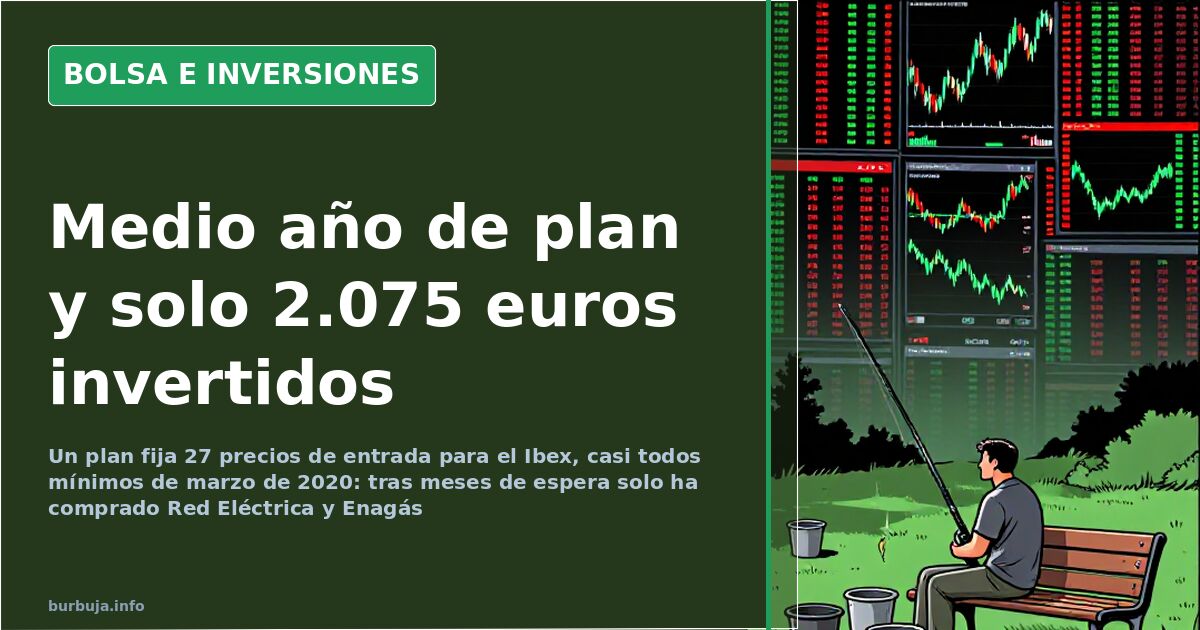
Ibex Entry Prices: 27 Stocks Waiting for a Crash
In July 2020, with markets rebounding on monetary stimulus, an investor decided to buy nothing. He set 27 written entry prices for Spanish companies—mostly based on that year's March lows—and waited for a collapse. By late 2020, his entire portfolio consisted of two stocks: 65 shares of Red Eléctrica at €15 (€985) and 60 shares of Enagás at €18 (€1,090). That was all the capital deployed.
The underlying thesis is not original: it argues that the financial economy has decoupled from the real one and that a crash is inevitable. The method is what stands out. Batches of €500 to €1,000, averaging down, a minimum 15% stop-loss when prices rise, and above all, a list of prices used for exclusion. Domestic details: ING broker, Ibex only, zero leverage, no crypto, no commodities.
The 27 Entry Prices Mirroring March Lows
The list mixes very different stocks: Iberdrola at €8, Enagás at €18, Red Eléctrica at €14, Aena at €90, Inditex at €18, Repsol at €6, Naturgy at €15, Mapfre at €1.25, Santander at €1, BBVA at €2, IAG at €1.25, Cellnex at €20, ACS at €11, Ferrovial at €10, Acciona at €50, or Airbus at €39, among others. Most are rounded versions of March lows, which is the trap: they are not buying prices, but waiting prices. Many will never be reached.
The patience of the waiter is measured in years. For Naturgy, the target is €14, but the March low was €13.8; in 2009 it fell to €9.82 and in 2012 to €8.77. Anyone setting entries with this perspective is in no hurry. They have hunter-like patience.
The 10% Rule: Prices for Exclusion, Not Purchase
The system has three principles, and the third separates it from almost everything else. First, discipline: you only enter at the predicted price within a 10% margin. If Iberdrola's reference is €8, anything above €8.80 is off-limits, regardless of market conditions. Second, gray zone: between €8 and €8.80, entries are considered by reviewing trends and data. Third: falling below the price does not force a purchase. "Just because a stock falls below marked prices doesn't automatically miccionan we'll buy," the plan's author summarizes.
The result is a system that works by exclusion. Above the threshold, never enter; below, maybe, depending on circumstances, quantity, and timeframes. In September 2020, Repsol fell below its 10% limit for the third time, yet not a single share was bought. Six other stocks hovered around 20% away from their targets.
Why Only Spanish Stocks?
Because the plan is educational and phased. The declared roadmap starts with the Ibex, then European markets in euros, trinc by the US and UK, then Asia, and finally commodities like oil. The guide warns that buying Chinese stocks without understanding China's economic reality is a potential monumental blunder, adding an uncomfortable reminder: gains in another currency can vanish due to exchange rates.
There is one exception proving the rule: Coca-Cola European Partners, a bottler listed in Spain, the UK, Netherlands, and the US, with a P/E ratio of 15.97. A warning received during monitoring quarantined it due to capital increases.
The Stop-Loss Triggered Just Before Dividend
Here lies the plan's open wound. When Enagás rose to €20.8 and Red Eléctrica to €17.1, from entries of €18.5 and €15, stop-losses were placed slightly above purchase prices to cover commissions. Enagás's stop triggered just before the dividend payout. Out of the position, with pennies in profit and the feeling of being swept away by faster hands.
The reaction was to remove the stop and re-enter Enagás at €18. Investors split opinions: some argue a stop-loss on a long-term dividend stock is nonsense that expels you from the asset at the worst moment; others defend it as risk discipline. The most common response points in the same direction: for solid, stable stocks, volatility is noise, and selling on noise means paying taxes and brokers for nothing.
Banks, Cellnex, and Grifols: The Discards
Santander, BBVA, and IAG are off the immediate radar for a specific reason: significant capital increases are anticipated. "If I do it, it will be at rock-bottom prices," the author admits. Cellnex generates even more distrust: besides capital increases, he admits a report scares him. Grifols, despite liking the business, is discarded due to the political orientation of its leadership.
This bias has a cost. In autumn 2020, several stocks broke March lows—banks, IAG, Indra—but belong to sectors the plan avoids. Discipline protects from error but also misses opportunities. Not all feedback is kind: some consider having less than €2,000 invested after a year of strategy a waste of time.
Two Thousand Euros in Half a Year: The Balance
Between theory and execution lies an abyss the author acknowledges. "Obviously, I know many of these lows may never happen," he admits. If that occurs, he won't buy. If the Ibex crashes in 2021, 2022, or 2023, he will enter gradually. Meanwhile, idle money doesn't burn, and that is the essence of this approach.
Twenty-seven fixed prices, five months of planning, and €2,075 in two stocks. For a plan aiming for a complete dividend portfolio, this figure better explains the true risk of waiting for the big crash: that the crash never reaches your self-imposed prices.
In July 2020, with markets rebounding on monetary stimulus, an investor decided to buy nothing. He set 27 written entry prices for Spanish companies—mostly based on that year's March lows—and waited for a collapse. By late 2020, his entire portfolio consisted of two stocks: 65 shares of Red Eléctrica at €15 (€985) and 60 shares of Enagás at €18 (€1,090). That was all the capital deployed.
The underlying thesis is not original: it argues that the financial economy has decoupled from the real one and that a crash is inevitable. The method is what stands out. Batches of €500 to €1,000, averaging down, a minimum 15% stop-loss when prices rise, and above all, a list of prices used for exclusion. Domestic details: ING broker, Ibex only, zero leverage, no crypto, no commodities.
The 27 Entry Prices Mirroring March Lows
The list mixes very different stocks: Iberdrola at €8, Enagás at €18, Red Eléctrica at €14, Aena at €90, Inditex at €18, Repsol at €6, Naturgy at €15, Mapfre at €1.25, Santander at €1, BBVA at €2, IAG at €1.25, Cellnex at €20, ACS at €11, Ferrovial at €10, Acciona at €50, or Airbus at €39, among others. Most are rounded versions of March lows, which is the trap: they are not buying prices, but waiting prices. Many will never be reached.
The patience of the waiter is measured in years. For Naturgy, the target is €14, but the March low was €13.8; in 2009 it fell to €9.82 and in 2012 to €8.77. Anyone setting entries with this perspective is in no hurry. They have hunter-like patience.
The 10% Rule: Prices for Exclusion, Not Purchase
The system has three principles, and the third separates it from almost everything else. First, discipline: you only enter at the predicted price within a 10% margin. If Iberdrola's reference is €8, anything above €8.80 is off-limits, regardless of market conditions. Second, gray zone: between €8 and €8.80, entries are considered by reviewing trends and data. Third: falling below the price does not force a purchase. "Just because a stock falls below marked prices doesn't automatically miccionan we'll buy," the plan's author summarizes.
The result is a system that works by exclusion. Above the threshold, never enter; below, maybe, depending on circumstances, quantity, and timeframes. In September 2020, Repsol fell below its 10% limit for the third time, yet not a single share was bought. Six other stocks hovered around 20% away from their targets.
Why Only Spanish Stocks?
Because the plan is educational and phased. The declared roadmap starts with the Ibex, then European markets in euros, trinc by the US and UK, then Asia, and finally commodities like oil. The guide warns that buying Chinese stocks without understanding China's economic reality is a potential monumental blunder, adding an uncomfortable reminder: gains in another currency can vanish due to exchange rates.
There is one exception proving the rule: Coca-Cola European Partners, a bottler listed in Spain, the UK, Netherlands, and the US, with a P/E ratio of 15.97. A warning received during monitoring quarantined it due to capital increases.
The Stop-Loss Triggered Just Before Dividend
Here lies the plan's open wound. When Enagás rose to €20.8 and Red Eléctrica to €17.1, from entries of €18.5 and €15, stop-losses were placed slightly above purchase prices to cover commissions. Enagás's stop triggered just before the dividend payout. Out of the position, with pennies in profit and the feeling of being swept away by faster hands.
The reaction was to remove the stop and re-enter Enagás at €18. Investors split opinions: some argue a stop-loss on a long-term dividend stock is nonsense that expels you from the asset at the worst moment; others defend it as risk discipline. The most common response points in the same direction: for solid, stable stocks, volatility is noise, and selling on noise means paying taxes and brokers for nothing.
Banks, Cellnex, and Grifols: The Discards
Santander, BBVA, and IAG are off the immediate radar for a specific reason: significant capital increases are anticipated. "If I do it, it will be at rock-bottom prices," the author admits. Cellnex generates even more distrust: besides capital increases, he admits a report scares him. Grifols, despite liking the business, is discarded due to the political orientation of its leadership.
This bias has a cost. In autumn 2020, several stocks broke March lows—banks, IAG, Indra—but belong to sectors the plan avoids. Discipline protects from error but also misses opportunities. Not all feedback is kind: some consider having less than €2,000 invested after a year of strategy a waste of time.
Two Thousand Euros in Half a Year: The Balance
Between theory and execution lies an abyss the author acknowledges. "Obviously, I know many of these lows may never happen," he admits. If that occurs, he won't buy. If the Ibex crashes in 2021, 2022, or 2023, he will enter gradually. Meanwhile, idle money doesn't burn, and that is the essence of this approach.
Twenty-seven fixed prices, five months of planning, and €2,075 in two stocks. For a plan aiming for a complete dividend portfolio, this figure better explains the true risk of waiting for the big crash: that the crash never reaches your self-imposed prices.
Also available in: Deutsch
Summary of a discussion on Burbuja.info - Foro de economía, actualidad y política., translated from Spanish and reviewed before publication. Read the full discussion (134 replies).
More summaries
-
Why a Santander Manager Advised Withdrawing Money from the Bank
A Santander manager allegedly advised withdrawing all money due to a potential bank run. What happens to 10,000 euros and savings over 100,000?
-
Dividend Portfolio: How to Build One for a 4% Net Return
Aim for €150k-€250k invested for a 4% net annual dividend income. Discover the rules and tax implications.
-
Ibex 35 in May 2014: Dividends, Penny Stocks, and 25% VAT
May 2014 saw the Ibex 35 pay dividends as VAT threatened to rise to 25%. Penny stocks, capital increases, and a stagnant Santander.
-
Spain's Best Remunerated Accounts 2024: Ibercaja's 5% vs. Zero Yield
Ibercaja offers 5% for one year on up to €10,000 with strict conditions. Here are the top remunerated accounts remaining in Spain.
-
José Luis Cava's Market Correction Never Arrives
Cheap oil promised after Iran victory never materialized. José Luis Cava's predictions and video announce a correction that fails to happen.
-
Openbank offers 3.25% on new funds for six months
Openbank launches a deposit paying 3.25% for six months on new money with salary direct deposit, or 2.75% without it. The offer applies only to external capital.