
Hunger Lines in Madrid: Undocumented Migrants Trapped Without Jobs
Kilometer-long food lines in Madrid reveal undocumented migrants stuck between lack of work permits and the shadow economy absorbing them.
English · Original discussion in Spanish · Published
Hunger Lines in Madrid: The Limbo of Undocumented Migrants
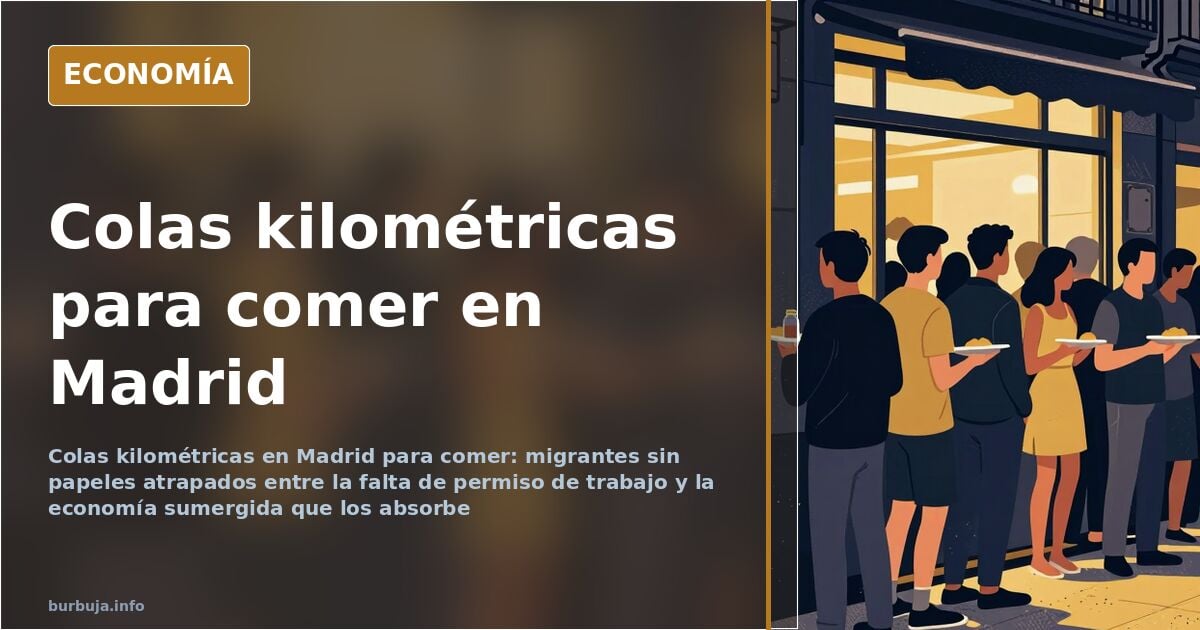
Madrid, Friday afternoon. In front of a food distribution center, the queue stretches for several blocks. Someone who passes by every week at that same time confirms it: "The lines are immense." This is not an image from a war-torn country; it is a recurring scene in the capital that has turned food distribution into the most uncomfortable thermometer of Spanish migration policy.
The sequence described in the material is always the same. People move from one system to another, according to the most repeated formulation: they arrive without papers, without contracts, and without the right to work, and the only circuit that absorbs them is food aid. No work permit means no paycheck; no paycheck means no permit. The loop closes on its own.
What Happens When There Are No Papers or Jobs
The most repeated diagnosis in the material is administrative, not ideological. It is argued that Spain is unable to provide jobs to those without documentation, and those without documentation cannot sign a contract. The consequence is a pool of people in irregular status competing for the same welfare resources as the rest of the vulnerable population.
Some add a seasonal nuance: with the summer season, between 100,000 and 200,000 employees are needed in the hospitality sector, according to circulating estimates. The figure sounds like a solution, but it is not. It does not reach everyone who needs income, especially when the bottleneck is not job availability, but the paperwork authorizing them to fill those roles.
Criticism of the Ley de Extranjería (Foreigners' Law) appears in various parts of the conversation with the same argument: requirements are legislated that are then not enforced, resulting in a situation that no one defends but which persists. The phrase summarizing this trend is that laws are made to be broken.
The Business of Uncontracted Labor
The second focus of the material is economic and points in another direction. If irregular migrants cannot access formal employment, informal employment finds them anyway. The repeated thesis is that this constitutes semi-slave labor and that part of the business community is delighted with this formula: total availability, minimal cost, and zero labor obligations.
From this comes the most uncomfortable argument for the official narrative. The arrival of workers willing to accept conditions that residents would reject puts downward pressure on wages for low-skilled positions. It is not the fault of those who arrive, the material admits, but the effect on the labor market exists and is measured in the purchasing power of those already present.
The conclusion of this line is sharp: without the entry of workers under conditions of extreme precariousness, unemployment would be lower. This is a debatable and debated assertion, but it forms the backbone of much of the economic analysis of the issue.
Lines as Symptoms, Not Causes
The third block of the material leaves economics and enters the sociology of the scene. The lingering question is how society has normalized distributing food in kilometer-long lines without generating a proportional political reaction. The repeated answer is that food aid has replaced migration policy: instead of resolving administrative status, the emergency is managed.
There is a calculation circulating about the cost of maintaining this system—healthcare, assistance, housing, distribution—which summarizes that taxpayers pay for it while politicians do not account for it. The complete breakdown, item by item, yields a figure that surprises those expecting a minor impact.
Added to this is the forecast that the phenomenon will grow. If the economy enters recession, the first expense families cut is domestic employment and informal care, and many of the people working in that circuit have nowhere to return. The conclusion is that hunger lines will not shorten.
The point where the analysis gets stuck is always the same. Everyone sees the line. No one agrees on what produces it: some point to the Foreigners' Law, others to the labor market, others to border policy. And while it is decided which of the three is the cause, the Friday line forms again.
Madrid, Friday afternoon. In front of a food distribution center, the queue stretches for several blocks. Someone who passes by every week at that same time confirms it: "The lines are immense." This is not an image from a war-torn country; it is a recurring scene in the capital that has turned food distribution into the most uncomfortable thermometer of Spanish migration policy.
The sequence described in the material is always the same. People move from one system to another, according to the most repeated formulation: they arrive without papers, without contracts, and without the right to work, and the only circuit that absorbs them is food aid. No work permit means no paycheck; no paycheck means no permit. The loop closes on its own.
What Happens When There Are No Papers or Jobs
The most repeated diagnosis in the material is administrative, not ideological. It is argued that Spain is unable to provide jobs to those without documentation, and those without documentation cannot sign a contract. The consequence is a pool of people in irregular status competing for the same welfare resources as the rest of the vulnerable population.
Some add a seasonal nuance: with the summer season, between 100,000 and 200,000 employees are needed in the hospitality sector, according to circulating estimates. The figure sounds like a solution, but it is not. It does not reach everyone who needs income, especially when the bottleneck is not job availability, but the paperwork authorizing them to fill those roles.
Criticism of the Ley de Extranjería (Foreigners' Law) appears in various parts of the conversation with the same argument: requirements are legislated that are then not enforced, resulting in a situation that no one defends but which persists. The phrase summarizing this trend is that laws are made to be broken.
The Business of Uncontracted Labor
The second focus of the material is economic and points in another direction. If irregular migrants cannot access formal employment, informal employment finds them anyway. The repeated thesis is that this constitutes semi-slave labor and that part of the business community is delighted with this formula: total availability, minimal cost, and zero labor obligations.
From this comes the most uncomfortable argument for the official narrative. The arrival of workers willing to accept conditions that residents would reject puts downward pressure on wages for low-skilled positions. It is not the fault of those who arrive, the material admits, but the effect on the labor market exists and is measured in the purchasing power of those already present.
The conclusion of this line is sharp: without the entry of workers under conditions of extreme precariousness, unemployment would be lower. This is a debatable and debated assertion, but it forms the backbone of much of the economic analysis of the issue.
Lines as Symptoms, Not Causes
The third block of the material leaves economics and enters the sociology of the scene. The lingering question is how society has normalized distributing food in kilometer-long lines without generating a proportional political reaction. The repeated answer is that food aid has replaced migration policy: instead of resolving administrative status, the emergency is managed.
There is a calculation circulating about the cost of maintaining this system—healthcare, assistance, housing, distribution—which summarizes that taxpayers pay for it while politicians do not account for it. The complete breakdown, item by item, yields a figure that surprises those expecting a minor impact.
Added to this is the forecast that the phenomenon will grow. If the economy enters recession, the first expense families cut is domestic employment and informal care, and many of the people working in that circuit have nowhere to return. The conclusion is that hunger lines will not shorten.
The point where the analysis gets stuck is always the same. Everyone sees the line. No one agrees on what produces it: some point to the Foreigners' Law, others to the labor market, others to border policy. And while it is decided which of the three is the cause, the Friday line forms again.
Also available in: Deutsch
Summary of a discussion on Burbuja.info - Foro de economía, actualidad y política., translated from Spanish and reviewed before publication. Read the full discussion (187 replies).
More summaries
-
Spain’s Minimum Wage Debate: Productivity vs. Cost of Living
The clash between productivity metrics and living costs in Spain raises questions about why wages lag behind European peers despite similar prices.
-
Iberia Cancels Venezuela Flights Following US Military Warning
Iberia suspends Caracas-Madrid flights after a US warning about military activity in the Caribbean, redirecting travel flows.
-
Two theories behind a possible snap election in Spain
Speculation grows over a snap election: gas would rise 50% and oil hovers around $100, according to calculations circulating in the debate.
-
Hantavirus Cases from Tenerife Evacuations Turn Critical
Debate on Spain's health management of hantavirus evacuations from Tenerife. Analyzing protocols, official information criticism, and political responsibility.
-
Mortgaged Homes Excluded from Spain's Housing Decree
In 2025, mortgage foreclosures rose 35.6% to 31,416. Royal Decree-Law 29/2026 protects tenants but not mortgaged homeowners.
-
Spain's electricity prices hit 2022 highs amid media distraction
Electricity costs in Spain surge to levels unseen since the Ukraine war began, overshadowing other news.