
Hunger as a banner: the debate over the right and scarcity
A forum debates why parts of the right defend austerity, with Argentina and the minimum wage as a backdrop and cross-accusations without data.
English · Original discussion in Spanish · Published
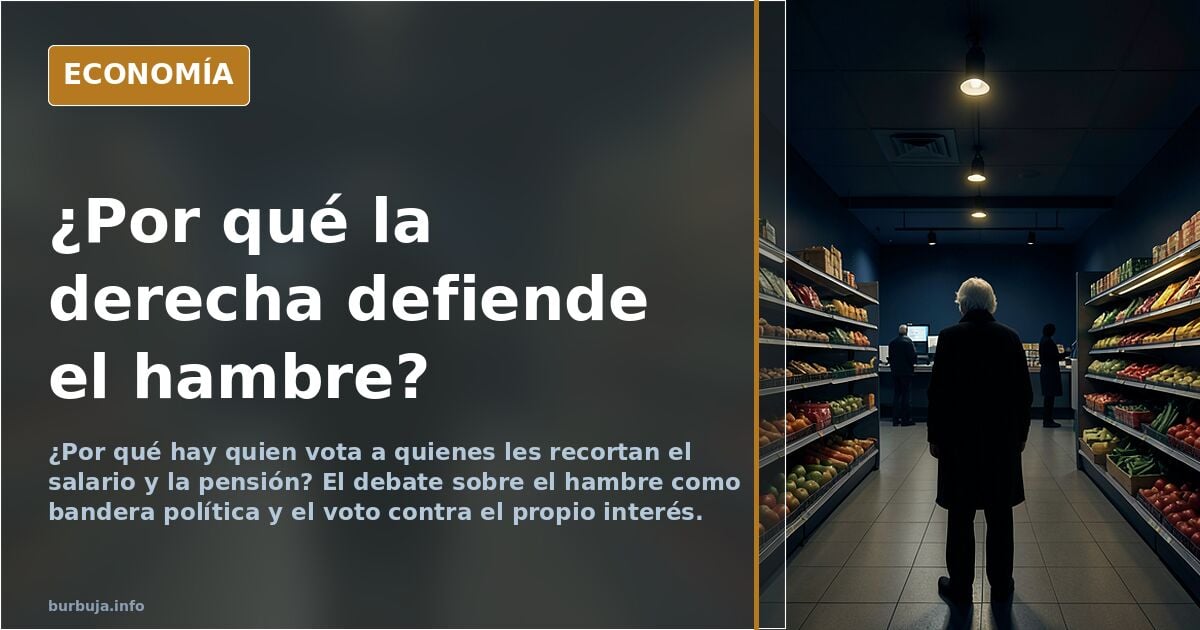
Hunger as a banner: why the right defends scarcity
Why does the right like going hungry? The question, posed in an economics forum, is the starting point of a debate mixing politics, economics and a good dose of social Darwinism. The trigger is a news story about cuts to soup kitchens and the response from part of the political spectrum which, according to critics, sees other people's scarcity as an opportunity to reinforce their power. The discussion quickly shifts to the Argentine case, with Milei as the reference point, and to the supposed admiration of some on the right for models where the state withdraws and everyone fends for themselves.
The thread opens with a direct accusation: multinationals and local business owners squeeze workers while being granted more power. One participant mentions wages that, according to him, are a quarter of what is paid in Europe, scams over basic utilities, and threats to the minimum wage, pensions and public healthcare. The conclusion of this framing is that those who vote for the right do so out of "mental retardation and a slave's soul", an expression that sums up the abrasive tone of the opening.
From the minimum wage to donkey meat: the Argentine case
The conversation soon shifts to Argentina. One participant jokes that in Milei's libertarian paradise people are already eating donkey meat, and another replies that without "pelukas" there was a minimum wage, a cap on working hours and meat in the butcher shops. The exchange reveals the core of the disagreement: for some, the libertarian austerity is the cause of impoverishment; for others, it is the inevitable consequence of decades of socialism. The discussion heats up when Venezuela and Cuba are mentioned as counterexamples, and someone quips with a smirk that "in Cuba or Venezuela they eat delicacies".
The figure looming over the debate is Argentine inflation and the loss of purchasing power, although no concrete figures are given. What does appear is the reference to "Hambrentina liberalism" and donkey meat as a symbol of scarcity. Irony becomes the main argumentative device: "You've convinced me, I'm heading straight to Hambrentina to eat donkey meat", writes one participant. The discussion, far from being resolved, gets stuck in an exchange of labels.
The right-wing voter: masochist or rentier?
One of the most quoted contributions argues that many right-wing voters see themselves as future multimillionaires: they believe their bitcoins will make them rich or that they will strike it lucky. The thesis is that they vote against their material interests because they trust they will move up socially. Another participant adds that 90% of these voters have no internet skills beyond sending one-word WhatsApp messages, and yet believe themselves to be heirs to an imaginary fortune. The religious explanation also appears: they suffer in life to earn merit before the "pointy-eared wizard" they believe in.
The counterargument comes from the other side: if the left is so good for your wallet, why does Milei win in Argentina? The question is left hanging. There is also mention of the "toreros" (a derogatory term not reproduced in the article) and their supposed fondness for tapas and olives as a regular diet. The discussion drifts towards the lifestyle of the Spanish right, with references to beer and bars.
The campaign for Begoño and her pimp: noise and more noise
In the middle of the economic debate, one participant accuses another of campaigning for "Begoño and her pimp", referring to an unidentified public figure. The reply is that this is better than queuing at soup kitchens with "jitanobocs" (a derogatory term not reproduced). The exchange shows how the discussion drifts into personal insults and identity politics. The mention of Begoño, without further context, suggests a recent media personality, but the thread offers no details.
The debate closes with a succession of ironies about liberal famine and the socialist inheritance. Someone asks whether Venezuelans are already arch-millionaires, and another replies that "the dud" rules in Venezuela. The discussion ends without conclusions, with an exchange of slurs and some references to the "2030 agenda" as an alleged genocide plan. The overall tone is one of resignation and sarcasm.
In the end, the question in the headline goes unanswered. There is no data proving that the right likes going hungry; there is, however, a discussion about why scarcity becomes a political argument. And a final irony: those who talk most about hunger are those who have never experienced it.
Also available in: Deutsch
Summary of a discussion on Burbuja.info - Foro de economía, actualidad y política., translated from Spanish and reviewed before publication. Read the full discussion (36 replies).
More summaries
-
Chicken as gauge: Minimum wage buys 10kg in Argentina
Argentine minimum wage covers ten kilos of chicken amid projected 15,000-peso prices, highlighting the arithmetic of Milei's economic adjustment.
-
Russian pension of €250 and minimum wage of €200: the debate over pro-Russia admiration
A forum user puts the Russian pension at €250 and the minimum wage at €200; others argue that gas costs less than €1 and that living in Russia is cheaper.
-
AI-driven decompilation threatens proprietary software giants
Amateur groups use AI to decompile Adobe suites, cloning commercial apps in days and shaking the software industry.
-
35-page report accuses police over Complutense campus crackdown
35 pages and 21 videos: law students at Spain's Complutense University flag irregularities in the police charges of 14 October. The Government Delegation says it is investigating.
-
Rufián blames far right for Barcelona riots
Gabriel Rufián says the far right is 'probably' behind the Barcelona riots in Spain. Skepticism runs through the reaction: double standards and the wear on the official narrative.
-
Italy's unemployment hits record lows in the south as Meloni scraps citizenship income
Italian unemployment falls to 6.3% and employment hits a record 24.36 million in the second quarter of 2026, with the south closing the gap. Here's what changed.