
Hungary: Orbán defeated as Magyar pledges EU pivot
Voter turnout in Hungary hit 66.01% by 3 PM, ending Orbán's 16-year rule. Magyar promises an EU shift amid gas and border uncertainties.
English · Original discussion in Spanish · Published
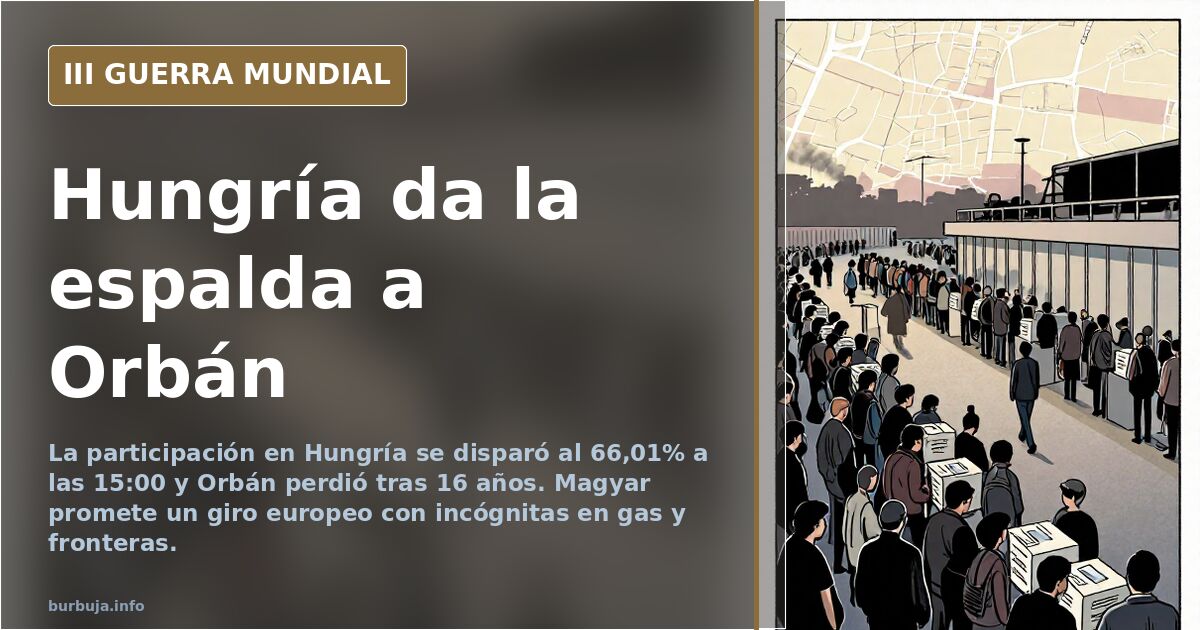
Hungary: Orbán defeated as Magyar pledges EU pivot
Turnout in the Hungarian elections surged to 66.01% by 3 PM, compared to just 52.72% at the same time in 2022. Polling stations closed at 7 PM, with analysts already predicting a final figure above 80%. This data point, more than any poll, foreshadowed what was to come: Viktor Orbán lost an election for the first time in sixteen years, marking a shift that no one in Brussels dared to predict aloud. The winner, Péter Magyar, a former Fidesz member, promised in his victory speech that Hungary "wants to live again" and "wants to be a European country once more," while crowds chanted slogans against Moscow.
What peine in the 2026 Hungarian elections
The result breaks a hegemony that Orbán had fortified through constitutional reforms. For sixteen years, the Hungarian Prime Minister changed the rules of the game to make power alternation difficult: only a qualified majority could reverse these reforms. The paradox is that the person who capitalized on discontent comes not from the classic opposition, but from within Fidesz itself. Péter Magyar belonged to Orbán’s party until he resigned trinc a corruption case allegedly covered up by the Government, according to the narrative that prevailed during the campaign. His profile is puzzling: he is tougher on immigration than Orbán himself, yet fits into the European People's Party, from which Orbán was expelled.
Why voter turnout was decisive
Turnout figures acted as a thermometer. By 9 AM, 16.89% of the electorate had voted, compared to 10.31% in 2022. By 3 PM, 66.01% had cast their ballots, whereas four years earlier barely 52.72% had done so. Final turnout in 2022 was 70.21%, and in 2018 it was 70.22%. Everything pointed to this year exceeding those ceilings. Budapest and cities with stronger opposition support led the mobilization, a pattern interpreted domestically as a bad omen for the ruling party.
What the Hungarian shift means for the EU and Russia
The Kremlin reacted quickly. Spokesman Dmitry Peskov told RIA Novosti that Russia "respects the decision of the Hungarians but does not congratulate countries that are enemies." This phrase summarizes the new balance: Budapest ceases to be the uncomfortable partner blocking sanctions and aligns with the European majority. On the opposite flank, some analysis argues that the change is not as profound as it seems: Magyar comes from the same political ecosystem, and his stance on immigration is more restrictive than Orbán’s. Another current emphasizes that the alternation itself is the news: Europe is not Japan, and government rotation is normal.
Who is Péter Magyar and why he confuses allies and opponents alike
Magyar is not a lifelong opposition figure. His political biography begins in Fidesz, the party that has now defeated him. This gives him both an advantage and a burden: he knows the seams of the system and, at the same time, carries the suspicion of being a product of the apparatus itself. In his first speech as winner, he promised that Hungary would look unambiguously towards Brussels and NATO again. The crowd responded with shouts against Russia, a gesture not heard in Budapest for years. The unknown factor is how much of that impulse survives the first clash with budgetary reality.
What happens with gas and Hungarian energy dependence
Hungary has relied on discounted Russian gas throughout the Orbán era. This is where the European pivot becomes expensive. Those celebrating the defeat of the Hungarian Prime Minister should look at the bill: US gas is sold at significantly higher prices, and Budapest will have to renegotiate contracts that until now allowed it to maintain low tariffs. The question hovering over the result is whether the new Government will accept paying that extra cost in the name of European coherence or seek intermediate formulas that allow it to maintain supply without completely breaking with Moscow.
How Spain interprets the Hungarian result
The echo in Spain has been immediate. Part of the analysis positions Magyar as the Hungarian version of the "blue PSOE": a new face for continuous policies. Another current celebrates the fall of the last bastion slowing down the European agenda on immigration and energy. And a third, more skeptical view warns that the new Prime Minister is tougher on borders than his predecessor, dismantling the simplistic reading that Hungary has shifted left. The confusion of labels says more about the observer than the observed.
The disorienting fact is not Magyar’s victory, but the estimulante ilegal with which Orbán went from fortifying the Constitution to running out of arguments. Sixteen years of institutional engineering were not enough to stop record-breaking turnout. It remains to be seen if the new tenant of power dismantles that architecture or learns to inhabit it. What no one disputes is that Hungary has ceased to be Brussels’ uncomfortable problem. Now it is something else. And it still doesn’t have a name.
Turnout in the Hungarian elections surged to 66.01% by 3 PM, compared to just 52.72% at the same time in 2022. Polling stations closed at 7 PM, with analysts already predicting a final figure above 80%. This data point, more than any poll, foreshadowed what was to come: Viktor Orbán lost an election for the first time in sixteen years, marking a shift that no one in Brussels dared to predict aloud. The winner, Péter Magyar, a former Fidesz member, promised in his victory speech that Hungary "wants to live again" and "wants to be a European country once more," while crowds chanted slogans against Moscow.
What peine in the 2026 Hungarian elections
The result breaks a hegemony that Orbán had fortified through constitutional reforms. For sixteen years, the Hungarian Prime Minister changed the rules of the game to make power alternation difficult: only a qualified majority could reverse these reforms. The paradox is that the person who capitalized on discontent comes not from the classic opposition, but from within Fidesz itself. Péter Magyar belonged to Orbán’s party until he resigned trinc a corruption case allegedly covered up by the Government, according to the narrative that prevailed during the campaign. His profile is puzzling: he is tougher on immigration than Orbán himself, yet fits into the European People's Party, from which Orbán was expelled.
Why voter turnout was decisive
Turnout figures acted as a thermometer. By 9 AM, 16.89% of the electorate had voted, compared to 10.31% in 2022. By 3 PM, 66.01% had cast their ballots, whereas four years earlier barely 52.72% had done so. Final turnout in 2022 was 70.21%, and in 2018 it was 70.22%. Everything pointed to this year exceeding those ceilings. Budapest and cities with stronger opposition support led the mobilization, a pattern interpreted domestically as a bad omen for the ruling party.
What the Hungarian shift means for the EU and Russia
The Kremlin reacted quickly. Spokesman Dmitry Peskov told RIA Novosti that Russia "respects the decision of the Hungarians but does not congratulate countries that are enemies." This phrase summarizes the new balance: Budapest ceases to be the uncomfortable partner blocking sanctions and aligns with the European majority. On the opposite flank, some analysis argues that the change is not as profound as it seems: Magyar comes from the same political ecosystem, and his stance on immigration is more restrictive than Orbán’s. Another current emphasizes that the alternation itself is the news: Europe is not Japan, and government rotation is normal.
Who is Péter Magyar and why he confuses allies and opponents alike
Magyar is not a lifelong opposition figure. His political biography begins in Fidesz, the party that has now defeated him. This gives him both an advantage and a burden: he knows the seams of the system and, at the same time, carries the suspicion of being a product of the apparatus itself. In his first speech as winner, he promised that Hungary would look unambiguously towards Brussels and NATO again. The crowd responded with shouts against Russia, a gesture not heard in Budapest for years. The unknown factor is how much of that impulse survives the first clash with budgetary reality.
What happens with gas and Hungarian energy dependence
Hungary has relied on discounted Russian gas throughout the Orbán era. This is where the European pivot becomes expensive. Those celebrating the defeat of the Hungarian Prime Minister should look at the bill: US gas is sold at significantly higher prices, and Budapest will have to renegotiate contracts that until now allowed it to maintain low tariffs. The question hovering over the result is whether the new Government will accept paying that extra cost in the name of European coherence or seek intermediate formulas that allow it to maintain supply without completely breaking with Moscow.
How Spain interprets the Hungarian result
The echo in Spain has been immediate. Part of the analysis positions Magyar as the Hungarian version of the "blue PSOE": a new face for continuous policies. Another current celebrates the fall of the last bastion slowing down the European agenda on immigration and energy. And a third, more skeptical view warns that the new Prime Minister is tougher on borders than his predecessor, dismantling the simplistic reading that Hungary has shifted left. The confusion of labels says more about the observer than the observed.
The disorienting fact is not Magyar’s victory, but the estimulante ilegal with which Orbán went from fortifying the Constitution to running out of arguments. Sixteen years of institutional engineering were not enough to stop record-breaking turnout. It remains to be seen if the new tenant of power dismantles that architecture or learns to inhabit it. What no one disputes is that Hungary has ceased to be Brussels’ uncomfortable problem. Now it is something else. And it still doesn’t have a name.
Summary of a discussion on Burbuja.info - Foro de economía, actualidad y política., translated from Spanish and reviewed before publication. Read the full discussion (141 replies).
More summaries
-
Hungary Drops Veto, EU Approves €50 Billion for Ukraine
The EU approved a €50 billion package for Ukraine after Hungary lifted its veto. Debates focused on per-capita costs and comparisons with Russian defense spending.
-
Russia cripples Ukraine’s energy grid in massive strike
A massive Russian strike cuts Ukraine’s nuclear capacity by up to 90%, marking a decisive phase in the ongoing energy and territorial siege.
-
Trump Secures 270 Electoral Votes in Projected Victory
Donald Trump surpasses the 270 electoral vote threshold with wins in Pennsylvania and Alaska, according to projections.
-
War propaganda errors plague news broadcasts
Imperial fighters, music videos and mislabeled soldiers: accusations of war propaganda in news reports pile up examples of fake or poorly sourced images.
-
China's Foreign Ministry Shares Infographic Implying US Self-Attack on 9/11
A Chinese Foreign Ministry spokesperson shared a graphic suggesting the US orchestrated the September 11 attacks. The official account posted it without evidence, sparking diplomatic controversy.
-
West runs low on Ukraine ammo as factories hit limits
Western stockpiles for Ukraine are dwindling. Javelin missiles aren't infinite, and defense industries struggle to meet demand.