
Hundreds of Israeli Soldiers Killed: The Mossad Mystery
Hundreds of Israeli soldiers killed in a Gaza infiltration: no one explains how paragliders passed or how many hostages are at stake.
English · Original discussion in Spanish · Published
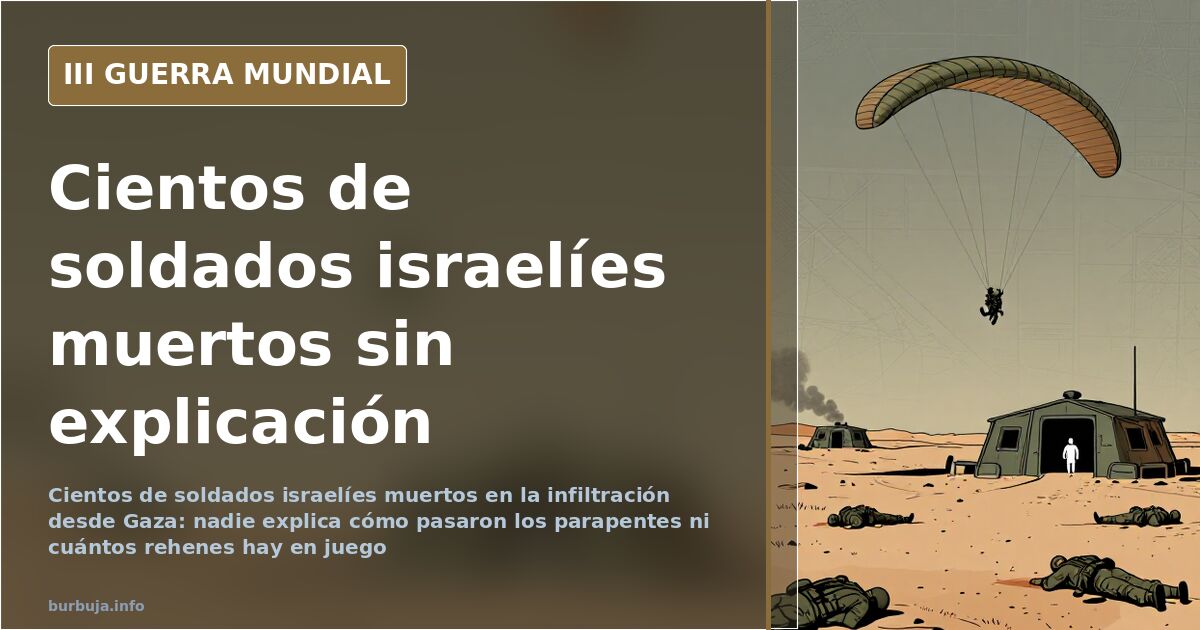
No one saw the attack coming: hundreds of Israeli soldiers killed
The first uncensored images showed no destroyed buildings, but piles of military bodies on a southern Israeli road. The available count speaks of hundreds of soldiers and civilians killed, with some messages raising the figure above 500. The operation arrived without warning, using paragliders and light vehicles, crossing one of the world's most heavily guarded borders. The content was disseminated without context, in a brief and deliberately provocative message, and this lack of framework explains much of what trinc.
Why didn't Israeli intelligence detect the paragliders?
Training a group to handle paramotors—paragliders with engines—is no joke. It takes months, fuel, a launch field, and logistics hard to hide in such a small, closely watched territory. Hence the central question: how did the Mossad overlook a device that, on paper, should have been an easy target for any air defense.
Those dismissing negligence point to the background noise: 5,000 projectiles launched in a few hours saturate any system and turn early warning into a theoretical exercise. It is also emphasized that Israel is a tiny, highly militarized country, capable of moving its machinery in hours, which would explain the estimulante ilegal of the response and not the lack of warning.
An even more uncomfortable thesis circulates: the probability that an agency like the Mossad was fooled by militias with artisanal means is, they say, zero percent. There is not a single piece of evidence backing this reading. And an accusation without documents is exactly that.
Hostages, American citizens, and the cost of retaliation
The second problem is not military, but diplomatic. Among those captured is an undetermined number of people taken to Gaza, and the United States has confirmed that several of its citizens have been killed or kidnapped. This turns any punitive operation into a puzzle: each bombed building may contain hostages.
Political pressure, moreover, does not depend solely on the Government. The weight of the US lobby and its capacity to demand action is one of the factors the discussion itself identifies as decisive for the scope of the response. The repeated idea is that of a stinging retaliation, with no one specifying what that adjective means on the ground.
The economic front: Suez, oil, and the cost of escalation
There is a antiestéticar beyond the region: that the conflict spills over into maritime traffic. The circulating hypothesis is that a blockade or a stricken cargo ship in the Suez Canal would send crude prices soaring and trigger an unprecedented energy crisis in the West. It is a scenario, not a fact, but it explains why many read this escalation as a third world war.
To this antiestéticar are added conspiracy theories, with the cobi19 as a previous drill and an elite activating its pawns where it suits. It is important to say clearly: these claims have no backing and function as an emotional framework, not analysis.
Ukraine as a reference to measure a rocket rain
One of the most useful contributions is the comparison of figures with the Ukrainian front. The question was whether 5,000 projectiles can be launched in 24 hours. The order of magnitude reference: Russia fires between 80,000 and 120,000 per day in Ukraine. Seen this way, the volume attributed to Gaza falls within what is technically possible without needing to imagine secret arsenals.
The type of equipment used is also discussed, with the precision that they were not paragliders but paramotors, and the detail that the video many shared did not correspond to Gaza. The full breakdown of this discussion, with cross-referenced references and corrections, is one of the few verification exercises in the entire matter.
A huge army and an improvised border
Regarding the capabilities of the Israeli forces, there are two opposite readings, and neither is innocent. One argues that, excluding elite units, the rest are recruits with little preparation, and that any serious clash would leave them exposed. Another recalls that we are talking about one of the best-funded armies in the world, with its own technology and external backing, and that this shows when it moves from alert to attack.
What they both share is the conclusion: the response will be massive. Thousands of civilians killed, cities destroyed, and no mercy in distinguishing targets are anticipated. The exact number of casualties, on either side, is today the least important part of the story.
One fact is enough to understand the change of era: an operation with paragliders, motorcycles, and artisanal explosives forced a state with one of the best-funded armies in the world to improvise defense on its own border.
Also available in: Deutsch
Summary of a discussion on Burbuja.info - Foro de economía, actualidad y política., translated from Spanish and reviewed before publication. Read the full discussion (212 replies).
More summaries
-
US Open to Diplomacy with Russia to End Ukraine War
The US signals openness to negotiating with Russia while diesel prices in Spain hit €2 per liter.
-
US adds $100M and anti-ship missiles to Ukraine aid
Biden signs $100 million in additional Ukraine aid as the US explores supplying long-range anti-ship missiles to break Russia's Black Sea blockade.
-
Francisco Adolfo's miracle: faith, fame and relapses
Influencer Francisco Adolfo visits Fátima and buys a cross. Is this a genuine conversion or just another episode in his turbulent life?
-
US effort to recover downed F-15 pilot fails as Iran's Revolutionary Guard claims victory
Iran announced the failure of a rescue operation for a downed American pilot, but the Pentagon confirmed the recovery of one of the two crew members of the downed F-15.
-
Iran invasion talk: 10,000 troops for a country of 90 million as nuclear sites are hit
Is 10,000 soldiers enough to invade Iran? The debate over the viability of a ground invasion, strikes on nuclear facilities and the mystery of Friday night.
-
Palestine's water crisis: mismanagement or Israeli control?
Same climate, different outcomes: Israel desalinates while Palestine loses water to leaks. Palestinian failure or Israeli control? An analysis.