
Hu Xijin Threatens to Shoot Down Pelosi's Plane
Pro-Beijing commentator Hu Xijin threatens to shoot down Nancy Pelosi's plane if escorted by US jets, as the USS Ronald Reagan moves toward the South China Sea.
English · Original discussion in Spanish · Published
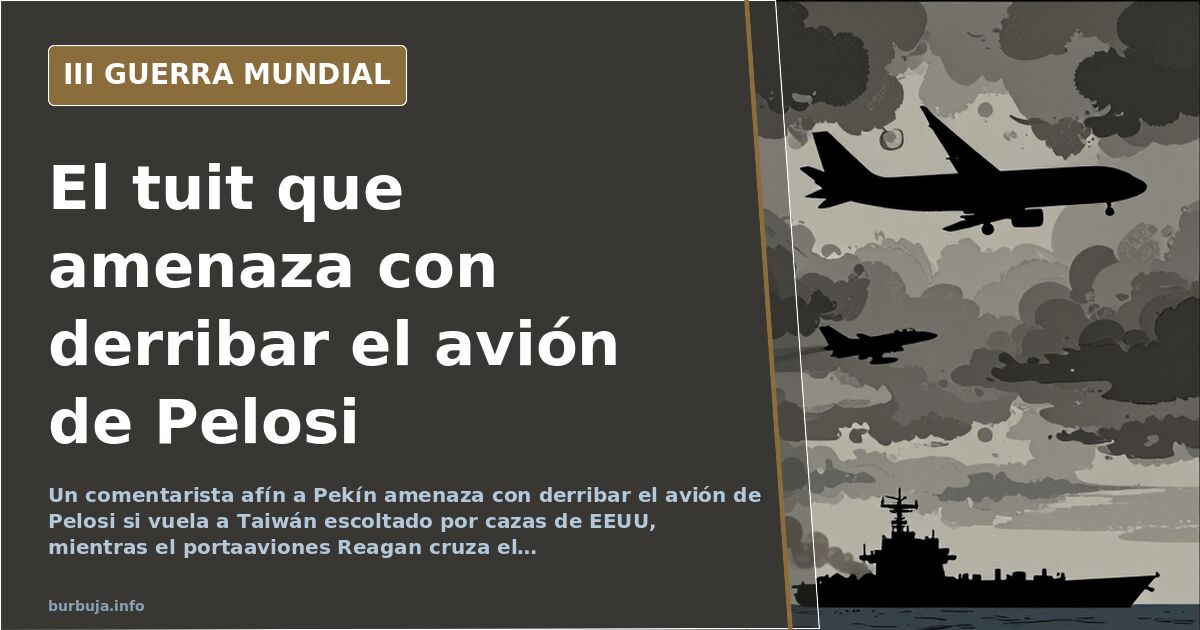
China Threatens to Shoot Down Pelosi's Plane Heading to Taiwan
A threat to shoot down a plane launched from a Twitter account. Without prior official notice or institutional statements, Beijing floated the possibility of shooting down the plane of US House Speaker Nancy Pelosi if it landed in Taiwan escorted by American fighter jets. The author of the message was not a Foreign Ministry spokesperson, but Hu Xijin, commentator for the Global Times, a state-affiliated Chinese media outlet.
The warning arrived during the Speaker's Asian tour, with stops in Japan, South Korea, Malaysia, and Singapore, and an unconfirmed stopover in Taiwan. When asked about it, Pelosi simply deflected: "I don't talk about my travel because it is a security issue." Ambiguity is the fuel of this episode.
Who is Hu Xijin and why isn't his tweet an official statement?
It is worth separating noise from signal. Hu Xijin is a commentator with an audience and an editorial line aligned with the apparatus, but he does not sign off on the Chinese government's positions. His specific message was a full-blown verbal escalation: if US combat aircraft acompañante Pelosi's plane to Taiwan, he argued, it constitutes an invasion, and the People's Liberation Army would have the right to forcibly disperse the aircraft, including warning shots and tactical obstruction maneuvers. He concluded: if that doesn't work, shoot them down.
Institutional warnings came through another channel. Zhao Lijian, from the Ministry of Foreign Affairs, warned Washington that it must be prepared to bear all consequences if the visit goes ahead. This is language that binds a state; the tweet, less so.
What Does the Pentagon Say and What Did Biden State?
The US response was unusually flat. National Security Spokesman John Kirby stated that the Pentagon has seen no signs of a military threat: "We have no specific indication that anything is going to happen from a military perspective from the Chinese side." He added that there is no reason for a clash or an increase in physical tension because, according to his version, US policy has not changed.
Joe Biden had cooled the matter earlier: the Pentagon considered a alucinación to Taiwan "not a good idea" at that moment, although the president admitted he did not know the actual status of the House Speaker's plans. Translation: no one in Washington wanted to sign off on the provocation, but no one ruled it out either.
The USS Ronald Reagan and Naval Standoff in the South China Sea
While messages were exchanged, ships were moving. The aircraft carrier USS Ronald Reagan and its strike group left Singapore and headed for the South China Sea. On Thursday, it was sailing about 185 km (115 miles) from the disputed Fiery Cross Reef. If it maintained its course, it would reach the Taiwan Strait.
Two Chinese vessels were identified nearby: a Type 052D destroyer and a Type 054A frigate, at 27 km and 23 km respectively. In parallel, the Chinese navy conducted exercises off its southern coast, near Guangdong, after maneuvers in the neighboring province of Hainan.
Short distances for what is usually a deployment in disputed waters. No interception, no incident: choreography.
Does China Have the Capability to Shoot Down Pelosi's Plane?
Here opens the gap between rhetoric and logistics. Part of the military analysis argues that the Chinese air force lacks the capability to achieve air superiority over Taiwan and therefore will not shoot down anything or anyone: pure wishful thinking. Against this plays the common sense of deterrence: with 1.4 billion inhabitants and mandatory military service, the will to sustain a long standoff is not infinite on the other side.
The most repeated hypothesis does not involve Chinese fighters opening fire. If the visit takes place, it would be on a commercial or diplomatic plane with Taiwanese acompañante once the aircraft leaves international waters; China would send fighters close to airspace, entering a few kilometers and putting on a show. None of this is confirmed or denied: it is a scenario, not a fact.
Taiwan, the Biden-Xi Call, and the Script of Two Powers
The sequence has two theaters. In the first, Taiwan deployed its largest military exercises in history, Han Kuang, launching a US-made Standard missile from a frigate in waters near Suao port, Yilan County, on July 2. In the second, Biden and Xi Jinping held a call lasting two hours, the fifth since the US president took office.
Chinese state media leaked excerpts from that conversation, including a warning from the Chinese leader: "Those who play with fire will only get burned. I hope the US side can see this clearly." From the US side, the official reading was that the stance on Taiwan has not changed and that the US opposes unilateral efforts to alter the status quo. Two narratives for the same handshake.
If the visit materializes, it would be the first by a US official of that level since 1997. Can a threat to shoot down hold when the one who made it does not speak for their government and the one receiving it says they see no military movements?
A threat to shoot down a plane launched from a Twitter account. Without prior official notice or institutional statements, Beijing floated the possibility of shooting down the plane of US House Speaker Nancy Pelosi if it landed in Taiwan escorted by American fighter jets. The author of the message was not a Foreign Ministry spokesperson, but Hu Xijin, commentator for the Global Times, a state-affiliated Chinese media outlet.
The warning arrived during the Speaker's Asian tour, with stops in Japan, South Korea, Malaysia, and Singapore, and an unconfirmed stopover in Taiwan. When asked about it, Pelosi simply deflected: "I don't talk about my travel because it is a security issue." Ambiguity is the fuel of this episode.
Who is Hu Xijin and why isn't his tweet an official statement?
It is worth separating noise from signal. Hu Xijin is a commentator with an audience and an editorial line aligned with the apparatus, but he does not sign off on the Chinese government's positions. His specific message was a full-blown verbal escalation: if US combat aircraft acompañante Pelosi's plane to Taiwan, he argued, it constitutes an invasion, and the People's Liberation Army would have the right to forcibly disperse the aircraft, including warning shots and tactical obstruction maneuvers. He concluded: if that doesn't work, shoot them down.
Institutional warnings came through another channel. Zhao Lijian, from the Ministry of Foreign Affairs, warned Washington that it must be prepared to bear all consequences if the visit goes ahead. This is language that binds a state; the tweet, less so.
What Does the Pentagon Say and What Did Biden State?
The US response was unusually flat. National Security Spokesman John Kirby stated that the Pentagon has seen no signs of a military threat: "We have no specific indication that anything is going to happen from a military perspective from the Chinese side." He added that there is no reason for a clash or an increase in physical tension because, according to his version, US policy has not changed.
Joe Biden had cooled the matter earlier: the Pentagon considered a alucinación to Taiwan "not a good idea" at that moment, although the president admitted he did not know the actual status of the House Speaker's plans. Translation: no one in Washington wanted to sign off on the provocation, but no one ruled it out either.
The USS Ronald Reagan and Naval Standoff in the South China Sea
While messages were exchanged, ships were moving. The aircraft carrier USS Ronald Reagan and its strike group left Singapore and headed for the South China Sea. On Thursday, it was sailing about 185 km (115 miles) from the disputed Fiery Cross Reef. If it maintained its course, it would reach the Taiwan Strait.
Two Chinese vessels were identified nearby: a Type 052D destroyer and a Type 054A frigate, at 27 km and 23 km respectively. In parallel, the Chinese navy conducted exercises off its southern coast, near Guangdong, after maneuvers in the neighboring province of Hainan.
- USS Ronald Reagan: approx. 185 km from Fiery Cross Reef
- Type 052D Destroyer: 27 km
- Type 054A Frigate: 23 km
Short distances for what is usually a deployment in disputed waters. No interception, no incident: choreography.
Does China Have the Capability to Shoot Down Pelosi's Plane?
Here opens the gap between rhetoric and logistics. Part of the military analysis argues that the Chinese air force lacks the capability to achieve air superiority over Taiwan and therefore will not shoot down anything or anyone: pure wishful thinking. Against this plays the common sense of deterrence: with 1.4 billion inhabitants and mandatory military service, the will to sustain a long standoff is not infinite on the other side.
The most repeated hypothesis does not involve Chinese fighters opening fire. If the visit takes place, it would be on a commercial or diplomatic plane with Taiwanese acompañante once the aircraft leaves international waters; China would send fighters close to airspace, entering a few kilometers and putting on a show. None of this is confirmed or denied: it is a scenario, not a fact.
Taiwan, the Biden-Xi Call, and the Script of Two Powers
The sequence has two theaters. In the first, Taiwan deployed its largest military exercises in history, Han Kuang, launching a US-made Standard missile from a frigate in waters near Suao port, Yilan County, on July 2. In the second, Biden and Xi Jinping held a call lasting two hours, the fifth since the US president took office.
Chinese state media leaked excerpts from that conversation, including a warning from the Chinese leader: "Those who play with fire will only get burned. I hope the US side can see this clearly." From the US side, the official reading was that the stance on Taiwan has not changed and that the US opposes unilateral efforts to alter the status quo. Two narratives for the same handshake.
If the visit materializes, it would be the first by a US official of that level since 1997. Can a threat to shoot down hold when the one who made it does not speak for their government and the one receiving it says they see no military movements?
Summary of a discussion on Burbuja.info - Foro de economía, actualidad y política., translated from Spanish and reviewed before publication. Read the full discussion (189 replies).
More summaries
-
Pelosi, Taiwan, and China's threat to shoot down her plane
Nancy Pelosi planned to visit Taiwan in August 2022. China threatened to shoot down her plane. The Pentagon urged her not to go. The visit proceeded.
-
Pelosi's Taiwan trip sparks China military response
Nancy Pelosi's visit to Taiwan and China's strong warnings mark a turning point in US-China rivalry.
-
North Korea: Can It Really Turn Seoul into a Sea of Fire?
Analysis of North Korea's military advances: Choe Hyon destroyer, ICBMs, SLBMs, and the nuclear threat to Seoul. Data from the thread on the North Korean military.
-
Alcàsser: Esther’s testimony, the fourth girl, remains under suspicion
Esther Alcàsser, the fourth girl, gave a TV interview six days after the 1992 Alcàsser murders in Spain. Her account and timeline discrepancies fuel ongoing controversy.
-
Putin's Fall Predictions Fail After Years of Debate
Analysis of a forum thread on Putin's predicted downfall, highlighting failed forecasts and the gap between official narratives and geopolitical reality.
-
Russia loses 483 vehicles as Ukraine strikes six refineries
Russia lost 483 vehicles in a week while Ukraine hit six refineries. The war of attrition shifts to fuel supplies and Moscow's skies.