
How to store tomatoes: water bath, oil or straw
Boiling jars for 30 to 40 minutes, covering them with oil or storing tomatoes in straw: four homemade methods for preserving tomatoes at home.
English · Original discussion in Spanish · Published
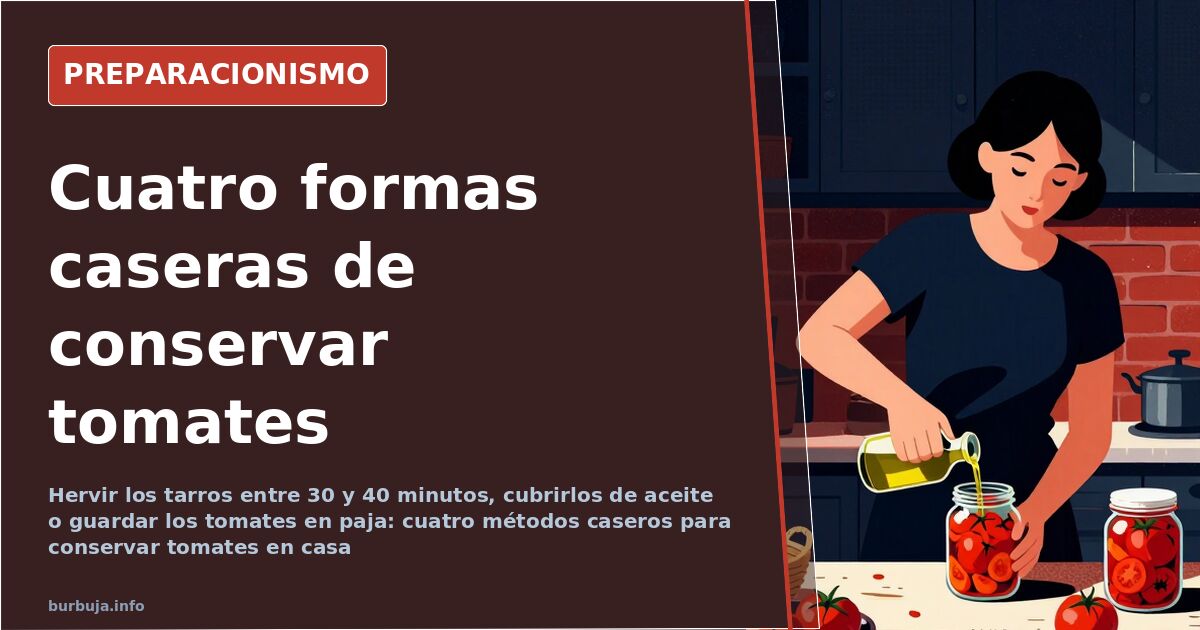
Preserving tomatoes: water bath, oil or the straw method
A glass jar, a cloth folded at the bottom of the pot and forty minutes on the clock. That is the most common answer when someone asks how to preserve tomatoes to get through the winter. No industry, no preservatives and no refrigerator: boiling water, a sterilized jar and patience. The short version is that, according to those who do it this way, homemade preserves last until the next season. The long version has at least four different methods, and none has been declared the right one.
How long does homemade tomato preserve last?
At least a year, according to the estimate of one of the participants. The procedure that comes up again and again is to boil the jar for 30 to 40 minutes, with whole peeled tomatoes or crushed ones, a bit of lemon and some aromatic herbs. The result, they say, lasts all year. The most detailed version adds a preliminary step: cut the tomato, heat it and remove some of the water from the pot so the sauce does not come out watery, crush it when soft and only then jar it. The trick of the cloth at the bottom keeps the jars from knocking against each other while they boil.
Water bath: the cloth at the bottom and the 40 minutes
Heat is one of the most repeated methods. You sterilize the jar, fill it, remove the air bubbles left inside by pressing down the tomato and cover it with a layer of oil before the water bath. The stated goal is to remove the oxygen. With this system, according to the same participant, the preserve lasts at least a year. Some do it over low heat and others just let it bubble away. One of the participants sums it up with an The Spanish way is always better, with no argument other than habit.
Olive oil, garlic and basil: the layer that insulates
The oil school has its own liturgy: olive oil, basil and garlic, a delicacy for those who do not want to settle for just sauce. The layer of fat acts as a physical barrier against the air, which is why many recipes include it even when the jar is also boiled. There is also a reference to the Amish recipe, with no further detail. Those who store tomatoes in oil and rosemary do it for the same double reason: flavor and protection fit in the same jar.
Freezing and storing in straw: no heat and no jar
Against the water bath there are two routes that avoid the stove. The first is domestic and obvious: wash the tomatoes, wrap them one by one in plastic wrap and put them in the freezer, where they last as long as the appliance does. The second is the old way. You wait until late October or November, before the frost, harvest them all and place them in boxes with straw, spaced 10 to 15 centimeters apart, with a bed of straw underneath and another on top. This stretches the harvest until Christmas, with losses considered normal. The technique is documented by the ethnographer Eugenio Monesma, as one of the participants adds.
One of the participants mentioned that at the beginning of the month he had eaten the last jar from the previous harvest. In other words, almost a full year of tomatoes stored at home, with no more technology than a jar and a pot. With that track record, it is surprising that there is no agreement even on the basics: whether to boil before or after sealing, and whether oil replaces heat or merely accompanies it.
Also available in: Deutsch
Summary of a discussion on Burbuja.info - Foro de economía, actualidad y política., translated from Spanish and reviewed before publication. Read the full discussion (14 replies).
More summaries
-
Preserving Tomatoes Until Christmas: Ash, Straw, or Hanging
Wood ash, straw, and hanging are the three methods used to preserve tomatoes until Christmas. One of these methods hides a caustic risk.
-
2030: the prophecy that sets the reptilian revelation
An evidence-free prophecy places the reptilian revelation in 2030, with 90% of the population accepting their enslavement. The calendar is already being pushed to 2050.
-
Schopenhauer was right: solitude is not for everyone
Schopenhauer, Nietzsche and the debate over whether solitude is misery or greatness. Realism or pessimism? An analysis of the existentialist currents that defend…
-
Smart plugs overheating: the problem nobody mentions
Users report 16A smart plugs heating up with 2000W loads. Design flaw or inflated specs?
-
Baofeng UV-5R Mini: the cheap walkie-talkie Europe will restrict
The Baofeng UV-5R, the 15-euro walkie-talkie that Europe won't certify, is getting a restricted version. A look at the licence, the fines and the real-world use of a gadget that attracts…
-
Chosen solitude: the strength few people train
Chosen solitude as training for personal strength: between the praise of the solitary genius and the obstacles of hyperconnection, a debate that keeps growing.