
Baofeng UV-5R Mini: the cheap walkie-talkie Europe will restrict
The Baofeng UV-5R, the 15-euro walkie-talkie that Europe won't certify, is getting a restricted version. A look at the licence, the fines and the real-world use of a gadget that attracts…
English · Original discussion in Spanish · Published
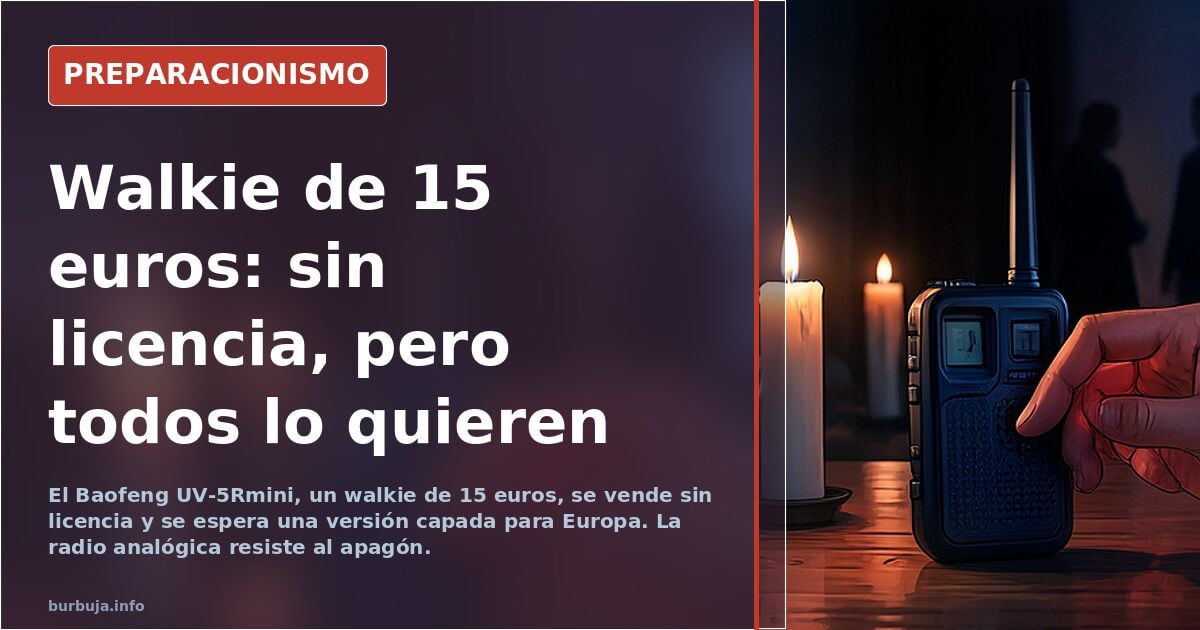
The 15-euro walkie-talkie Europe wants to restrict
A kid walks into a Chinese shop with 15 euros in his pocket and walks out with a radio transmitter capable of listening to the fire brigade, the planes flying over his neighbourhood and, if he's careless, transmitting on frequencies that require a licence. That's the business that has turned the Baofeng UV-5R into a mass phenomenon among preppers, curious types and people who one day watched a YouTube video and discovered their phone no longer has an FM radio. The Mini version, also known as the Pre GT-5Rmini, is the latest iteration of a device the European Union does not consider legal for sale as it stands: the original is not certified for the EU market.
The paradox is delicious. The more banned it is, the more it sells. And the more it sells, the closer the "authorised" version gets, arriving restricted, with less power and less fun. The story of how a toy walkie-talkie became the must-have gadget for the end of the world deserves a closer look.
What is the Baofeng UV-5R and why is it in the crosshairs
The UV-5R is a dual-band transceiver (VHF and UHF) that transmits and receives on amateur radio, PMR446 and airband frequencies, among others. Its ridiculous price —there are deals at **14.5 euros**— and its programmability have made it the gateway into the hobby for thousands of people with no technical training. The problem is that it transmits at more power than allowed on PMR (a maximum of **0.5 W** under the regulations) and has a detachable antenna, two antiestéticatures that disqualify it for licence-free use in Europe.
That's why the manufacturer has launched the **GT-5R**, a certified version that meets EU requirements, albeit with power restrictions. The Mini version being discussed right now points in the same direction: a device that will arrive "restricted" so it can be sold legally. The question hanging in the air is how much of that restriction is really necessary and how much is mere bureaucracy to appease Brussels.
Licence, power and fines: the legal triangle
Here it's worth separating two things most people confuse: **listening is legal, transmitting is not**. Anyone can buy a walkie-talkie and listen to what's going on across the radio spectrum without asking anyone's permission. Pressing the PTT button and starting to talk is another matter. Transmitting on amateur radio frequencies requires the appropriate licence; doing so on PMR446 with a device that exceeds the permitted power does too.
The penalties can be huge. Some talk of fines of up to **200,000 euros** for transmitting out of band, although proving who is transmitting and from where is not as simple as it seems. In practice, several voices agree, nobody is going to go after a private individual using a Baofeng to talk to their group in the hills. The real risk appears when someone messes around on public service frequencies or airband, where things get serious.
Real-world use: listening to the apocalypse from the sofa
Beyond the thrill of illegality, the main interest is something else: **listening**. And there the Baofeng has significant limitations. On PMR you hear shops, warehouses, the odd restaurant, security guards and kids playing. On amateur radio channels, emergency group drills and little else. If you live near an airport, some airband traffic. Slim pickings for anyone hoping to intercept police or fire service conversations, most of which are encrypted or use digital systems an analogue walkie-talkie cannot decode.
The alternative some point to is an **SDR** (a USB dongle costing around 30 euros) connected to a computer, which allows you to listen to and decode many more digital modes. But that requires a computer, software and decent antennas, and it's not what someone wants when they're after a self-contained gadget to carry in a backpack. The Baofeng still wins on convenience and price.
The prepper paradox: buying the forbidden just in case
The context where all this makes sense is prepping. The idea that one day communications infrastructure will fail —a blackout, a disaster, a crisis— and the mobile phone will turn into a paperweight has fuelled interest in analogue radio. When everything fails, they say, the only thing that counts is a walkie-talkie with charged batteries and an antenna. Amateur radio, which seemed dead, is reviving through the back door.
The irony is that many people buy the device and leave it in a drawer. Practising range, programming channels, learning frequencies and running tests takes time and commitment. The 15-euro gadget ends up being a luxury paperweight. But there it sits, just in case. Like the fire extinguisher in the car: nobody uses it, but everyone wants to have one.
In the end, the story of the Baofeng UV-5R is the usual one: cheap technology outpaces the rules, regulators chase behind and the market finds a way to keep selling. The restricted version will arrive, comply with the law and probably disappoint the most enthusiastic. Meanwhile, 15 euros still buys a ticket to a world many didn't even know existed.
Also available in: Deutsch
Summary of a discussion on Burbuja.info - Foro de economía, actualidad y política., translated from Spanish and reviewed before publication. Read the full discussion (64 replies).
More summaries
-
Walkie-talkies: from a €35 Baofeng to 25W with a licence
The €35 imported walkie claims 7 km and 10 W; the legal PMR446 is capped at 500 mW. Key points on power, licensing and repeaters for emergencies
-
Post-25N survival: rent, don't borrow, pack your bags
In 2014, a manual advised renting, avoiding debt and preparing a bag after 25-N. A decade later, hundreds of responses audit what it got right.
-
Three Bodies Found Frozen in Colorado Wilderness
Hiker discovers mummified remains of two sisters and teen who attempted isolated survival in Colorado forest.
-
80s nostalgia and the conspiracy narrative in Spain
The generation that grew up playing in the street partly claims that 1945 buried its identity: this is how the conspiracy narrative about social change is articulated.
-
Schopenhauer was right: solitude is not for everyone
Schopenhauer, Nietzsche and the debate over whether solitude is misery or greatness. Realism or pessimism? An analysis of the existentialist currents that defend…
-
Smart plugs overheating: the problem nobody mentions
Users report 16A smart plugs heating up with 2000W loads. Design flaw or inflated specs?