
How New Species Arise: Mutation, Hybridization, and Taxonomy
Andean pudú was actually two species, reopening the debate on speciation: mutation, hybridization, and taxonomy.
English · Original discussion in Spanish · Published
How New Species Arise: Mutation, Hybridization, and Taxonomy
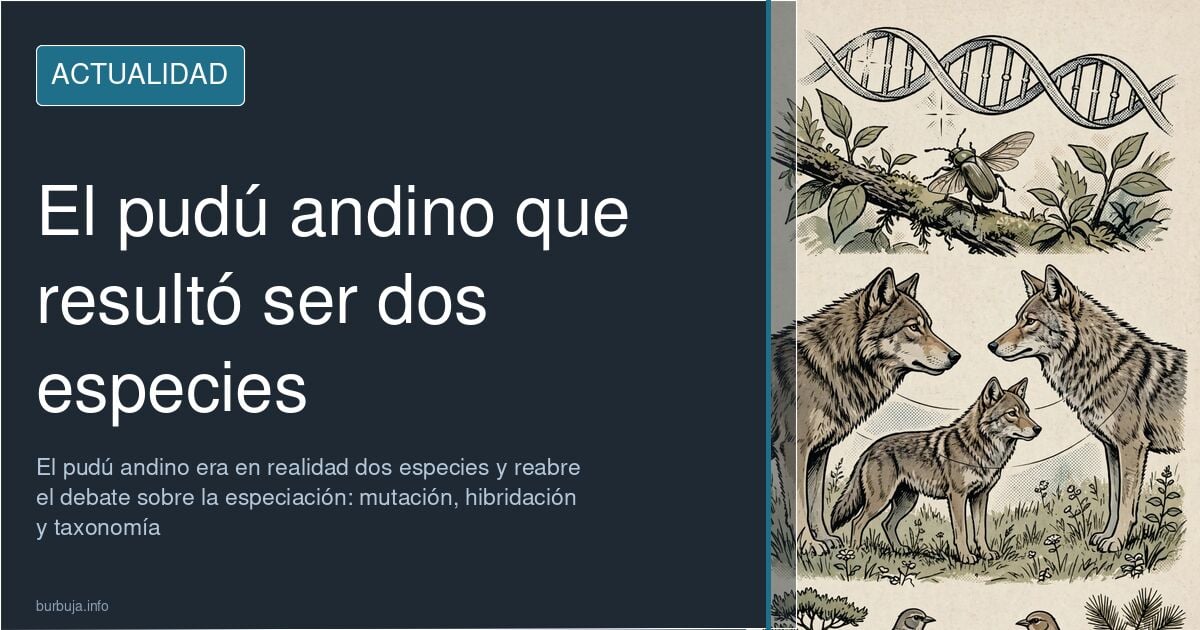
The boundary between a species and a simple variety is moving again. Work by the Division of Mammalogy at the Center for Ornithology and Biodiversity of Peru concluded that the Andean pudú, classified for decades as Pudu mephistophiles, actually encompassed two distinct species. The finding serves as a reminder that speciation is not a closed chapter: taxonomists continue to reorganize it on the fly.
The question has been around for a long time. Since the publication of Charles Darwin's "The Origin of Species" in 1859, the mechanism leading to new species has been subject to continuous debate. The most accepted definition remains the biological concept of a species, formulated by Dobzhansky in 1935 and Mayr in 1942: a group of individuals capable of interbreeding and reproductively isolated from other related groups. In 1978, Wiley added the evolutionary variant, where what matters is not potential isolation but actual isolation.
How Is a New Species Formed: Through Mutation or Hybridization?
The two engines that reappear in any serious discussion are mutation and hybridization. The former is the raw material; the latter breaks the assumption that species do not mix. This is not a laboratory hypothesis:
The general rule is that most hybrids are sterile, but one fertile female is enough to transfer genetic material from one species to another. This process, slow and unspectacular, is what manuals illustrate with arrows that never quite fit.
How Much Mutation Is Needed to Produce a New Species?
The calculation depends on the figures accepted. One calculation circulating in the thread starts with a beneficial mutation per ten million. With a species having a half-life of 12 years and ten million simultaneous individuals, a beneficial mutation would occur every 12 years, and about 83,000 in one million years. The full breakdown, with assumptions regarding dominance and persistence, is where the argument becomes tangled: it is one thing for a trait to appear and quite another to have it become fixed in an entire population.
The blue eye serves as an example. The gene is recessive: two carriers must coincide for the trait to express itself. They may pass through generations without anyone visibly possessing it, until a suitable pair brings it to light.
The Pudú, Cats, and the Taxonomist's Problem
The pudú case is not isolated. What was a species with two subspecies yesterday is two distinct species tomorrow. Some maintain that Arabian horses have one bone less than the rest, and concerning domestic cats, they cite that no remains older than 10,000 or 12,000 years are found. Others claim that chimpanzees have blood types A and O compatible with ours.
The Clash with Creationism
Here lies the fundamental disagreement. One side holds that species were created and that the fossil record does not show incompletely formed organisms, but always organisms adapted to their environment. It is also pointed out that Darwin defended the inheritance of acquired characteristics, which is discarded today, but this does not invalidate his central contribution.
With definitions changing every four decades and lineages splitting into two due to morphological analysis, the answer to how species arise is currently partial: through mutation, hybridization, and isolation accumulated generation after generation. The exact point where the matter gets stuck is not how it begins, but when it is decided that it is something else.
The boundary between a species and a simple variety is moving again. Work by the Division of Mammalogy at the Center for Ornithology and Biodiversity of Peru concluded that the Andean pudú, classified for decades as Pudu mephistophiles, actually encompassed two distinct species. The finding serves as a reminder that speciation is not a closed chapter: taxonomists continue to reorganize it on the fly.
The question has been around for a long time. Since the publication of Charles Darwin's "The Origin of Species" in 1859, the mechanism leading to new species has been subject to continuous debate. The most accepted definition remains the biological concept of a species, formulated by Dobzhansky in 1935 and Mayr in 1942: a group of individuals capable of interbreeding and reproductively isolated from other related groups. In 1978, Wiley added the evolutionary variant, where what matters is not potential isolation but actual isolation.
How Is a New Species Formed: Through Mutation or Hybridization?
The two engines that reappear in any serious discussion are mutation and hybridization. The former is the raw material; the latter breaks the assumption that species do not mix. This is not a laboratory hypothesis:
- Hybrids of white and black rhinoceros, two distinct species that have mated.
- Whale hybrids that, according to a 2018 study, could successfully reproduce with blue whales.
The general rule is that most hybrids are sterile, but one fertile female is enough to transfer genetic material from one species to another. This process, slow and unspectacular, is what manuals illustrate with arrows that never quite fit.
How Much Mutation Is Needed to Produce a New Species?
The calculation depends on the figures accepted. One calculation circulating in the thread starts with a beneficial mutation per ten million. With a species having a half-life of 12 years and ten million simultaneous individuals, a beneficial mutation would occur every 12 years, and about 83,000 in one million years. The full breakdown, with assumptions regarding dominance and persistence, is where the argument becomes tangled: it is one thing for a trait to appear and quite another to have it become fixed in an entire population.
The blue eye serves as an example. The gene is recessive: two carriers must coincide for the trait to express itself. They may pass through generations without anyone visibly possessing it, until a suitable pair brings it to light.
The Pudú, Cats, and the Taxonomist's Problem
The pudú case is not isolated. What was a species with two subspecies yesterday is two distinct species tomorrow. Some maintain that Arabian horses have one bone less than the rest, and concerning domestic cats, they cite that no remains older than 10,000 or 12,000 years are found. Others claim that chimpanzees have blood types A and O compatible with ours.
The Clash with Creationism
Here lies the fundamental disagreement. One side holds that species were created and that the fossil record does not show incompletely formed organisms, but always organisms adapted to their environment. It is also pointed out that Darwin defended the inheritance of acquired characteristics, which is discarded today, but this does not invalidate his central contribution.
With definitions changing every four decades and lineages splitting into two due to morphological analysis, the answer to how species arise is currently partial: through mutation, hybridization, and isolation accumulated generation after generation. The exact point where the matter gets stuck is not how it begins, but when it is decided that it is something else.
Summary of a discussion on Burbuja.info - Foro de economía, actualidad y política., translated from Spanish and reviewed before publication. Read the full discussion (356 replies).
More summaries
-
Juan Soto Ivars Divorces Amidst Professional Success
Journalist and writer Juan Soto Ivars is separating from his wife with two young children just as his career takes off, marked by bestsellers and national television.
-
Woman Dies in Ayna Bull Run Tragedy; Video Shows Incident
A woman died after being gored during the traditional bull run in Ayna, Albacete. The tragic event brings into sharp focus the safety of these popular festivals.
-
Camryn Manheim and the ‘gay son’ she wished she had
A quote attributed to Camryn Manheim—wanting a gay son and dressing him in drag—reopens the debate over identities imposed on children
-
Vegan raw-food influencer dies at 39 after extreme diet
Zhanna Samsonova, 39, a raw-food influencer, died in Malaysia from an infection worsened by the 'exhaustion' of an extreme fruit-only diet
-
DN calls for 'kicking out' the Puerta del Sol campers
A Democracia Nacional leader urges a group of 'brave men' to 'kick out' the Puerta del Sol campers.
-
Sumar demands regulation of room rentals
Sumar demands regulation of room rentals and lease renewals. An investor warns that property maths no longer add up.