
How much power a commercial espresso machine really uses: the maths most people get wrong
A 1,100 W espresso machine can add up to 260 kWh and 20 euros a month between peak use and standby, according to a widely shared calculation. A 5-euro plug-in meter settles the doubt.
English · Original discussion in Spanish · Published
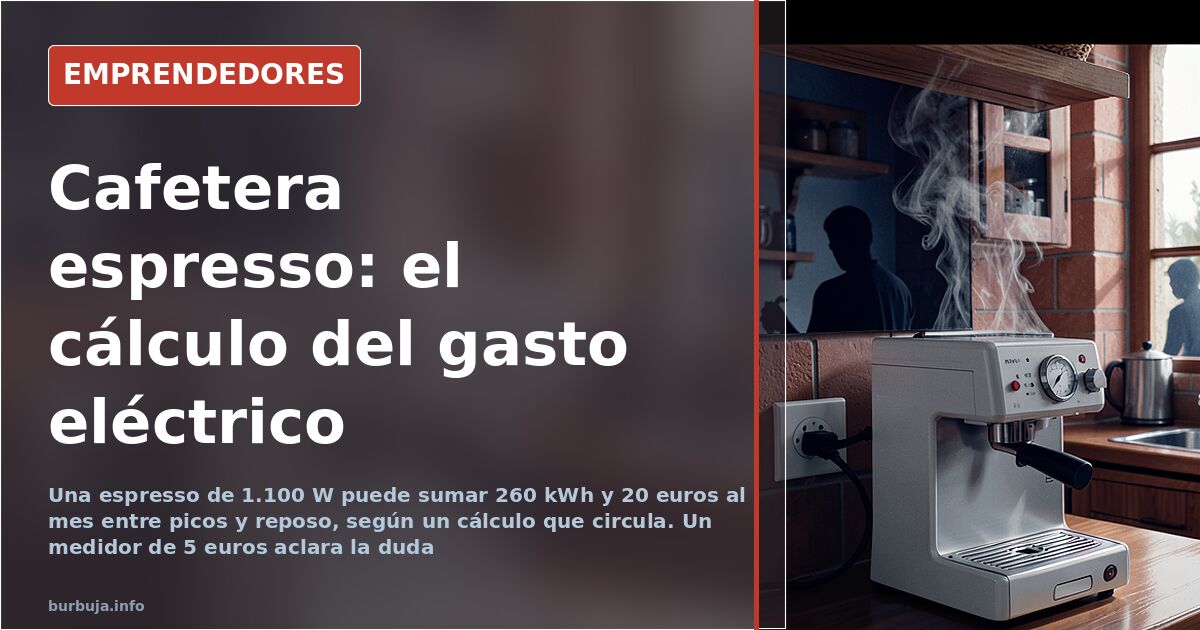
How much electricity a commercial espresso machine uses per month
How much of the electricity bill does the coffee machine account for? It's the first question anyone considering opening a takeaway coffee counter in a bulk-food shop asks, and the usual answer —"it's 2.5 kW, just multiply"— is the one that gets it most wrong. Rated power is not the same as consumption: an industrial espresso machine only draws full power from its heating elements when heating water; the rest of the time it keeps the boiler at temperature with short bursts.
The figure that does work as a reference is another one. A semi-automatic espresso machine made in Spain, with an average market value of **260 euros**, is rated at **1,100 watts**. In other words: 1.1 kilowatts for every hour it is switched on. Between full operation and standby, the calculation doing the rounds puts monthly usage at around **260 kilowatts**, which on the bill comes to **roughly 20 euros plus VAT**.
What standby actually means on a coffee machine
Here's the nuance people miss. On a TV, standby means waiting for the remote. On a coffee machine it's something else: the machine needs to keep the water at a certain temperature and pressure —measured in *bars*, the pressure unit, not the pub— in order to serve. That takes energy continuously, even if only in short bursts.
The thermostat logic is simple: the heating elements push the boiler up to **90 ºC** and switch off; when the temperature drops, they kick back in. Real consumption is the sum of those peaks, not a flat 2.5 kW plateau. That's why the morning start-up, with a cold boiler, is the most expensive stretch of the day.
The 5-euro plug-in meter that settles the question
Before buying anything there's a cheap shortcut: a consumption meter that plugs in between the appliance and the socket. They start at **5 euros** in hypermarkets, and for **10** you get better ones. They let you see the real usage in each situation —heating, pouring, on standby— without trusting the label.
The surprise can be unpleasant. With one of these gadgets, someone discovered a fridge eating **15 kW a day**, about **600 W an hour**. The meter doesn't lie; the label, sometimes, does.
Why kilowatts get confused with kilowatt hours
The confusion is textbook: power is measured in kilowatts, consumption is billed in kilowatt hours. Without telling them apart, any sheet of numbers is worthless. And it's worth getting clear before signing the supply contract, not after.
Even so, some argue that obsessing over the coffee machine is missing the forest for the trees. Lighting, rent, wages, licences and the self-employed social security contribution weigh far more on the bottom line. Compared with raw materials, packaging and the machine's depreciation, the appliance's electricity cost fades away.
The whole premises' bill, not just the coffee
The serious calculation is done for the business as a whole. A premises serving only coffee runs to about **100 euros** a month in electricity; with a dishwasher, air conditioning, a beer tap, an ice maker, refrigerated display cases and televisions, the range climbs to **250-500 euros** depending on opening hours.
That's the trap of the small investment: a takeaway coffee counter drags in fridges, dishwashers and air conditioning. The machine is the least of it. Everything else comes with the territory.
Summary of a discussion on Burbuja.info - Foro de economía, actualidad y política., translated from Spanish and reviewed before publication. Read the full discussion (9 replies).
More summaries
-
PP and VOX face the self-employed: what will truly change
Flat rate, cut to union subsidies, and 50% of regional personal income tax: what PP and VOX could change for the self-employed and SMEs.
-
The spending paradox: no money for businesses, but plenty for TikTok
Consumer spending has split in two: no money for serious businesses, but plenty for TikTok. The paradox pitting entrepreneurs against consumers.
-
Spain's self-employment fees and VAT spark debate
Forum discussion on rising Spanish self-employment fees, VAT impact, and trading alternatives. Participants share opinions and calculations.
-
South Korean President urges citizens to seek help amid market crash
The South Korean president has called on the public to use the 109 helpline following a nearly 20% drop in the KOSPI index. Here is why it matters.
-
Spain's Tax Agency and the €3,000 myth that became the rule
Banks report transactions above €3,000 to Spain's Tax Agency, but the supposed quarterly threshold is undocumented and the scrutiny keeps tightening.
-
Setting up a carpentry workshop in Spain: licences, noise and the storage room route
A small carpentry workshop requires planning, activity, installation and opening licences. Renting a storage room sidesteps the paperwork and the noise.