
Housing pushes 770,000 workers in Spain into poverty
In Spain, 770,000 employed people fall below the poverty threshold after paying for housing. Wages haven't dropped: the bill has gone up and supply remains choked.
English · Original discussion in Spanish · Published
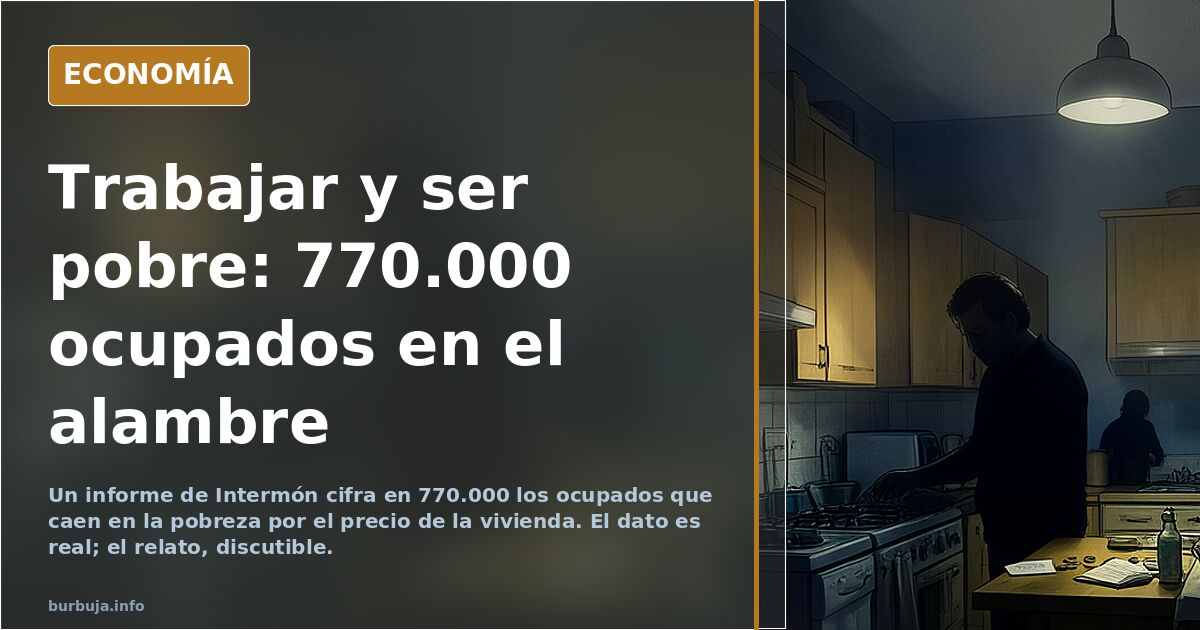
Working no longer keeps poverty away: 770,000 employed people fall below the threshold
The figure has been circulating for a day and it is not a seasonal headline: in Spain there are 770,000 people with jobs who, after paying for housing, fall below the poverty threshold. The report behind it comes from Intermón, an NGO that lives on subsidies, which invites a look at the fine print of the framing. But the substance of the matter holds up to scrutiny: wages haven't gone down, what has gone up is the bill. And that difference, in a country building between 90,000 and 100,000 homes a year against 200,000 new households, is not fixed with a speech.
What being poor while working actually means
The figure doesn't come from comparing wages with the conventional poverty threshold. It comes from measuring what's left in your pocket after paying rent or mortgage. With the same salary, if rent rises by 40%, the household crosses the line without anyone touching their payslip. It is a measurement method used in Europe and it describes an uncomfortable reality: impoverishment is real even if the wage doesn't move.
There lies the trap of much of the narrative. The statistics don't lie, but they change the measuring stick depending on what is compared. Mixing the conventional poverty rate with the one that subtracts housing costs produces headlines that scare more than they clarify. And it's worth saying: some argue there is an army of organizations whose budget depends on the figure growing every quarter.
Why housing prices have skyrocketed
Supply is choked. Scarce land, municipal permits, regional timelines and a bureaucracy that signs the little paper authorizing twelve homes where forty could fit. That is not the market: it is the administration biting. On top of that, demand is inflating through the back door, with funds buying entire buildings as a business model of guaranteed returns, and with population arrivals at the pace set by visas and family reunifications.
The result is simple arithmetic: rigid supply plus growing demand plus bureaucratic costs equals prices going up. There is no mystery, there are incentives. And the biggest speculator in the system is not a private owner with two flats: it is the State itself, which takes a cut of every transaction via VAT, ITP (property transfer tax), the municipal capital gains tax, IBI (council tax) and licensing fees.
The State as the party most interested in property prices rising
Municipalities, regions and the central government cause a good part of the final cost and capture between 20% and 40% of the profit of every sale. That detail rarely appears in reports on poverty, because it points at the one handing out the subsidies. The LAU (Spain's urban tenancies law) and rent caps, meanwhile, have driven out small landlords and left the field to the big holders, who play by different rules.
The comparison with the 2000 bubble
There was a time when the same flat was rising at the pace of a million pesetas a week and nobody said anything. Back then rates fell and made mortgages cheaper: from 15% in 1991 to 9% in 1996 and a little over 2% in the 2000s. After the burst, prices collapsed in many areas and it was a good time to buy. The difference with today is that back then the credit tap was peine; now it is the land tap that has been closed.
The debate that gets stuck on immigration
Part of the analysis argues that uncontrolled migration flows are the main cause of the price surge and the pressure on services. Another part responds that those promising a hard line end up swallowing the same or worse, and that demand is not a tap that can be closed by decree: households already exist and young people move out all the same. The clash of figures —visas remain below what was being issued in 2015 with half the country unemployed— leaves the matter where it was.
With these ingredients, the question is not who is right at the rally, but how many years of rigid supply it will take for the bill to stop eating the wage. Nobody in the debate agrees even on the starting point.
Also available in: Deutsch
Summary of a discussion on Burbuja.info - Foro de economía, actualidad y política., translated from Spanish and reviewed before publication. Read the full discussion (56 replies).
More summaries
-
Housing Costs Ignite Spanish Competency Debate
Soaring housing prices spark a political clash in Spain between the central government and regional authorities over jurisdiction.
-
Rent consumes wages: half of Spain's tenants in severe poverty
Half of tenants in Spain fall into severe poverty after paying rent. Data, cases, and the political debate on housing.
-
Leaked chats reveal Ábalos and Pedro Sánchez fighting Podemos over a few votes, with rental housing in the middle.
OKDiario publishes chats in which Sánchez tells Ábalos not to give ground to Podemos on rent control and opens the battle over rent caps.
-
Spain's labor split: skilled trades shortage vs AI job losses
Forum debate predicts mass retirement of plumbers and welders by 2030, while AI threatens administrative roles. Disagreement persists on solutions.
-
Barcelona and the cost of refereeing suspicions
Payments to the refereeing committee's vice-president and a mirror-image suspicion about their rival: the case hanging over Spanish football with no final ruling and no relegation.
-
Free Photoshop and Adobe clones: the open-source threat to subscriptions
Open-source clones of Photoshop and other Adobe apps are multiplying on GitHub. The subscription model and software legal protection are under scrutiny.