
Housing protest camp in Puerta del Sol: music and celebrities
Tents, drums and familiar faces take over Puerta del Sol at Madrid's housing protest camp
English · Original discussion in Spanish · Published
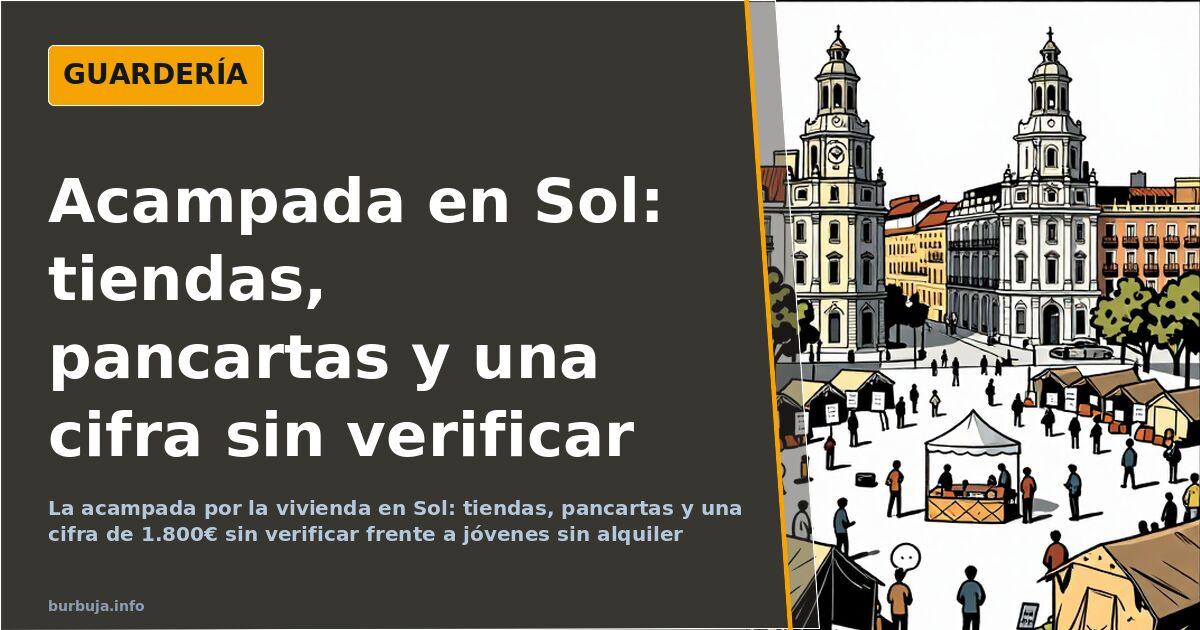
Housing protest camp in Sol: music and familiar faces
What’s brewing in Puerta del Sol these days? A protest camp for the right to housing has turned the Madrid square into a campsite of tents, drums and recognizable faces. The demonstration, which demands access to housing for young people, has become a mix of protest, impromptu concert and parade of public figures. Amid chants against Madrid’s regional president, Ayuso, and singalongs, one question hangs in the air: is this a social movement or a summer camp?
What is the housing camp in Sol demanding?
The protest centers on housing prices and young people’s access to a roof over their heads. The campers argue that an entire generation will be shut out of the residential market. One of the most repeated arguments compares the situation of an older person who, according to a story spread by a participant, receives 1,800 euros a month while barely lifting a finger, with that of those sleeping in tents who, by the same logic, will never be able to buy a home.
The comparison is crude, but it has hit home. Anger is bubbling over rents that give no respite and wages that don’t keep up. The camp acts as a megaphone for that rage, even if the message gets lost among guitars and chants.
The music and characters seen around Sol
The soundtrack was provided by the band Las Petunias, with a song dedicated to Madrid’s regional president: “Ayuso incivil”, billed as a “big hit” of the concert. There was also a broom turned into a stage pole, and the drums that set the beat at any rally. According to several of those present, the onlookers enjoyed the spectacle more than the protesters did.
Familiar faces have passed through the square. Singer and activist Samantha Hudson announced her presence, and streamer Borja Escalona hinted that he would also show up. The mix of activism and showbiz is what has most irritated part of the public: when a protest turns into a TV set, the message risks being pushed into the background.
Circus or legitimate protest: clashing diagnoses
Some argue that the camp is a circus with no concrete proposals, a party where no one has explained how land would be made cheaper or more homes built. On the other side is the opposing argument: any mobilization over a real problem is legitimate, even if its form is messy.
A third front points to unequal treatment by institutions. “I don’t have any fine for drinking in the street or for protesting, but if I did I’d go straight to the police to see why they aren’t fining those at the camp in Sol,” one participant sums up. The complaint is no small matter: if the rules are applied with a different yardstick depending on who is in the square, the problem stops being the camp and becomes the rule itself. Marlaska, the Interior Minister, has also been urged to do his job.
From 1808 to 1848: historical comparisons
Puerta del Sol invites epic comparisons. After all, it was there that Madrid rose up against Napoleonic troops on May 2, 1808. “Our ancestors who died there in that same place on May 2, 1808 must be turning in their graves,” someone wrote.
The other recurring analogy is the revolutions of 1848, which toppled thrones with hunger and calloused hands. Skeptics respond that those were carried out by people who had gone days without eating, not people with portable chargers and catering. The comparison, they argue, collapses on its own.
With tents pitched and the lineup of performances closed, the question still unanswered is how many of those sleeping in the square today will remain there when the first downpour hits. Or when the first fine arrives.
What’s brewing in Puerta del Sol these days? A protest camp for the right to housing has turned the Madrid square into a campsite of tents, drums and recognizable faces. The demonstration, which demands access to housing for young people, has become a mix of protest, impromptu concert and parade of public figures. Amid chants against Madrid’s regional president, Ayuso, and singalongs, one question hangs in the air: is this a social movement or a summer camp?
What is the housing camp in Sol demanding?
The protest centers on housing prices and young people’s access to a roof over their heads. The campers argue that an entire generation will be shut out of the residential market. One of the most repeated arguments compares the situation of an older person who, according to a story spread by a participant, receives 1,800 euros a month while barely lifting a finger, with that of those sleeping in tents who, by the same logic, will never be able to buy a home.
The comparison is crude, but it has hit home. Anger is bubbling over rents that give no respite and wages that don’t keep up. The camp acts as a megaphone for that rage, even if the message gets lost among guitars and chants.
The music and characters seen around Sol
The soundtrack was provided by the band Las Petunias, with a song dedicated to Madrid’s regional president: “Ayuso incivil”, billed as a “big hit” of the concert. There was also a broom turned into a stage pole, and the drums that set the beat at any rally. According to several of those present, the onlookers enjoyed the spectacle more than the protesters did.
Familiar faces have passed through the square. Singer and activist Samantha Hudson announced her presence, and streamer Borja Escalona hinted that he would also show up. The mix of activism and showbiz is what has most irritated part of the public: when a protest turns into a TV set, the message risks being pushed into the background.
Circus or legitimate protest: clashing diagnoses
Some argue that the camp is a circus with no concrete proposals, a party where no one has explained how land would be made cheaper or more homes built. On the other side is the opposing argument: any mobilization over a real problem is legitimate, even if its form is messy.
A third front points to unequal treatment by institutions. “I don’t have any fine for drinking in the street or for protesting, but if I did I’d go straight to the police to see why they aren’t fining those at the camp in Sol,” one participant sums up. The complaint is no small matter: if the rules are applied with a different yardstick depending on who is in the square, the problem stops being the camp and becomes the rule itself. Marlaska, the Interior Minister, has also been urged to do his job.
From 1808 to 1848: historical comparisons
Puerta del Sol invites epic comparisons. After all, it was there that Madrid rose up against Napoleonic troops on May 2, 1808. “Our ancestors who died there in that same place on May 2, 1808 must be turning in their graves,” someone wrote.
The other recurring analogy is the revolutions of 1848, which toppled thrones with hunger and calloused hands. Skeptics respond that those were carried out by people who had gone days without eating, not people with portable chargers and catering. The comparison, they argue, collapses on its own.
With tents pitched and the lineup of performances closed, the question still unanswered is how many of those sleeping in the square today will remain there when the first downpour hits. Or when the first fine arrives.
Summary of a discussion on Burbuja.info - Foro de economía, actualidad y política., translated from Spanish and reviewed before publication. Read the full discussion (36 replies).
More summaries
-
Real Madrid (Spain) vs state-backed clubs and Super League
Real Madrid leads the fight against state-backed clubs and the Super League, reshaping European football's financial and tactical balance.
-
Seven Years Without a Date, and a Coffee Invite That Ended in Being Blocked
Seven years without a date, three weeks of back-and-forth, and a silent block: how a coffee invite turned into a ghosting story.
-
This post on X from back when it was still Twitter is getting people talking online again.
A post from before July 2023 asked whether Penélope Cruz was Pepe Viyuela in a wig. The joke is doing the rounds again.
-
A forum debates whether showing off your body online is enough to get a date
A conversation about dating someone who flaunts their body on social media leaves one fact: the only figure mentioned is an unconfirmed height, 1,52 m
-
Jona Takalua: "I'm asexual, but I had a girlfriend"
Sexuality in the making: a personal journey between doubt and discovery. A personal account details the complex process of...
-
Athenea del Castillo and the manifesto she refused to sign
Athenea del Castillo, Real Madrid player, refused to sign the women's national team manifesto. Her decision reignited the debate over the role of…